Appendix F — Frequently asked questions
What you will learn
- Find the page of this appendix that answers a question about a command or about running nlmx.
- Start from the message you see (an exit code, a missing file, a warning) and reach the answer.
- Know how far an answer can be trusted, and where the authority on an option lies.
Prerequisites: none.
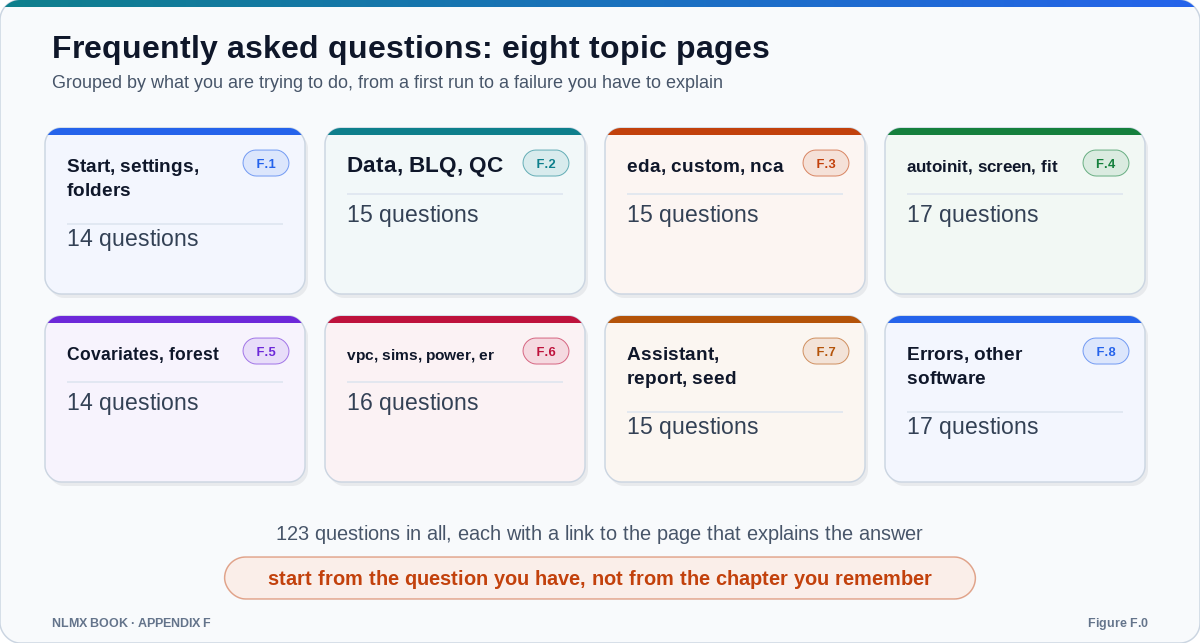
Appendix F collects 123 questions that readers ask when they use nlmx, grouped by what they are trying to do: start, check the data, explore, fit, select covariates, evaluate, simulate, plan, report, and find out why something failed. The questions are phrased the way they are asked ("Why is there no AUCinf?", "Which folder holds the result?"), and each answer is short, checked against the page of the book that explains it, and ends with a link to that page.
The pages of this appendix
| Page | Topic | Commands named | Questions |
|---|---|---|---|
| F.1 Getting started, settings and output folders | Getting started | qc-data, qc-nm, eda, nca, autoinit, screen, fit, cov, posterior, resume, inspect, validate, sims, generate, simulate-study, schema |
14 |
| F.2 Data, events, BLQ and quality control | Data and quality control | qc-data, qc-nm, nca, autoinit, screen, fit, vpc, sims, power |
15 |
| F.3 eda, custom and nca | Exploration and NCA | eda, custom, nca |
15 |
| F.4 autoinit, screen and fit | Building and fitting the model | autoinit, screen, fit |
17 |
| F.5 Covariates, posterior stability, resume and forest plots | Covariates and forest plots | fit, cov, posterior, resume, inspect, validate, forest, simulate-study |
14 |
| F.6 vpc, sims, generate, power and er | Evaluation, simulation, design and exposure–response | fit, vpc, sims, generate, simulate-study, power, er |
16 |
| F.7 Maxson, report, determinism and reproducibility | Assistant, reports and reproducibility | ask, report |
15 |
| F.8 Errors, other software and validation | Errors, comparison and validation | resume, validate |
17 |
| Complete FAQ reference | every question, with its page, and the questions that name each command | all | 123 |
If you see this, go there
A reader often arrives with a message, not a topic. This table starts from what you see.
| What you see | FAQ page | The book page | The answer in a line |
|---|---|---|---|
output directory is not empty (exit code 3) |
F.1 | 4.2 Output folders: what is written, never overwritten, and the log | Choose a new -o folder; --overwrite lifts the rule. |
| A settings file is rejected with exit code 4 | F.1 | 7.6 Unknown keys, types and range validation | Unknown keys and values that are not allowed stop the command. |
qc-data reports failures but the exit code is 0 |
F.2 | 11.9 Exit status, fail_on and pipelines | The gate is fail_on; the default is never. |
A plot you selected in eda is missing |
F.3 | 13.8 Selecting standard plots and tables | Selection does not guarantee generation; read the reason. |
| A profile has no AUCinf or clearance | F.3 | 14.13 AUC to infinity and the extrapolated fraction | A precondition of the terminal phase failed. |
| A fit stops at the iteration limit | F.4 | 20.30 Evaluate-only runs, iteration limits, and rescue | Evaluate-only mode checks a fixed set of estimates. |
| A fit has no standard errors | F.4 | 20.32 Covariance failures, zero variances, and F_FLAG problems | Was the covariance step requested, and did it fail? |
After --retry, which folder holds the result? |
F.4 | 20.40 Retry folders, the attempt ledger, and provenance | The parent folder is attempt 0; read the ledger. |
| The frozen method drops a covariate that SCM keeps | F.5 | 22.24 Frozen score selection | An uncertain relationship is not a rejected one. |
resume refuses to continue (exit code 11) |
F.5 | 39.13 Exit code 11: checkpoint or resume incompatibility | A checkpoint stands for one exact computational identity. |
| Some VPC percentiles fall outside the bands | F.6 | 27.15 Outside flags and multiple comparisons | Isolated flags are expected; look for a pattern. |
power gives different sample sizes by FIM and by SSE |
F.6 | 41.34 Case 7: power by simulation and estimation, and what the formula missed | Start with FIM and confirm by simulation. |
| A report has no figure and the exit code is 0 | F.7 | 36A.11 Images, paths, copying, and missing-file warnings | Image paths in standard-input mode resolve from the start folder. |
| Two runs with different thread counts differ | F.7 | 9.12 Thread-count determinism | Compare the tables, not the logs. |
| A control stream is rejected with exit code 5 | F.8 | 39.7 Exit code 5: unsupported model or method feature | An unsupported record changes the model; it is refused. |
| The objective differs from NONMEM's | F.8 | 40.4 OFV, likelihood, approximation, and constants | Six sources of difference; evaluate at identical parameters. |
How the answers were made
- Every answer restates the book. An answer is a summary of the page it links to. A number in an answer (a default, a limit, an exit code) is the number of that page.
- No answer promises more than the page does. Where the book says that a result depends on the data, the answer says so.
- The answers do not replace the manual. Chapter 36 is the authority on every option, and the settings chapters are the authority on every key. When an answer and the manual seem to differ, the manual is right and the answer is out of date.
- Questions that the book answers at length stay short here. For a decision, read the linked page: it has the worked example and the case for and against.
What this appendix does not do
- It does not teach a method. The concept chapters do.
- It does not list every option. Chapter 36 and the complete references at the end of each chapter do.
- It is not a troubleshooting manual. Chapter 39 is, and F.8 answers its most frequent questions in brief.
Review checklist
- Can you find, from the table above, the page that answers a message you have just seen?
- Do you follow the Read more link before you act on an answer that affects a decision?
- Do you check the manual page of a command when an answer and your run seem to disagree?
Navigation
See the next page, the complete FAQ reference and the index.