16.6 Groups, regimen pooling, and consistency checks
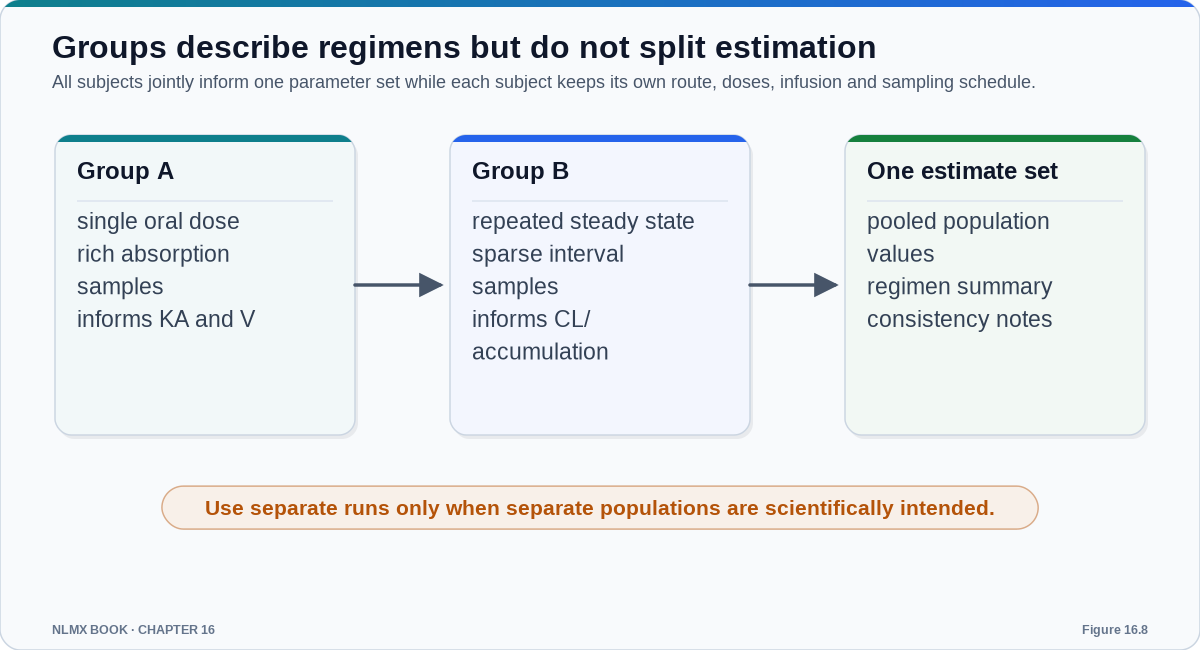
--group REGIMEN or [data] groups=["STUDY","FORM"] labels subjects sharing a dosing design, study, formulation, or route. It does not split estimation. All subjects contribute to one pooled parameter set while keeping their own doses, sampling times, infusion durations, and steady-state status.
Why pooling is useful
A rich single-dose group can inform absorption and volume. A sparse steady-state group can inform clearance through accumulation. An IV group can identify absolute F1 when paired with oral exposure. Pooling lets these complementary designs inform one starting set without pretending every subject followed the same regimen.
The subject's group is read from its first record. Without CMT, group values on dose records also help route classification. Ensure the first record carries the intended label and that subjects do not accidentally change group midstream when the variable is intended as subject-level.
regimens.csv
Each group receives a row with subject count, route, dose amounts, doses per subject, interval, steady-state indicator, infusion duration, samples per subject, and sampling times after the first dose. The listing and HTML report reproduce this summary.
Autoinit also compares group individual clearances with the pooled value. A difference exceeding about 1.5-fold produces a note. The cause might be dose/route/unit coding, a genuine covariate, or a population difference that should not be pooled. It is a diagnostic, not automatic correction.
If groups truly represent separate populations requiring separate starting values, run controlled separate analyses rather than expecting --group to create them.
Common mistakes
- Interpreting one output group label as separate parameter estimation.
- Putting a treatment-period value only on observation rows.
- Pooling populations with incompatible kinetics without review.
- Ignoring a group-clearance inconsistency note.
Checklist
- Define group purpose and level.
- Verify first-record and dose-record labels.
- Review every
regimens.csvrow. - Investigate clearance inconsistency notes.
- Use separate runs when separate populations are intended.
Further reading
See route detection, mixed-regimen worked example, and output evidence.