Figure, table, and example numbering; companion files
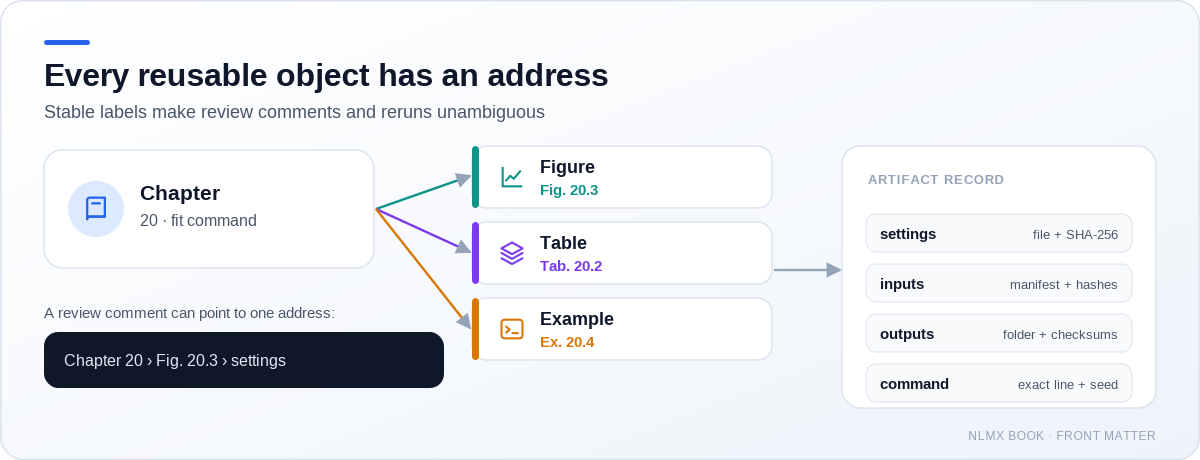
Scientific review becomes easier when every claim and artifact has a stable address. This book uses chapter-based labels in prose and stable filenames in the repository. Companion files live under the book root so an offline copy can retain its text, figures, references, and regeneration tools together.
Numbering scheme
| Object | Printed-style label | Outline identifier | Example | Meaning |
|---|---|---|---|---|
| Chapter | Chapter 20 | — | Chapter 20 | fit command chapter |
| Numbered page/section | 20.4 | — | Section 20.4 | fourth numbered Markdown topic in that chapter |
| Figure | Fig. 20.3 | F20.3 |
Fig. 20.3 | third figure assigned in Chapter 20 |
| Table | Tab. 20.2 | T20.2 |
Tab. 20.2 | second table assigned in Chapter 20 |
| Worked example | Ex. 20.4 | X20.4 |
Ex. 20.4 | fourth worked example assigned in Chapter 20 |
| Equation | Eq. (20.5) | E20.5 when needed |
Eq. (20.5) | fifth numbered equation in Chapter 20 |
| Requirement/test | project-specific ID | controlled source ID | REQ-FIT-001 |
not invented by the book unless explicitly defined |
The compact identifiers F-, T-, and X- in the master outline correspond to figures, tables, and examples. A rendered caption may use “Figure” instead of “Fig.” The identifier, not punctuation, carries identity.
Suffix chapters preserve the suffix in labels: Chapter 13A can use Fig. 13A.2. Front matter is unnumbered and uses descriptive figure filenames such as fig-front-05-paths.svg; this avoids pretending that front-matter figures belong to Chapter 0.
Markdown pages versus print pages
One Markdown file is called a “page” in the writing plan and manifest. It can render to more than one physical page in PDF or Word. Therefore:
- cite a chapter/section heading or stable file, not a renderer-dependent physical page alone;
- include the edition/version and access date in formal review comments;
- do not assume “planned 10 pages” means exactly ten sheets after printing;
- use PDF page numbers only when citing a frozen PDF artifact.
Figure requirements
Every instructional figure should have:
- a descriptive filename and Markdown alt text;
- an SVG
<title>and<desc>when SVG is used; - labels that remain meaningful without colour alone;
- legible text at the intended display and print size;
- a caption or surrounding paragraph that states the intended lesson;
- source data and a regeneration script for data-derived figures;
- a review for clipped labels, incorrect units, misleading axes, and inconsistent legends.
Decorative graphics should not be cited as evidence. A diagram explains relationships; it does not prove that a command behaved as drawn. A plot used as evidence needs its data, method, settings, version, and acceptance interpretation.
Table requirements
A table should define units, denominators, missing-value handling, rounding, and abbreviations. Sort order must be stable when order has meaning. Values copied from software output should be traceable to a retained file, not manually retyped without verification. Large option tables should state whether they are exhaustive for a specific version.
For comparison matrices, distinguish not available, outside product role, not assessed, and unknown. A blank cell is ambiguous. For results, distinguish zero, missing, not computed, below quantification, and not applicable.
Worked-example requirements
A complete worked example records:
- the scientific or operational question;
- input filenames, versions, and hashes;
- exact command and settings;
- expected output directory and key files;
- numerical or structural checkpoints with tolerances;
- warnings and expected exit status;
- interpretation and next action;
- limitations and what the example does not validate.
An example that only shows a command is a usage snippet, not a worked example. An example that reports nlmx output as its own independent expected value is a regression snapshot, not an independent accuracy test.
Companion-material layout
| Location | Purpose |
|---|---|
book-root *.md |
reader-facing pages included in the manifest |
figures/ |
shared teaching figures referenced by Markdown |
images/ |
screenshots or raster assets where required |
documents/<chapter>/reference/ |
machine-readable inventories, source ledgers, local reference artifacts |
tools/ |
scripts that regenerate pages, figures, inventories, or checks |
source data/ and example folders |
controlled example inputs supplied with nlmx |
source docs/ |
compact command guides that complement the book |
The book must not silently depend on a personal absolute path. A companion settings file should use portable relative paths where possible and explain any environment-specific value. Never place credentials, tokens, patient identifiers, proprietary model code, or unredacted clinical data in public documentation assets.
Figure regeneration
From the nlmx-book folder, the front-matter graphics and the installation, life-cycle and upgrade figures can be regenerated with:
python tools/front_matter_figures.py
python tools/chapter_figures.py
The scripts write only the named figure files. The front-matter pages themselves are maintained by hand, and manifest.json remains an explicitly reviewed navigation file. After regeneration, review the diff, parse the manifest, verify every link and image, and visually inspect the SVGs. Generation success is not visual QA.
Reproducibility bundle
documents/front-matter/reference/front-matter-inventory.json records the page order, figure list, and companion files. It identifies the pages and figures of the front matter; it does not prove that all statements are correct or that the executable passed intended-use tests.
For an analysis, use the same pattern at a larger scale: immutable inputs, hashes, exact command, resolved settings, logs, outputs, software identity, expected results, deviations, and review disposition.
Companion-file acceptance checklist
- Does every manifest entry resolve to one Markdown file?
- Does every local image link resolve, and is the image visually legible?
- Can generated assets be reproduced from retained scripts and source data?
- Are version/date claims consistent with the changelog, README, and executable output?
- Are relative paths portable and free of secrets or private data?
- Do expected numerical results have an independent basis and tolerance?
- Are all generated changes reviewed before publication?
Navigation
See notation and version stamps, continue to feedback, errata, and updates, or start Chapter 1.