43.18 Oliver: the large-model agent
What you will learn
- How Oliver turns a message into a cited, computed answer.
- Why a question can never start a run.
- What data leaves the service when Oliver is used.
A large-model agent that cannot invent results
Oliver is the second assistant of Maxson mode in Super in nlmx. Where Maxson is a small model on the service, Oliver is a large model reached through OpenRouter, from the Claude, Gemini, DeepSeek and GLM families, which you choose in Options. It knows nlmx through a search of the nlmx manual and does analyses only by starting nlmx commands. The nlmx engine computes; the model never does.
Oliver shares everything else with Maxson: the page layout, the data section, the run panel and results, All runs and the conversation folders.
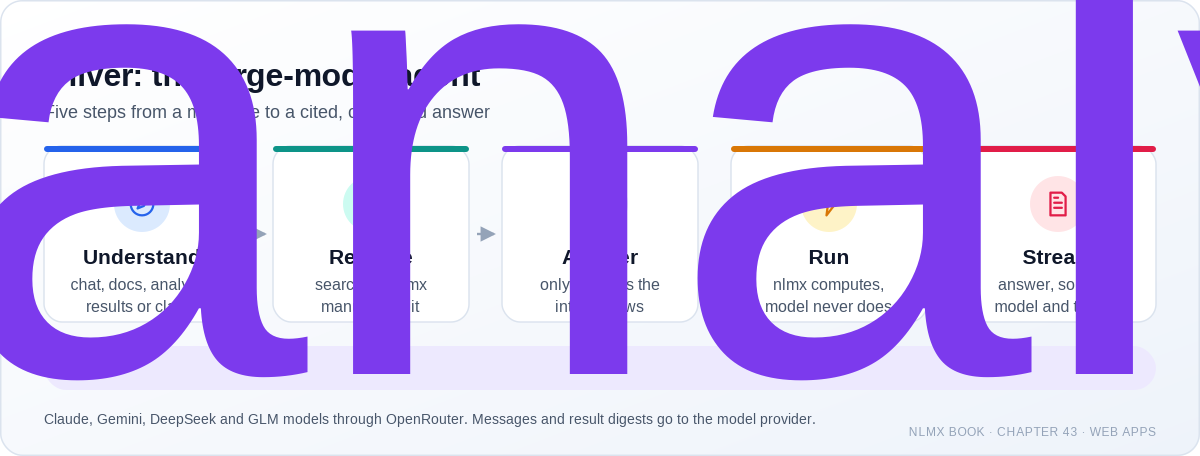
One message, five steps
- Understand first. A quick model reads your message and the state of the conversation (datasets, runs, last messages) and classifies the intent:
chat(a general question, greeting or thanks),docs(a question about nlmx, its commands, options, files or theory),analysis(do something with the data),results(explain a result) orclarify(too vague, so one question is asked back rather than a guess). You see one line: Understood: a question about nlmx, so I check the manual. - Retrieve. For docs, analysis and results, the manual is searched. The best passages go into the prompt and are cited under the answer, for example From the nlmx manual: VPC.md › 3.2 pcVPC.
- Answer with the right tools. The intent decides what the model may use. Chat has no tools. Docs gets the manual (search, read, command help). Results also gets the files of the conversation (list files, inspect a dataset, read a result). Analysis also gets write_report and run_nlmx. A question therefore cannot start a run, whatever the model says.
- Run. A command is checked against a policy (only nlmx commands from the app's list, the options nlmx's own policy forbids, upper limits for heavy ones), mapped to a run by the same code as Maxson's, with files only from the conversation, and started. With Run commands without asking it starts at once; otherwise a card waits for Run. The model receives the outcome and a digest of the result, or nlmx's error to correct the command, and goes on, up to a fixed number of calls and commands per message.
- Stream. The answer arrives word by word, and at the end carries its sources and the model, time and tokens used.
The manual as knowledge
The retrieval index is built from the nlmx documentation: about 640 passages from 22 files, split at headings (code blocks are never cut). Ranking is BM25 with a boost for headings, exact --options and guide names, and results of several queries are fused. There are no embeddings, so nlmx terms such as --pred-correct and qc-data are matched exactly. The practical effect is that Oliver answers how do I questions from the real documentation, with the section named, rather than from memory.
Reports
For a report Oliver writes the Markdown itself from the result files of the conversation, with figures named by their run folder and every number with its source (the write_report tool), then runs report to produce the Word document, PDF and web page. The numbers in the text are the numbers in the results.
Models and keys
Models come from OpenRouter's live list, with the newest tool-capable models of each family and the price per million tokens; any other model identifier can be typed. The choice is per conversation, and a new conversation starts with the last one. Calls ask for the fastest providers, stream the answer and retry on transient errors. You may use your own OpenRouter key in Options, kept in your browser and sent only to make the request; Test asks OpenRouter whether the key works and shows its usage and limit.
What goes where
The messages, the manual passages and the digests of the results that Oliver explains (summary, key figures and the listing, not the whole dataset) are sent to OpenRouter and the model's provider. Maxson keeps everything on the service. Do not use Oliver for data that must not leave it. This is the one place in the suite where the choice of assistant is also a choice about data flow, so it is stated plainly here and in the app.
When to choose which
| Need | Choose |
|---|---|
| Data must stay on the service | Maxson |
| Quick routine runs and explanations | Maxson |
| Questions about nlmx answered with citations from the manual | Oliver |
| Multi-step analysis from a vague request, with clarification | Oliver |
| A written report built from your results | Oliver |
Both are best used with a project that has clear tags and clean data, because the assistants read your tags and results.
Navigation
See the previous page, next page, and the chapter overview.