The SCM candidates-per-step control
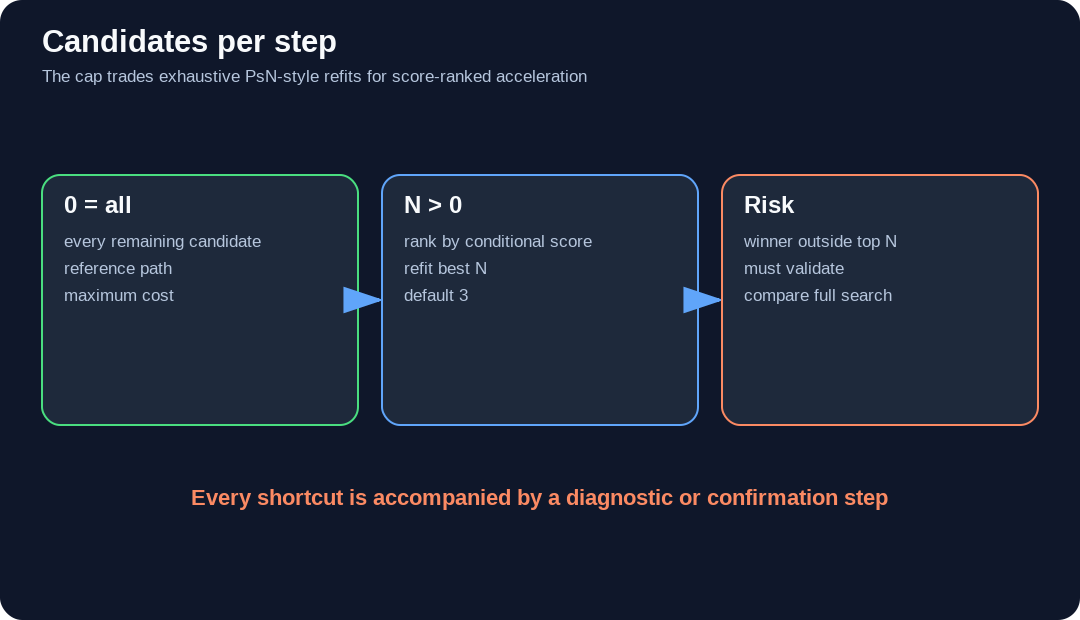
--scm-candidates-per-step N controls how many score-ranked candidates receive full refits at each forward step. The default is 3. N=0 means refit every remaining candidate, matching the exhaustive candidate evaluation expected in a PsN-style forward step. The cap does not turn the score into the decision statistic; it only chooses which models are allowed to compete by refitted LRT.
A positive cap can greatly reduce cost in a wide scope, but it creates an accuracy envelope. If the true best refitted candidate ranks outside the top N by the local score, the accelerated path can choose a different term or stop prematurely. Backward deletion still refits each active term; the forward candidate cap is not its limiting mechanism.
Qualification should compare the intended cap with N=0 across representative datasets, correlated designs, weak effects, and failure cases. In this chapter, N=3 and N=0 produced the same three-effect endpoint and OFV, while the full trace contained three additional candidate rows.
Common mistakes
- Treating a stepwise p-value as clinical importance or causal proof.
- Reading a candidate comparison without its active model, convergence state, degrees of freedom, and exact threshold.
- Reporting only the terminal relationship list while discarding failed models, path decisions, configuration, and provenance.
Page checklist
- The scientific question, model identities, and comparison direction are explicit.
- Numerical validity is reviewed before interpreting statistical evidence.
- The result is linked to the complete trace and final joint-model diagnostics.