Worked post hoc steady-state exposure
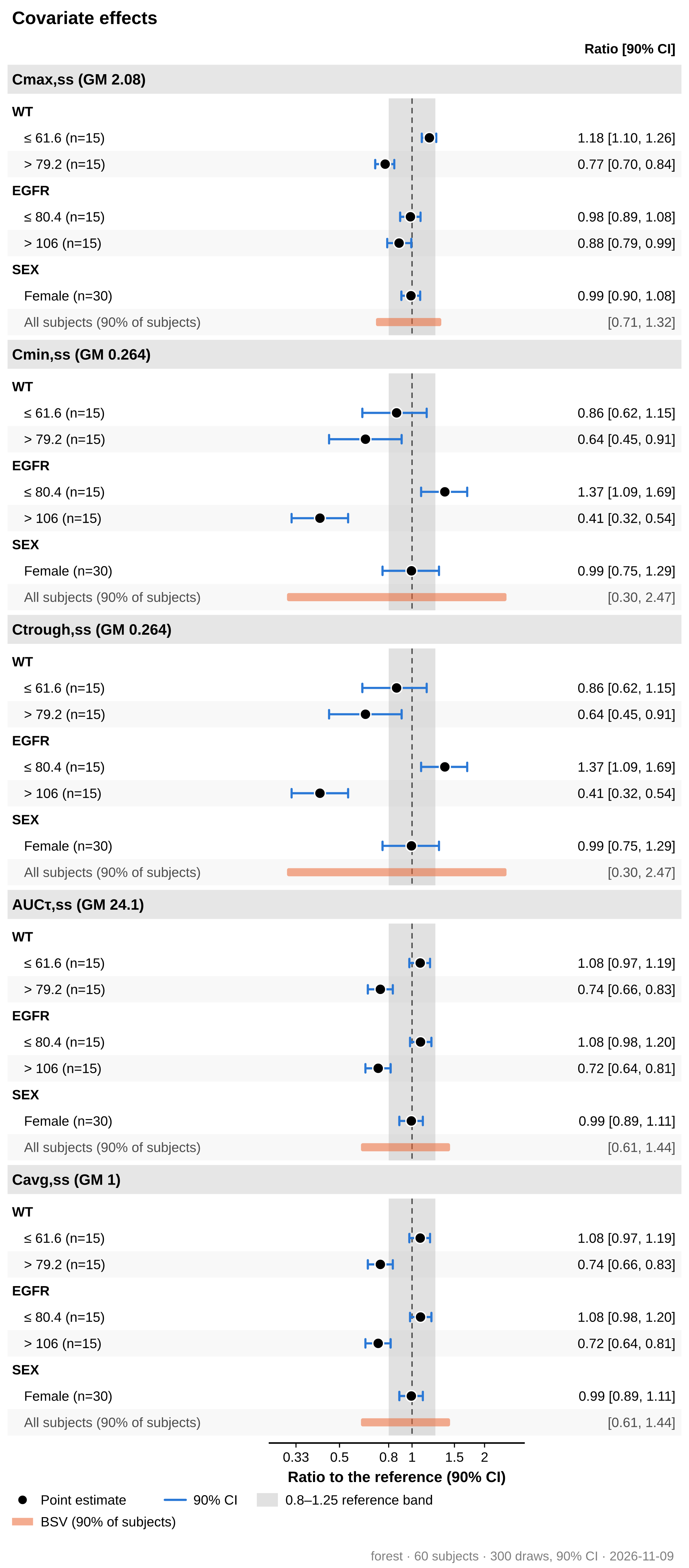
The post hoc run simulates 60 subjects from PHI at a common 100-unit dose every 24 hours, displays WT/EGFR/SEX groups, uses 25th/75th percentile bins, bootstraps subjects 300 times, and reports all five exposure metrics. Exposure-only mode removes parameter sections.
There are 30 rows. High EGFR has Cmin and Ctrough ratios 0.41 [0.32,0.54], outside the band. High WT AUC is 0.74 [0.66,0.83] and overlaps; female-versus-male AUC is 0.99 [0.89,1.11], within. AUC and Cavg ratios match because tau is common.
These are subgroup geometric-mean contrasts using individual ETAs, not direct covariate coefficients. Shrinkage, group support, regimen standardization, and bootstrap design belong in the interpretation.
Common mistakes
- Treating a forest ratio or reference-band class as covariate-selection evidence, causality, or an automatic dosing recommendation.
- Omitting the reference subject, uncertainty source, regimen, subgroup denominator, data support, or fitted-model diagnostics.
- Confusing parameter-uncertainty intervals, BSV ranges, and subject-bootstrap intervals because they share one graphic.
Page checklist
- The numerator, denominator, fitted model, covariate settings, and units are explicit.
- The interval source and clinical meaning are distinguished from BSV and selection uncertainty.
- Tables, resolved settings, commands, diagnostics, limitations, and confirmation evidence are retained.