Complete FAQ reference: every question, by page and by command
What you will learn
- Search all 123 questions of the appendix on one page.
- See which questions touch each command.
- Reach the page that explains an answer.
Prerequisites: the overview.
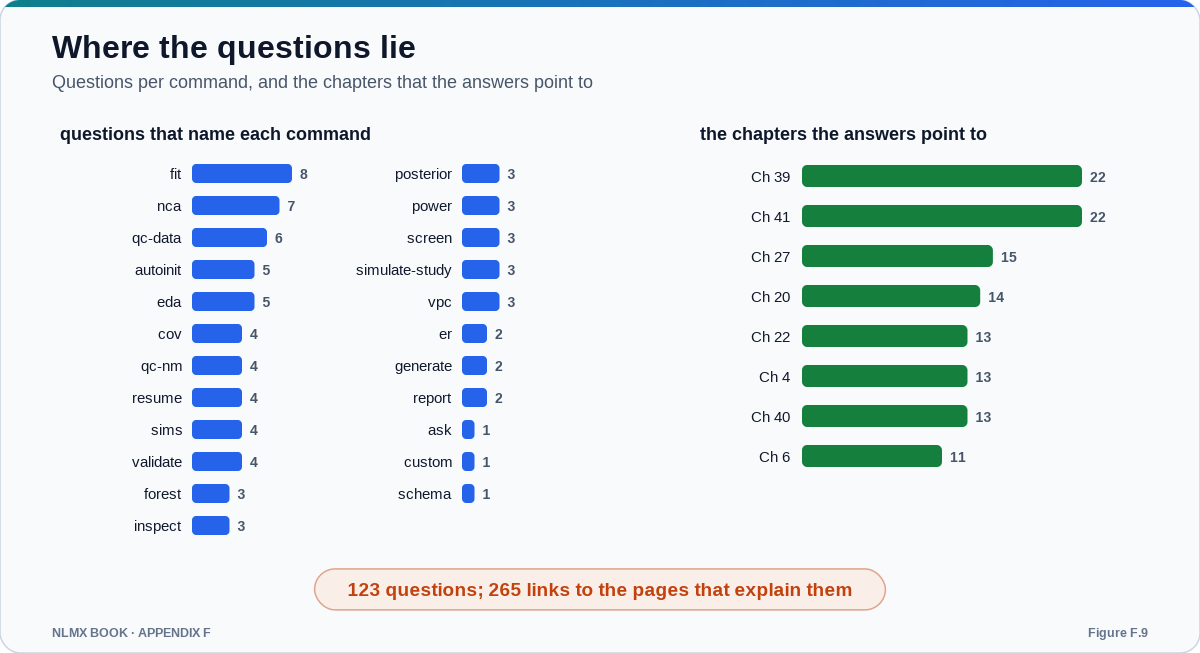
This page lists all 123 questions of Appendix F in one place, so that a reader can search it as a single page, and then the questions that name each command.
Every question
F.1 Getting started, settings and output folders
| No. | Question | The page it points to first |
|---|---|---|
| F.1.1 | What should I run first on a new project? | A first hour with nlmx: a guided tour |
| F.1.2 | Do I need a project file? | 4.1 Projects, run families and stems |
| F.1.3 | What is a *run family* and a *stem*? | 4.1 Projects, run families and stems |
| F.1.4 | Is there a web version of nlmx? | The nlmx web apps |
| F.1.5 | nlmx stopped with exit code 3 and said that the output directory is not empty. What now? | 4.2 Output folders: what is written, never overwritten, and the log |
| F.1.6 | What does every output folder contain? | 4.2 Output folders: what is written, never overwritten, and the log |
| F.1.7 | Does a command ever change my dataset or control stream? | 4.2 Output folders: what is written, never overwritten, and the log |
| F.1.8 | My settings file says one thing and my command line says another. Which wins? | 7.1 Configuration layers and precedence |
| F.1.9 | How do I get a settings file to start from? | 7.5 Generating templates with --print-config |
| F.1.10 | Why does a settings file give exit code 4? | 7.6 Unknown keys, types and range validation |
| F.1.11 | What are the extensions of the settings files? | E.4 Identifiers: exit codes, check IDs, plot codes and file extensions |
| F.1.12 | Where do I find the options of a command? | 4.5 Command-line grammar |
| F.1.13 | Where does the output go on the screen, and where in the log? | 4.4 Exit codes, errors, warnings and notes |
| F.1.14 | What do the exit codes mean at a glance? | 4.4 Exit codes, errors, warnings and notes |
F.2 Data, events, BLQ and quality control
| No. | Question | The page it points to first |
|---|---|---|
| F.2.1 | Which rows does nlmx treat as observations and which as doses? | 6.5 EVID, MDV and CMT |
| F.2.2 | What if my dataset has no EVID or MDV column? | 6.5 EVID, MDV and CMT |
| F.2.3 | How do ADDL and II work, and what happens to an observation at a dose time? |
6.7 ADDL, II, SS and resets |
| F.2.4 | Does an occasion number reset the model state? | 6.7 ADDL, II, SS and resets |
| F.2.5 | How do I tell nlmx that a value is below the limit of quantification? | 6.11 BLQ coding, flags and quantification limits |
| F.2.6 | Is MDV=1 the same as a BLQ observation? |
6.11 BLQ coding, flags and quantification limits |
| F.2.7 | Is there one BLQ rule for the whole program? | 6.12 BLQ behavior by command |
| F.2.8 | How should I handle missing covariates? | 6.10 Missing-covariate policies and carry-forward |
| F.2.9 | What is the difference between \$DATA IGNORE/ACCEPT and a command filter? |
6.13 Row and observation filters |
| F.2.10 | What do PASS, WARN, FAIL, COMMENT and N/A mean in qc-data, and what is the verdict? |
11.3 PASS, WARN, FAIL, COMMENT, N/A and verdicts |
| F.2.11 | qc-data found failures but exited with code 0. Is that a bug? |
11.9 Exit status, fail_on and pipelines |
| F.2.12 | How do I find the row behind a finding? | 11.25 Line numbers and the flagged dataset |
| F.2.13 | What does qc-nm change in my control stream? |
12.1 Your first qc-nm run |
| F.2.14 | Can qc-nm or qc-data be my only release gate? |
12.26 fail-on, exit status and automation |
| F.2.15 | How many checks are there, and what do the letters of an ID mean? | E.4 Identifiers: exit codes, check IDs, plot codes and file extensions |
F.3 eda, custom and nca
| No. | Question | The page it points to first |
|---|---|---|
| F.3.1 | What is the smallest eda run? |
13.1 Your first eda run |
| F.3.2 | In what order does eda apply --mutate and the filters? |
13.3 Processing order: mutate, filter, and analysis |
| F.3.3 | What is the difference between --filter and --obs-filter? |
13.3 Processing order: mutate, filter, and analysis |
| F.3.4 | I asked for a plot and it is not in the output. Why? | 13.8 Selecting standard plots and tables |
| F.3.5 | How do I see which plots and tables exist? | 13.8 Selecting standard plots and tables |
| F.3.6 | When should I use custom instead of eda or a dedicated command? |
13A.1 Why and when to use custom |
| F.3.7 | How does nca know the route of administration? |
15.5 Route detection, mixed routes, and C0 |
| F.3.8 | What does the default nca do about C0 after an intravenous bolus? |
15.5 Route detection, mixed routes, and C0 |
| F.3.9 | Which AUC method is the default, and do the two hybrid rules agree? | 14.6 Linear-up/log-down and linear-log methods |
| F.3.10 | How is the terminal slope (λz) chosen? | 14.10 Best-fit window selection and adjusted R² |
| F.3.11 | Why is there no AUCinf (or clearance, or MRT) for a profile? | 14.13 AUC to infinity and the extrapolated fraction |
| F.3.12 | Which BLQ rule should I use for NCA? | 15.8 BLQ, LLOQ, and censoring controls |
| F.3.13 | nca finished with exit code 0, but some profiles are missing from the table. Is that expected? |
15.26 Errors, exit codes, and troubleshooting |
| F.3.14 | How does nca judge dose proportionality? |
15.14 Dose-proportionality settings and output |
| F.3.15 | Can I run nca on sparse or heavily censored data? |
15.30 Worked example: BLQ-heavy and sparse profiles |
F.4 autoinit, screen and fit
| No. | Question | The page it points to first |
|---|---|---|
| F.4.1 | What does autoinit do, and how are its three methods combined? |
16.7 Three methods and the recommendation rule |
| F.4.2 | The three methods disagree. What do I do? | 16.26 Troubleshooting method disagreement and poor starts |
| F.4.3 | Why does autoinit choose KA > CL/V? |
16.18 KA, ALAG, and flip-flop ambiguity |
| F.4.4 | How do I use init\_blocks.txt? |
16.25 Using init_blocks.txt safely |
| F.4.5 | How does screen choose a recommended structure? |
17.22 Recommendation rule, ties, and passed-over models |
| F.4.6 | A model with a lower objective was not recommended. Why? | 17.22 Recommendation rule, ties, and passed-over models |
| F.4.7 | Which method does fit use, and what does it read? |
20.2 Your first fit |
| F.4.8 | Which estimation method should I choose: FO, FOCE, FOCE-I, Laplace or SAEM? | 18.15 Comparing FO, FOCE, FOCE-I, and Laplace |
| F.4.9 | Can I compare the objective values of two methods? | 18.15 Comparing FO, FOCE, FOCE-I, and Laplace |
| F.4.10 | My fit stopped at the iteration limit, but the estimates look fine. Can I use them? | 20.30 Evaluate-only runs, iteration limits, and rescue |
| F.4.11 | What is the first thing to do about a nonconverged fit? | 20.31 Nonconvergence, boundary estimates, and local optima |
| F.4.12 | There are no standard errors. Is the fit broken? | 20.32 Covariance failures, zero variances, and F_FLAG problems |
| F.4.13 | What does --retry do, and which failures does it retry? |
20.36 Retryable versus non-retryable failures |
| F.4.14 | After a retry, which folder holds the result? | 20.40 Retry folders, the attempt ledger, and provenance |
| F.4.15 | Can I fit many control streams in one command? | 36.7 fit command reference |
| F.4.16 | How should I read shrinkage? | 21.17 ETA and EPS shrinkage |
| F.4.17 | How do I decide whether a model is good enough? | 21.29 From a diagnostic finding to a model decision |
F.5 Covariates, posterior stability, resume and forest plots
| No. | Question | The page it points to first |
|---|---|---|
| F.5.1 | What do cov and its relatives need as input? |
4.1 Projects, run families and stems |
| F.5.2 | Which --method should I use? |
22.23 Method selection map |
| F.5.3 | Does both include the stepwise method? |
22.23 Method selection map |
| F.5.4 | Why can the frozen engine drop a relationship that SCM keeps? | 22.24 Frozen score selection |
| F.5.5 | How does the stepwise engine decide? | 22.25 Stepwise covariate modelling (SCM) |
| F.5.6 | What does a selection probability from the posterior engine mean? | 22.26 Posterior stability selection |
| F.5.7 | What is the joint final refit, and can I skip it? | 22.27 Both mode and joint final refit |
| F.5.8 | The two engines disagree. Which do I believe? | 22.27 Both mode and joint final refit |
| F.5.9 | What is the difference between inspect and validate? |
22.9 Inspect, validate, schema, and resume |
| F.5.10 | How do I resume an interrupted covariate run? | 22.9 Inspect, validate, schema, and resume |
| F.5.11 | How are missing covariates handled in cov? |
6.10 Missing-covariate policies and carry-forward |
| F.5.12 | What is the reference subject of a forest plot? |
26.5 The reference subject and denominator |
| F.5.13 | What does the interval of a forest plot represent? |
26.13 Point estimate, draw median, and confidence interval |
| F.5.14 | Can I use a forest plot to justify a dose change? |
26.5 The reference subject and denominator |
F.6 vpc, sims, generate, power and er
| No. | Question | The page it points to first |
|---|---|---|
| F.6.1 | Which predictive check should I run: a VPC, a pcVPC or a pvcVPC? | 27.12 Choosing VPC, pcVPC, pvcVPC, or NPC |
| F.6.2 | What does a prediction correction do? | 27.8 Prediction-corrected VPC |
| F.6.3 | How many replicates should a VPC use? | 27.30 Replicate count, Monte Carlo stability, and seed |
| F.6.4 | Some observed percentiles fall outside the bands. Is the model wrong? | 27.15 Outside flags and multiple comparisons |
| F.6.5 | How does vpc treat BLQ data? |
27.25 LLOQ censoring and percentile behavior |
| F.6.6 | How do I include parameter uncertainty in a VPC? | 27.27 Fixed-estimate versus parameter-uncertainty VPC |
| F.6.7 | What are the three stages of sims? |
28.3 The three-stage pipeline |
| F.6.8 | Can sims use my own dataset instead of generating subjects? |
28.5 Generated population or supplied design |
| F.6.9 | How do I carry parameter uncertainty into a simulation? | 28.22 Parameter uncertainty from covariance or empirical rows |
| F.6.10 | What is the difference between generate and simulate-study? |
29.1 Choosing generate or simulate-study |
| F.6.11 | Should I use power --method fim or sse? |
31.1 Quick start: a first power run |
| F.6.12 | How does the power calculation turn information into a sample size? | 30.23 Wald power and sample-size scaling |
| F.6.13 | How many sample sizes should I put in the grid? | 31.8 Sample sizes and bracketing the crossing |
| F.6.14 | What is the difference between dropout and missingness in power? |
31.10 Dropout and intermittent missing observations |
| F.6.15 | How do I run a first er analysis? |
33.1 The command map and your first run |
| F.6.16 | Which endpoints does er handle, and how is the effect of exposure expressed? |
33.10 Effect contrasts and predictions at useful exposures |
F.7 Maxson, report, determinism and reproducibility
| No. | Question | The page it points to first |
|---|---|---|
| F.7.1 | What is Maxson, and what can it do? | 34.1 The Maxson trust model |
| F.7.2 | Can the assistant run any command or write anywhere? | 34.5 Allowed commands, self-invocation, and the no-shell boundary |
| F.7.3 | Does Maxson need an internet connection or a remote server? | 34.8 Embedded, server, and mock backends |
| F.7.4 | How do I see what it would do without running anything? | 35.9 Auto mode, guide mode, plan-only, and slash commands |
| F.7.5 | How do I audit a Maxson session? | 34.14 Transcript, JSONL events, commands, and settings history |
| F.7.6 | Does the assistant's judgement get validated by these guardrails? | 34.17 What Maxson cannot establish |
| F.7.7 | How do I turn a Markdown file into Word, PDF and HTML with report? |
36A.2 Quick start and the three input modes |
| F.7.8 | Why does my report have no figure when it was built from standard input? | 36A.11 Images, paths, copying, and missing-file warnings |
| F.7.9 | How do I write an equation in a report? | 36A.10 Pharmacometric equations in four formats |
| F.7.10 | Is exit code 0 from report enough to release it? |
36A.22 Visual QA, accessibility, troubleshooting, and exit codes |
| F.7.11 | What exactly does nlmx promise about reproducibility? | 4.3 Determinism and the seed |
| F.7.12 | Two runs with different thread counts have different checksum lines. Is something wrong? | 4.3 Determinism and the seed |
| F.7.13 | Does changing the seed change everything? | 4.3 Determinism and the seed |
| F.7.14 | What should I keep so that I can rerun an analysis later? | 7.15 Settings-used files and rerun records |
| F.7.15 | Should I expect the same simulated rows from nlmx and from NONMEM with the same seed? | 40.6 Random numbers, seeds, threads, and stochastic equivalence |
F.8 Errors, other software and validation
| No. | Question | The page it points to first |
|---|---|---|
| F.8.1 | What should I do in the first five minutes of a failure? | 39.2 The first five minutes: a safe triage |
| F.8.2 | The folder contains results. Did the run finish? | 39.23 Frequently asked troubleshooting questions |
| F.8.3 | Does exit code 0 mean PASS? | 39.3 Warnings, notes, and the meaning of exit 0 |
| F.8.4 | Can I ignore a warning if the estimates look reasonable? | 39.3 Warnings, notes, and the meaning of exit 0 |
| F.8.5 | Should I increase the iterations or the tolerance? | 39.23 Frequently asked troubleshooting questions |
| F.8.6 | Can I just delete the subject that causes trouble? | 39.23 Frequently asked troubleshooting questions |
| F.8.7 | Why is there no log file? | 4.4 Exit codes, errors, warnings and notes |
| F.8.8 | Why did resume refuse after a tiny change of settings? |
39.13 Exit code 11: checkpoint or resume incompatibility |
| F.8.9 | Can I copy a .cov file from another run? |
39.23 Frequently asked troubleshooting questions |
| F.8.10 | The control stream is rejected with exit code 5. Can I delete the record? | 40.20 Unsupported NM-TRAN records and constructs |
| F.8.11 | My command worked yesterday and fails today. What changed? | 39.15 After an upgrade: version changes and requalification |
| F.8.12 | What do I include in a bug report? | 39.24 Reporting a problem that can be reproduced |
| F.8.13 | How does nlmx differ from NONMEM, PsN, PopED and Monolix? | 40.1 How to read a cross-software comparison |
| F.8.14 | Why is my objective function different from NONMEM's? | 40.3 Why correct implementations can give different numbers |
| F.8.15 | How do I move an analysis from NONMEM, PsN, PopED or Monolix? | 40.16 Migrating a NONMEM analysis to nlmx |
| F.8.16 | What does the validation chapter cover, and who declares the program qualified? | Chapter 42 — Validation and testing |
| F.8.17 | Where do I look when none of this answers my question? | Appendix E — Index |
Questions that name a command
A question is listed under a command when the command appears in a code span in the question or in its answer. Numbers refer to the questions above.
| Command | Questions | Count |
|---|---|---|
qc-data |
F.1.1, F.2.5, F.2.10, F.2.11, F.2.14, F.2.15 | 6 |
qc-nm |
F.1.7, F.2.13, F.2.14, F.2.15 | 4 |
eda |
F.1.1, F.3.1, F.3.2, F.3.5, F.3.6 | 5 |
custom |
F.3.6 | 1 |
nca |
F.1.1, F.2.7, F.3.7, F.3.8, F.3.13, F.3.14, F.3.15 | 7 |
autoinit |
F.1.1, F.2.7, F.4.1, F.4.3, F.4.13 | 5 |
screen |
F.1.1, F.2.7, F.4.5 | 3 |
fit |
F.1.1, F.1.7, F.1.11, F.2.7, F.4.7, F.4.15, F.5.1, F.6.8 | 8 |
cov |
F.1.7, F.1.11, F.5.1, F.5.11 | 4 |
posterior |
F.1.11, F.5.1, F.5.2 | 3 |
resume |
F.1.11, F.5.1, F.5.10, F.8.8 | 4 |
inspect |
F.1.11, F.5.1, F.5.9 | 3 |
validate |
F.1.11, F.5.1, F.5.9, F.8.3 | 4 |
forest |
F.5.12, F.5.13, F.5.14 | 3 |
vpc |
F.2.5, F.2.7, F.6.5 | 3 |
sims |
F.1.13, F.2.7, F.6.7, F.6.8 | 4 |
generate |
F.1.1, F.6.10 | 2 |
simulate-study |
F.1.11, F.5.1, F.6.10 | 3 |
power |
F.2.7, F.6.11, F.6.14 | 3 |
er |
F.6.15, F.6.16 | 2 |
ask |
F.7.1 | 1 |
report |
F.7.7, F.7.10 | 2 |
schema |
F.1.9 | 1 |
version |
none | 0 |
Commands with none are described in the manual and the concept chapters, but they did not give rise to a question that the book answers in a few sentences.
Review checklist
- Can you search this page for a word from your question?
- Do you open the page of the first link in the table, and not only the summary?
- Do you use the command table to find every question that touches a command you are about to run?
Navigation
See the previous page, and the overview.