16.10 Two-compartment check and curve stripping
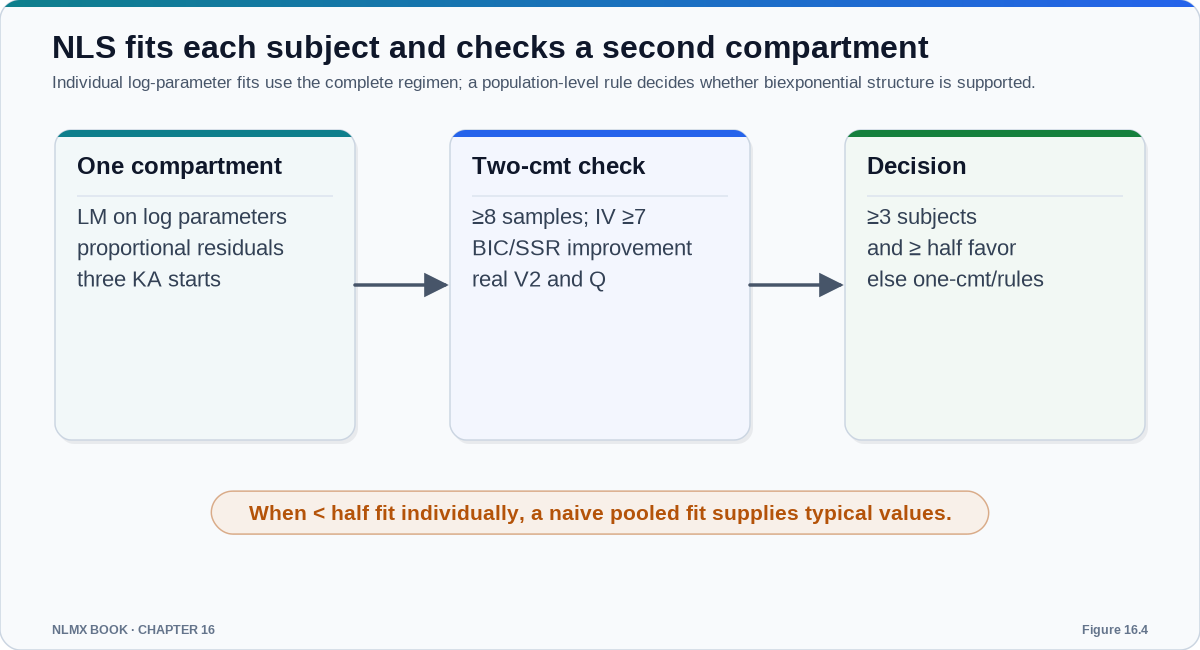
Every sufficiently sampled subject receives a two-compartment NLS check after its one-compartment fit. At least eight measurable samples are required, or seven for intravenous data.
Subject-level support
A subject favors two compartments when all of these hold:
- BIC improves, expressed as
n × ln(SSR1/SSR2) > 2 × ln(n); - V2 is at least 5% of V1;
- Q is at least 1% of CL;
- the one-compartment fit is not already effectively exact.
The last safeguards prevent a tiny, meaningless peripheral compartment from “improving” noise-free one-compartment data.
At the dataset level, at least three subjects and at least half of successfully checked subjects must favor two compartments. Sparse data use a pooled comparison instead.
Consequences for recommendations
When supported, two-compartment NLS means supply V1, Q, and V2. Their spread can supply OMEGA for CL, V1, and KA. Recommended CL combines NCA with two-compartment NLS; KA uses two-compartment NLS alone because a one-compartment curve can mistake distribution for absorption. The ordinary V row remains an apparent one-compartment volume, with V1+V2 explained in its note.
NCA curve stripping offers another V1/Q/V2 estimate but is more sensitive to phases and sampling. Compare it with NLS rather than assuming equality.
For a novice, the safest interpretation is hierarchical: first ask whether the profiles visibly contain early and late phases; next confirm that enough subjects were eligible; then inspect how many passed every numerical safeguard. A dataset-level decision is stronger than an isolated good fit, but it still proposes a starting structure rather than selecting the final model.
Common mistakes
- Selecting two compartments from one subject only.
- Ignoring minimum peripheral-size safeguards.
- Treating the V row as identical to V1 or V1+V2.
- Keeping one-compartment KA after clear distribution evidence.
Checklist
- Count eligible and favoring subjects.
- Review BIC/SSR and real-peripheral criteria.
- Compare NCA stripping and NLS values.
- Read V, V1, Q, and V2 SOURCE/NOTE separately.
- Confirm later screen/fit supports the structure.
Further reading
See parameter availability, IV two-compartment example, and Chapter 17 for formal structural screening.