41.9 Case 2: bioavailability from a crossover, and a sparse study with BLQ
What you will learn
- Compute absolute bioavailability from a crossover and verify it by hand.
- Read the flags the program attaches to a profile (
C0_BACKEXTRAP,INF_AFTER_EARLIER_DOSES,LZ_SPAN_SHORT,AUC_EXTRAP_GT_20,NO_LZ).- Follow a BLQ rule from the data file to the final parameter table.
- Decide what to report when a profile cannot support a parameter.
Prerequisites: 41.6 and Chapter 15.
The questions: (a) what fraction of an oral dose reaches the circulation? (b) what can be reported when a study has too little quantifiable drug?
The evidence: two Chapter 15 bundles: crossover_bioavailability (six subjects, 100 mg IV bolus on occasion 1 and 100 mg orally on occasion 2, one week apart) and blq_sparse (six subjects, 25 mg orally, nine samples each, LLOQ 0.05, 16 of 47 observations below it).
Part A: absolute bioavailability
With an IV dose and an oral dose of the same drug in the same subjects, absolute bioavailability is the ratio of dose-normalised AUCs:
F = (AUCinf,oral / dose_oral) / (AUCinf,IV / dose_IV)
The doses are both 100 mg, so the ratio reduces to the AUC ratio.
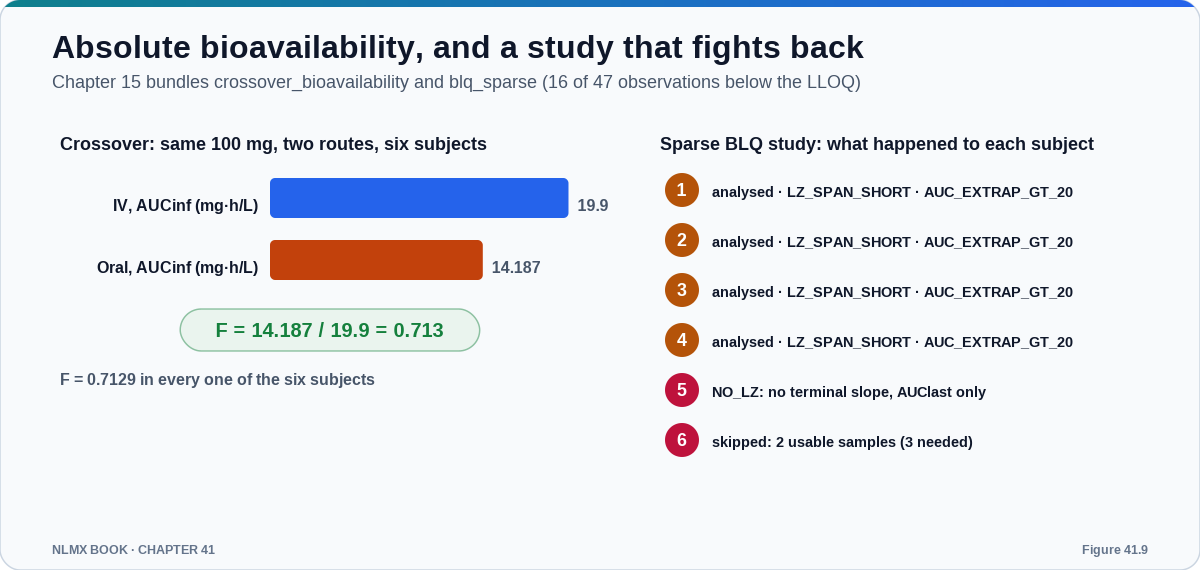
| Route | Mean AUCINF (mg·h/L) | CL (IV) or CL/F (oral) | Mean t½ (h) |
|---|---|---|---|
| IV bolus, occasion 1 | 19.900 | 5.056 | 6.931 |
| Oral, occasion 2 | 14.187 | 7.092 | 6.938 |
F = 14.187 / 19.900 = 0.713.
The nca_bioavailability.csv file gives it per subject: 0.7129 for every one of the six (F_AUCINF), and 0.7124 on AUClast. A hand check by clearance: for subject 1, CL(IV) = 5.682 L/h and CL/F(oral) = 7.970 L/h, and 5.682 / 7.970 = 0.713 ✔. Equivalently, an oral clearance is the IV clearance divided by F, which is why "apparent" oral clearance is larger than the true one.
The half-lives agree (6.93 and 6.94 h), a requirement for the method: the AUC ratio equals F only if clearance is the same on both occasions. A crossover whose second-occasion half-life were far from the first would invalidate the comparison no matter how neat the ratio looked.
The flags
The individual rows carry flags worth knowing:
| Flag | Where | Meaning |
|---|---|---|
C0_BACKEXTRAP |
IV occasion | No sample at time zero after a bolus, so C0 is back-extrapolated (subject 1: C0 = 1.76 mg/L from the first points) |
AUC_FROM_FIRST_SAMPLE |
oral occasion | The area is counted from the first sample rather than from a measured pre-dose value |
INF_AFTER_EARLIER_DOSES |
oral occasion | The area to infinity is measured after an earlier dose (the IV on occasion 1), so washout must be confirmed |
The last one is a question to the study, not the program: the oral occasion starts at 168 h, a full week after the IV dose. With a half-life of 6.9 h, that is 24 half-lives, so residual drug is negligible, and the flag is a prompt to confirm, not an error.
Part B: a study where the assay runs out
The second bundle is a deliberately difficult one. The LLOQ is 0.05 mg/L; samples at 24, 36 and 48 h are all at the limit and flagged BLQ in every subject, plus the 12 h sample for subject 5. That is 16 of 47 observations (34 %).
The settings choose the rule tmax-zero-missing: BLQ values before or at Tmax are treated as zero, and BLQ values after Tmax are treated as missing, which is the program's default rule. It has a physical reading (before the peak, little drug had yet arrived; after it, the drug is still there but cannot be quantified, so the value is left out rather than invented), and it is stated in the summary header (BLQ tmax-zero-missing (LLOQ 0.05)).
What happened to each subject
profiles 5 analysed of 6 dosing intervals; terminal slope found in 4
| Subject | Outcome | Why |
|---|---|---|
| 1–4 | analysed, flagged LZ_SPAN_SHORT, AUC_EXTRAP_GT_20 |
λz from three points (4, 8, 12 h), span 1.14 half-lives; 33.1 % of AUCinf is extrapolated |
| 5 | analysed to AUClast only: NO_LZ |
"too few points after the maximum": the 12 h sample and later are BLQ |
| 6 | skipped | "2 usable samples (at least 3 are needed)" |
The consequence is in the summary: AUCINF is reported for 4 of 6; CL/F varies 5.0 to 14.3 L/h (CV 47.6 %) where the oral single-dose bundle of page 41.6 had a CV of 8.6 % (a different bundle, quoted only for contrast). That variability is not biology; it comes from extrapolating a third of the area from three points with a span of about one half-life. The 33.1 % figure is the same for all four profiles because the profiles are scaled copies; in real data it would vary.
What to report
| Parameter | Reportable? | Reason |
|---|---|---|
| CMAX, TMAX | yes, 5 of 6 | observed |
| AUCLAST | yes, 5 of 6, with a caveat | the tail is truncated at the BLQ boundary |
| AUCINF, CL/F, V/F | no (or only as an exploratory range) | 33 % extrapolated, span 1.14 half-lives |
| Subject 6 | exclude from NCA | fewer than three quantifiable points |
The summary file's own notes say the same: "1 of 6 profile(s) were not analysed", "1 profile(s) have no terminal slope, so no area to infinity, clearance or volume".
The decision
| Question | Evidence | Decision | Reversible? |
|---|---|---|---|
| What is absolute bioavailability? | nca_bioavailability.csv: F = 0.713 in 6 of 6; t½ equal on both occasions |
Report F = 0.713; note the one-week washout | yes |
| What can be reported from the sparse BLQ study? | nca_summary.txt notes; flags AUC_EXTRAP_GT_20, NO_LZ, skipped |
Report CMAX, TMAX and AUCLAST; do not report AUCINF-based parameters; move to population modelling if clearance is needed | yes |
The last clause is the useful one. When individual NCA runs out of data, a population model (Chapters 18–20) can borrow strength across subjects, including the BLQ ones, which is why sparse-sampling studies are analysed that way.
What this case does not show
It does not show a BLQ rule that imputes a value (for example half the LLOQ) or a rule that drops all BLQ observations, both of which the program offers and each of which shifts AUC in a different direction. Changing the rule changes the numbers; the rule belongs in the analysis plan, not in the analyst's judgement of the day.
Review checklist
- Do both occasions show the same half-life before you divide the AUCs?
- Have you read each flag and decided whether it is a warning or a prompt for a study check?
- Is the BLQ rule written in the plan and quoted in the summary header?
- When a profile cannot support AUCINF, do you report it as missing rather than as a guess?
Navigation
See the previous page, the next page and the complete case-study reference.