16.7 The three methods and the recommendation rule
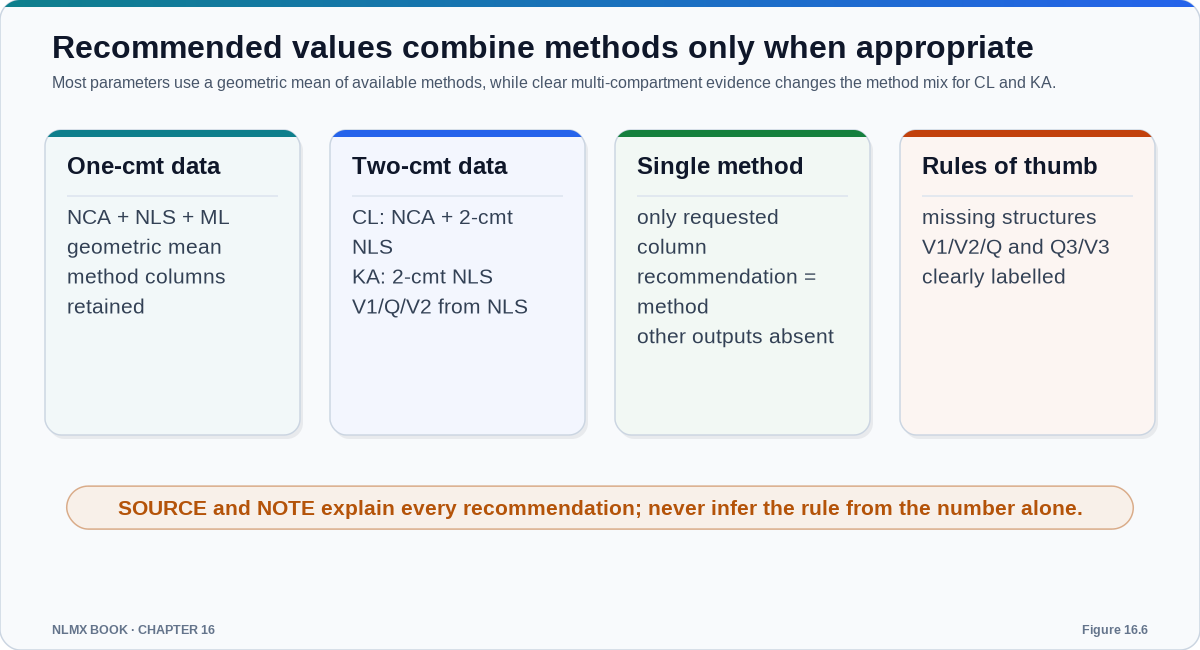
With method="auto", autoinit runs every method supported by the data and retains each result. The recommendation usually uses a geometric mean because PK parameters are positive and method differences are naturally multiplicative.
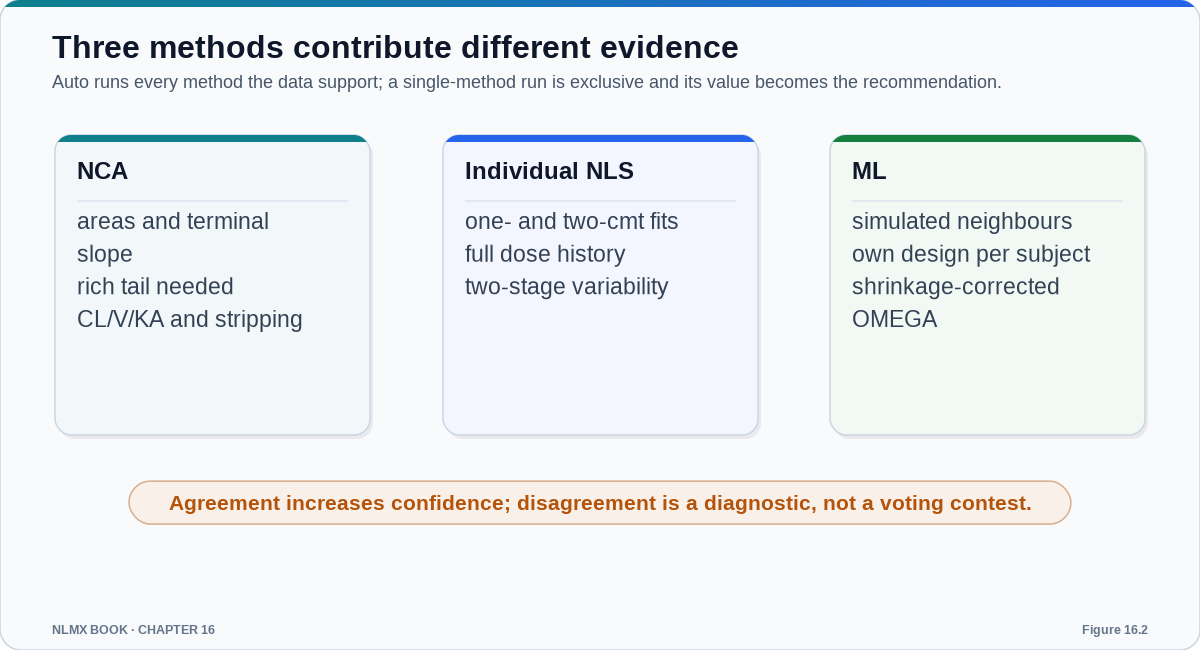
What each method contributes
NCA uses terminal slope and area, requiring rich enough coverage. NLS fits a one-compartment curve to each subject's full dosing history and checks whether two compartments are supported. ML simulates each subject's design across population parameter draws and uses close neighbours, allowing sparse profiles to contribute probabilistically.
Each has different biases. NCA can depend strongly on tail selection. One-compartment NLS can confound distribution and absorption. ML is limited by its simulated one-compartment family and sampling range. Agreement is evidence that these weaknesses are not dominating; disagreement identifies a review question.
Recommendation exceptions
For ordinary one-compartment data, available NCA/NLS/ML values enter the geometric recommendation. When clear two-compartment evidence exists, CL is combined from NCA and two-compartment NLS, KA comes from two-compartment NLS, and V1/Q/V2 come from the two-compartment fits. One-compartment ML is intentionally excluded from those affected recommendations.
If only one method is requested, its value becomes RECOMMENDED and other method columns remain absent. Structural fields without direct evidence can still receive labelled rules of thumb for model starts.
Common mistakes
- Averaging methods arithmetically by hand.
- Treating the recommendation as a majority vote.
- Including one-compartment ML in a confirmed two-compartment KA start.
- Hiding the individual method columns from reviewers.
Checklist
- Identify which methods actually ran.
- Compare values on a ratio/log scale.
- Read SOURCE and NOTE for exceptions.
- Check two-compartment decision evidence.
- Preserve method-specific values with the recommendation.
Further reading
Continue with NCA, NLS, ML, and single-method runs.