11.15 Time, order, TAD and nominal time: TIM01–TIM09
TIM01 requires nondecreasing TIME within a subject except at a valid reset. TIM02 requires every ID to occupy one contiguous block. A split ID can be interpreted as two individuals; a decreasing time can stop NONMEM or corrupt event execution.
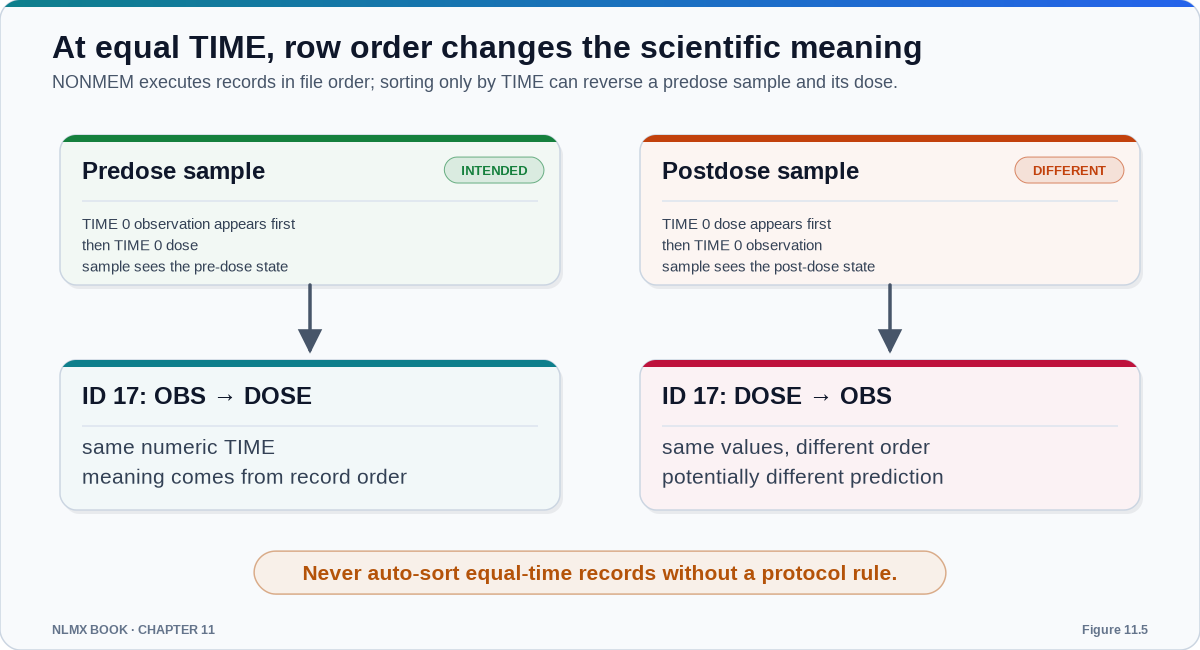
Figure 11.8. Equal numeric TIME does not erase file order. Observation-before-dose and dose-before-observation represent different states.
TIM03 reports negative times, which may be valid predose samples. TIM04 compares maximum time with a plausibility limit. TIM05 lists observation/dose ties. Optional TIM06 reports large gaps, TIM07 checks TAD, and TIM08 compares actual with nominal time. TIM09 inventories predose observations.
Do not sort blindly
Sorting by ID/TIME can fix a split block but reverse equal-time semantics. Use an explicit event-order key derived from protocol meaning. Preserve the original row order and document the sorting rule.
TAD and nominal time
TAD is recomputed from dose history; it is not simply TIME modulo II when regimens change. Nominal-time tolerance is the larger of an absolute default (0.5) and a relative fraction (0.1). Configure both in study units.
How to inspect a timeline
Filter one subject at a time and retain the original file sequence. Add a review-only row number, classify each record, and calculate time since the latest actual or implied dose. For a decrease after an EVID 3/4 reset, verify that reset behavior is intentional. For TIM08, compare actual and nominal values without replacing actual TIME: nominal time describes the schedule, while actual collection time normally drives pharmacokinetic prediction.
Common mistakes
- Sorting equal-time rows alphabetically by EVID.
- Rejecting every negative TIME despite planned predose collection.
- Treating nominal time as the time used in the model.
- Checking TAD without including all dose records.
Checklist
- Confirm one contiguous block per ID.
- Define same-time dose/sample order.
- Verify time units and reset semantics.
- Configure and review TAD/nominal columns when available.
Further reading
See subject blocks/order, event timeline execution and time defect case study.