The schema command and versioned settings
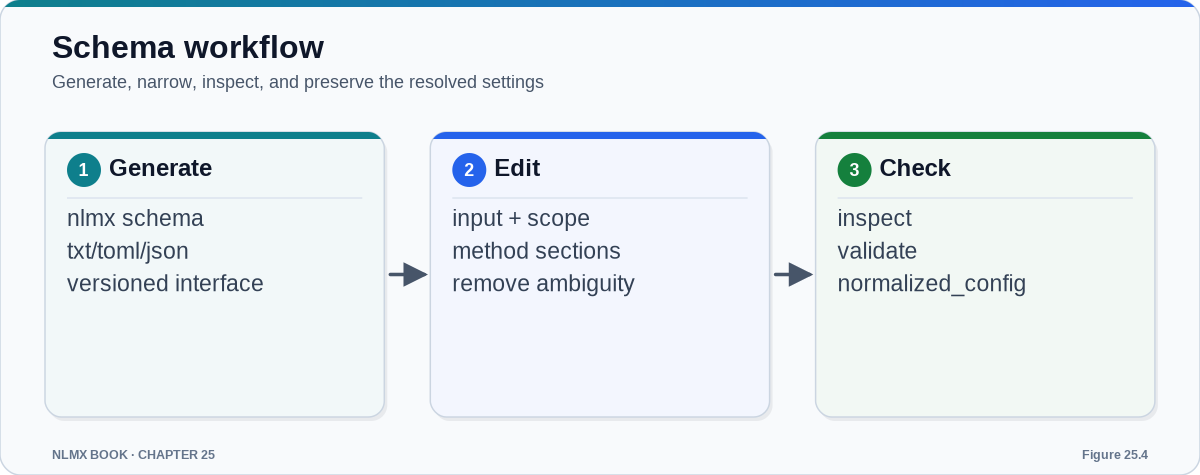
Run nlmx schema before authoring or upgrading a configuration. The default text is an annotated, valid .covar template containing accepted tables, keys, values, defaults, and examples. --format txt|toml|json|json-schema changes the representation; capture the executable version beside it because schemas and defaults evolve.
The text schema is best for a novice starting file. JSON/JSON Schema are useful for tooling, validation interfaces, and automated comparison. Do not copy the entire reference blindly into production: begin with input and scope, then add only settings whose defaults you intend to freeze or whose behavior must be explicit. An unused engine table is harmless but can confuse reviewers if its role is not stated.
When nlmx is upgraded, generate the new schema, compare it with the archived version, inspect the changelog, and rerun validation and frozen reference examples. A configuration that parses is not automatically equivalent across versions; changed defaults, engine code, schema version, or RNG derivation can alter results and deliberately prevent resume.
Common mistakes
- Changing the scientific question after seeing the result while presenting it as the original run.
- Reading one engine's summary without checking its prerequisites, failures, normalized settings, and fitted endpoint.
- Treating a generated draft, comparison label, or completed checkpoint as a substitute for model diagnostics and reference-software confirmation.
Page checklist
- The exact command, version, inputs, resolved settings, and output directory are identifiable.
- Engine-specific evidence is interpreted on its own scale before cross-method comparison.
- Recovery state, final refit, diagnostics, and remaining confirmation work are explicit.