20.39 Retries 2–N: random perturbations with guardrails
After retry 1, every further retry changes estimated values around a fixed recovery center by at most ±15%. When retry 1 used autoinit successfully, that center is the mapped autoinit state. When autoinit was unavailable and retry 1 used the random fallback, later retries perturb the resolved submitted or EXT start. For a THETA, nlmx multiplies the applicable center by a factor between 0.85 and 1.15. OMEGA and SIGMA variances are scaled similarly; covariances are adjusted so the implied correlations remain unchanged. Bounds are respected by moving a proposed THETA just inside its legal interval when necessary.
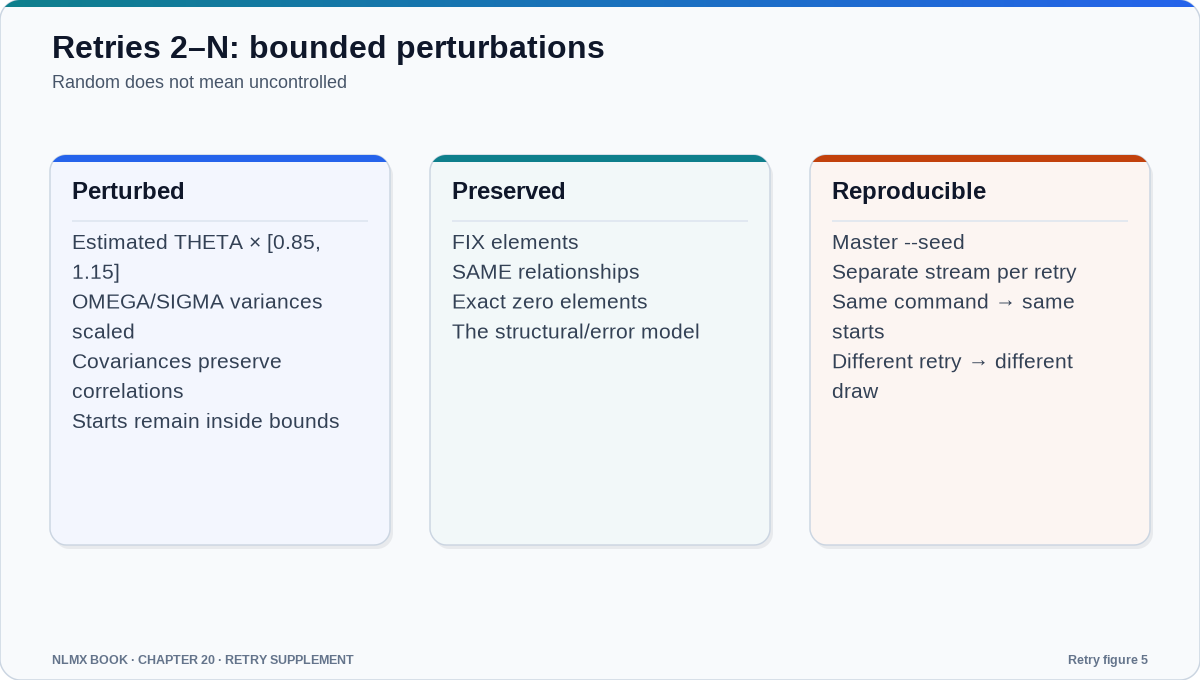
Several quantities are deliberately preserved: FIX elements, SAME-linked structure, exact zero elements, the model equations, dataset, approximation, and numerical controls. The perturbations therefore explore nearby starting points without silently changing the scientific model.
Randomness is deterministic. The master --seed and retry number define a separate stream for each attempt. Repeating the same version, inputs, command, and seed produces the same proposed starts. Retry 2 and retry 3 receive different streams, so they explore different nearby values. When no seed is supplied, retry perturbations use the documented default 20240611; an explicit seed is still preferable in a regulated or comparative workflow.
nlmx fit run101.ctl --retry 5 --seed 88421 -o run101_recovery
The ±15% range is a local-start sensitivity, not an exhaustive search of the parameter space. If all starts converge to the same estimates and OFV, confidence in local numerical stability increases. If they converge to materially different solutions, do not simply select the lowest OFV and discard the rest. Compare plausibility, parameter boundaries, covariance, predictions, diagnostics, and whether the solutions represent distinct local optima.
For a parameter centered at zero, multiplicative perturbation cannot create a nonzero value; exact zeros stay zero. For strongly nonlinear models, ±15% may be too narrow to escape a basin or too disruptive for a fragile model. In those cases, construct scientifically motivated alternative starts in separate, explicitly named runs rather than misrepresenting retry as a global optimizer.
Common mistakes
- Calling the perturbations independent model replicates.
- Expecting zero starts to move away from zero.
- Comparing retries generated with different seeds without recording that difference.
- Using ten retries to mask repeated identification failures.
Checklist
- Record nlmx version and master seed.
- Preserve every generated
retry_NN.ctl. - Verify that FIX and SAME structures remain intact.
- Compare converged solutions for local-optimum sensitivity.
- Escalate to model revision or designed starting values when local perturbations fail.
Further reading
See retry outcomes and reproducibility controls.