Chapter 33 — er: the command
nlmx er performs continuous, binary, ordinal, count, time-to-event, and longitudinal exposure–response analyses. This chapter is the operational companion to Chapter 32: it explains every command-line control, every .er settings section, the data/exclusion pipeline, selection and uncertainty, all 16 plots, every output family, and complete workflows on the synthetic data/er project.
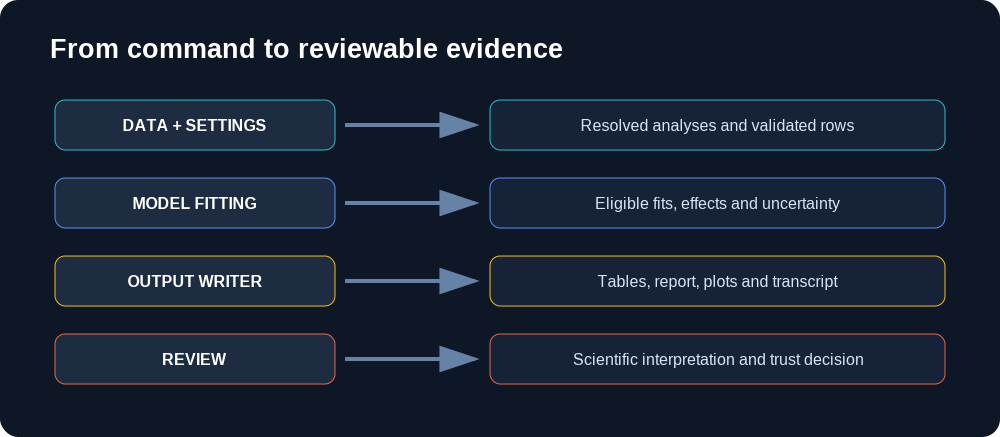
Start here
- Use the complete command and settings index to see the entire interface before choosing options.
- Follow 33.1 through 33.25 for input, fitting, graphics, configuration, and operating controls.
- Work through ten executed examples in 33.26 through 33.35.
- Finish with implementation, validation, and limits in 33.36 through 33.38.
Executed evidence
Eleven nlmx 4.16.0 workflows were executed into documents/ch33/results: continuous quick start, exposure-metric comparison, covariate selection, placebo correction, binary bootstrap, ordinal, count, TTE, longitudinal, filtered subgroups, and a five-endpoint combined run. Each directory contains the emitted transcript, report, tables, plots, and SHA-256 manifest.
| Workflow | Main observed behavior |
|---|---|
| continuous | 98 subjects; Emax best eligible; unstable sigmoid excluded from ranking |
| metrics | four exposure metrics and correlation/distribution evidence |
| selection | 5 of 10 candidates selected; complete OFV trace |
| placebo | study-specific correction with raw values retained |
| binary | numeric and text responder definitions; 50-replicate smoke bootstrap |
| ordinal/count/TTE/longitudinal | endpoint-specific likelihoods, diagnostics, plots and tables |
| filters/all | subgroup expansion and five endpoint types sharing one settings file |
These are synthetic teaching analyses, not clinical evidence. Their purpose is to demonstrate command behavior, auditability, warnings, and interpretation boundaries.
Chapter deliverables
The chapter contains 38 numbered pages plus this overview and the complete interface index. Every numbered page has a purpose-built visual; worked pages add native nlmx output figures. Continue with the complete index or your first run.