33.7 Covariate encoding and fixed adjustment
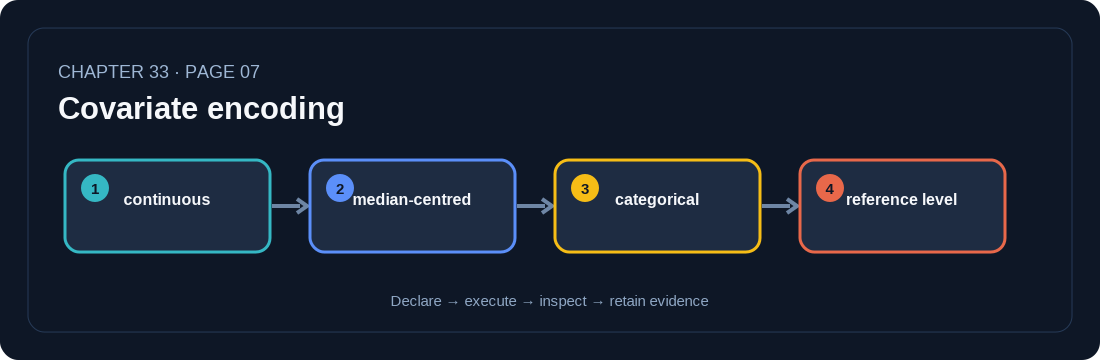
Numeric covariates with more than five distinct values are continuous and centred on their median. Text or few-level variables are categorical with the most frequent level as reference. Covariates enter additively on the response scale for continuous endpoints and on the link or log-hazard scale otherwise.
Command or configuration pattern
nlmx er er.csv --er-covariates BASE,AGE,SEX,ECOG ...
The relevant controls are: covariates; forced_covariates; --er-covariates. Use the complete command and settings index for accepted values, defaults, CLI mappings, and settings-only controls.
A reliable operating sequence
- State the endpoint estimand, exposure metric/window/units, analysis population, adjustment set, and clinically useful contrast.
- Reconcile input rows, subjects, arms, exposure availability, endpoint information, and all endpoint-specific fields.
- Run the smallest useful specification first; inspect exclusions and eligible models before adding subgroups, selection, or bootstrap.
- Read absolute predictions and observed support alongside relative effects, information criteria, p-values, and diagnostics.
- Archive the command,
.erfile, mutated/used data, exclusions, transcript, tables, plots, report, version, and checksums.
How to read and review the result
Inspect levels, missingness, reference categories, centring values, collinearity, and exposure overlap. A variable coded 0–4 with five values becomes categorical; decide whether that matches the estimand. Fixed adjustment is preferable for prespecified confounders and prognostic factors because it does not condition inclusion on observed p-values.
For a novice, the safest reading order is er_summary.txt → er_analyses.csv → the analysis-specific exclusions and model table → effects/predictions → diagnostic plots → row-level data → report.html. The report is a presentation layer; the CSV/JSON files and transcript are the audit layer.
Quality-control questions
- Did the number of analysed subjects, events, categories, exposure groups, and visits match the specification?
- Were placebo, active zeros, missing values, filters, repeated rows, categories, offsets, censoring, and covariate references handled as intended?
- Were ineligible fits retained and explained rather than silently dropped or allowed to win?
- Does the reported contrast stay inside exposure support, and are its units and endpoint direction clear?
- Do diagnostics and sensitivities support the same decision, and are causal and transportability limits explicit?
Common failure modes
- Treating the best criterion or smallest p-value as a clinical conclusion.
- Reading an odds, rate, or hazard ratio without its exposure contrast and absolute outcome context.
- Overwriting an evidence directory before preserving the prior settings, log, and checksums.
Navigation
See the previous page, next page, and complete command and settings index.