22.3 What a covariate coefficient means
An effect coefficient is meaningful only with its equation, reference, covariate units, and parameter scale. The same numeric value can imply very different behavior in a power, exponential, or linear equation.
For a power effect P = TVP × (X/ref)^theta, theta is an elasticity: approximately the fractional change in P for a fractional change in X near the reference. Theta = 0.75 is not “75% higher”; at X twice the reference, the factor is 2^0.75, about 1.68.
For P = TVP × exp(theta × (X-ref)), theta is the log-parameter change per unit of X. Its magnitude depends on units: per year differs from per decade. For P = TVP × (1 + theta × (X-ref)), theta is a fractional change per unit and the factor must remain positive.
For a binary proportional effect, theta = 0.2 means the non-reference group’s typical parameter is 1.2 times the reference group. For categorical proportional effects, each non-reference level receives its own coefficient; grouped uses one coefficient for all non-reference levels.
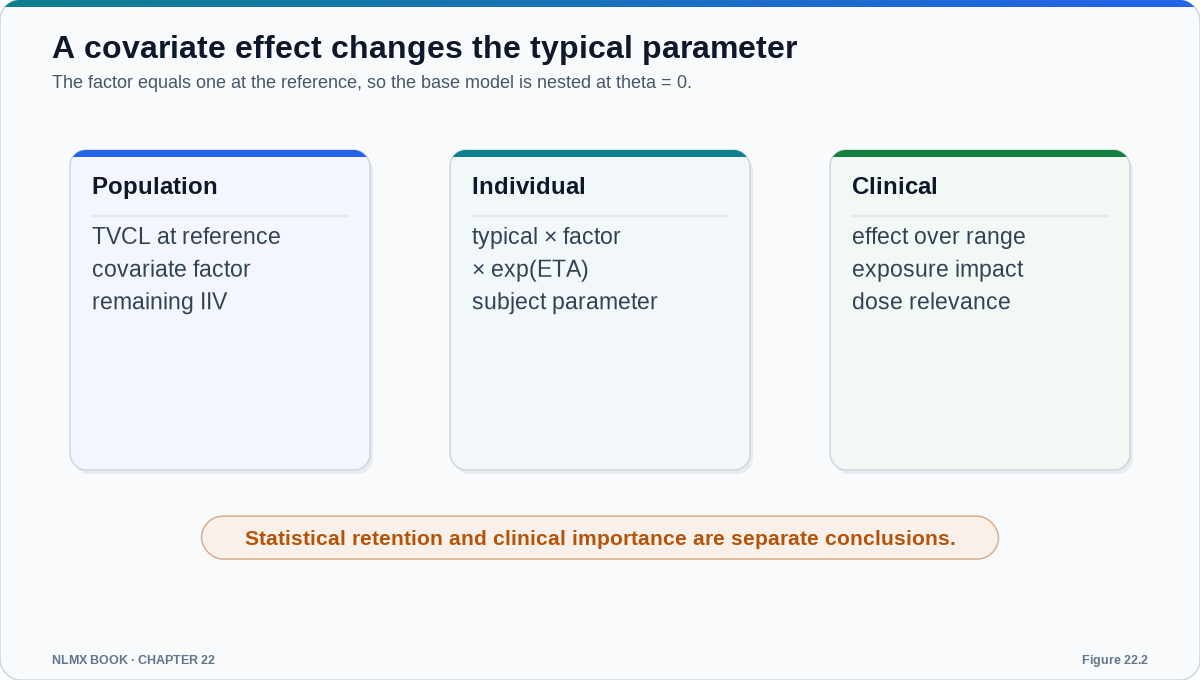
Always translate theta into parameter ratios at clinically meaningful covariate values. Then propagate the parameter change into exposure or response when the decision concerns dosing. A CL ratio of 1.2 generally implies an inverse steady-state exposure relationship under simple conditions, but the exact consequence depends on model, dosing, and endpoint.
Common mistakes
- Reporting theta without equation or units.
- Calling a power exponent a percent change.
- Comparing exponential coefficients under different covariate units.
- Reporting parameter effects without exposure consequences.
- Interpreting the coefficient outside observed support.
Checklist
- State equation, reference, units, and parameter scale.
- Calculate factors at low, reference, and high values.
- Translate parameter changes into relevant predictions.
- Include uncertainty and observed-range limits.
- Avoid extrapolating the functional form without evidence.
Further reading
Continue with typical and individual parameters, the equation pages, and clinical interpretation.