22.27 both mode and the joint final refit
--method both runs frozen and posterior engines on the same analysis definition. It does not include SCM. Use it to compare score-based conditional evidence with posterior/resampling stability.
Agreement strengthens confidence that a relationship is not an artifact of one method. Disagreement is informative: it may reflect shrinkage, correlated features, resampling instability, local score approximation, or learner behavior. Do not resolve disagreement automatically by taking the union or intersection; investigate the reason and intended use.
All methods normally perform a joint final refit of retained effects with base parameters re-estimated. This converts provisional score, two-stage, or stepwise coefficients into a coherent population model and produces final OFV and estimates. --no-final-refit saves time but leaves a provisional model without comparable final likelihood evidence.
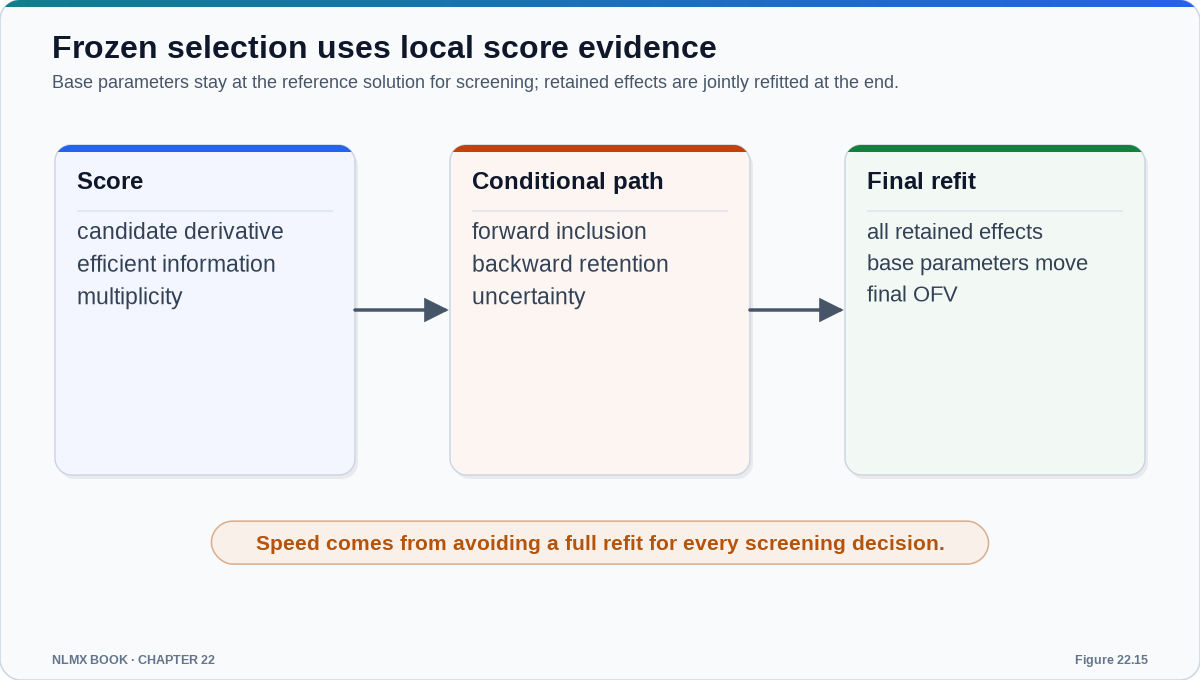
Joint refit can fail or materially change coefficients. Review convergence, boundaries, OMEGA/SIGMA, covariance, parameter correlations, shrinkage, and diagnostics. A retained effect that collapses or reverses in the joint model requires explanation.
When frozen and posterior retain different sets, create explicit candidate final models rather than silently mixing. Compare them under the same fitting and diagnostic workflow, then document the decision.
Resolving disagreement between engines
Agreement strengthens confidence that a relationship is not an artifact of one approximation, but disagreement is diagnostically useful. A frozen-only signal may be locally strong yet unstable under resampling; a posterior-only signal may be stable in EBE patterns but weak in a full likelihood refit. Compare form coding, references, usable subjects, signs, estimates, uncertainty, and numerical warnings before comparing labels. Prespecify whether the union, intersection, or adjudicated set enters the joint refit. The joint refit changes all coefficients simultaneously and is the first opportunity to assess the combined model's OFV, covariance, random effects, and diagnostics. Never average coefficients produced by different engines as a substitute for refitting.
Common mistakes
- Assuming
bothmeans frozen plus SCM. - Automatically unioning retained relationships.
- Reporting screening coefficients after a successful joint refit.
- Skipping refit because selection evidence looks strong.
- Ignoring coefficient reversal or convergence problems.
Checklist
- Define how method agreement will be used.
- Keep scope/features identical where possible.
- Perform and inspect the joint final refit.
- Compare alternative retained sets explicitly.
- Report disagreement and resolution rationale.
Further reading
Continue with SCM, outputs, and validation.