23.15 Observed-Hessian information and its boundary
--information-estimator observed estimates curvature with finite differences of the reconstructed likelihood. This can be useful as a sensitivity analysis because it asks how the local observed surface differs from subject-score OPG information. It is not the default.
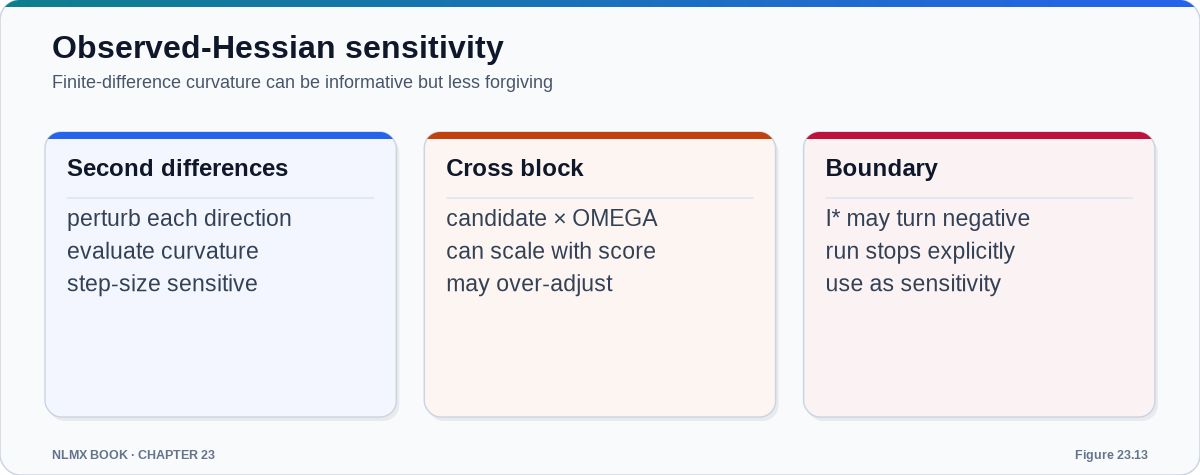
Observed curvature is sensitive to finite-difference scale, conditional-mode precision, boundaries, and parameter scaling. In the frozen implementation, the candidate–OMEGA cross term can be proportional to the candidate score; when a covariate explains a large fraction of ETA variability, nuisance subtraction may remove more information than the candidate block contains. Efficient information then becomes negative rather than positive semidefinite.
The preserved Chapter 23 run illustrates the guardrail. The observed estimator produced strong early statistics and selected four relationships during forward search, but a backward V–WT evaluation had minimum efficient-information eigenvalue about −1349 and an adjustment of 264.8%. nlmx exited with numerical code 9 and retained the transcript. It did not manufacture a p-value by hiding the negative direction.
Treat such a failure as information about the approximation. Compare OPG, step-size sensitivity, candidate-only diagnostics, and likelihood refits. Do not report the successful early observed-Hessian steps as though the failed path completed.
What the preserved failure teaches
The failed sensitivity selected V–SEX before the negative-information error, even though SEX has no simulated effect. That partial path must not be interpreted as an observed-Hessian discovery; the same curvature behavior that made early statistics extreme also destabilized backward conditioning. The correct record is “sensitivity analysis non-estimable under these settings.” A follow-up can examine OPG, larger finite-difference steps, and individual refits, but each is a new analysis with its own command and directory. This example is deliberately retained because suppressing unsuccessful alternatives would give users an unrealistically clean picture of numerical method comparison.
Common mistakes
- Assuming observed information is intrinsically more accurate than OPG.
- Ignoring a negative efficient eigenvalue.
- Reporting partial classifications from a failed run.
- Increasing ridge until the desired p-value appears.
- Replacing the primary estimator after seeing results.
Checklist
- Run observed information only as a prespecified sensitivity where appropriate.
- Inspect curvature, eigenvalues, and adjustment fraction.
- Preserve failure logs and exit codes.
- Compare with OPG and refit evidence.
- State clearly when a sensitivity path is non-estimable.
Further reading
Open the txtpreserved failure command, then read finite differences and troubleshooting.