Running posterior stability selection
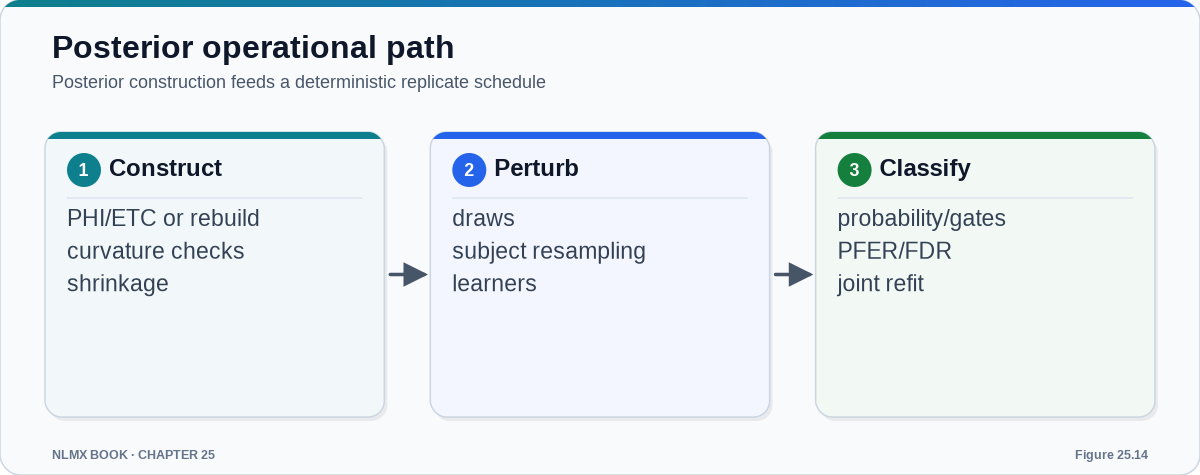
Use nlmx cov --method posterior to reconstruct/ingest subject posteriors, build ETA-targeted features, schedule posterior draws and subject resamples, fit the requested learners, apply stability and error-control gates, and jointly refit retained relationships. The seed and schedule determine reproducible unit-indexed random streams.
Major controls cover posterior source/response/draw method, resampling method/replicates/fraction/strata, draws per resample, base-parameter draws, learner set/primary learner/CV folds, retention/uncertainty/sign thresholds, maximum features, variance consistency, PFER/FDR settings, checkpoint interval, and optional detailed outputs. --no-checkpoint removes recovery and should be exceptional for long runs.
Selection probabilities are frequencies under this configured perturbation design, not posterior probabilities of biological truth. Review failed fits, source/curvature diagnostics, shrinkage, probability intervals, sign/form/agreement gates, PFER attainability, correlated-cluster switching, and the final refit before interpretation.
Common mistakes
- Changing the scientific question after seeing the result while presenting it as the original run.
- Reading one engine's summary without checking its prerequisites, failures, normalized settings, and fitted endpoint.
- Treating a generated draft, comparison label, or completed checkpoint as a substitute for model diagnostics and reference-software confirmation.
Page checklist
- The exact command, version, inputs, resolved settings, and output directory are identifiable.
- Engine-specific evidence is interpreted on its own scale before cross-method comparison.
- Recovery state, final refit, diagnostics, and remaining confirmation work are explicit.