18.5 Residual error and SIGMA
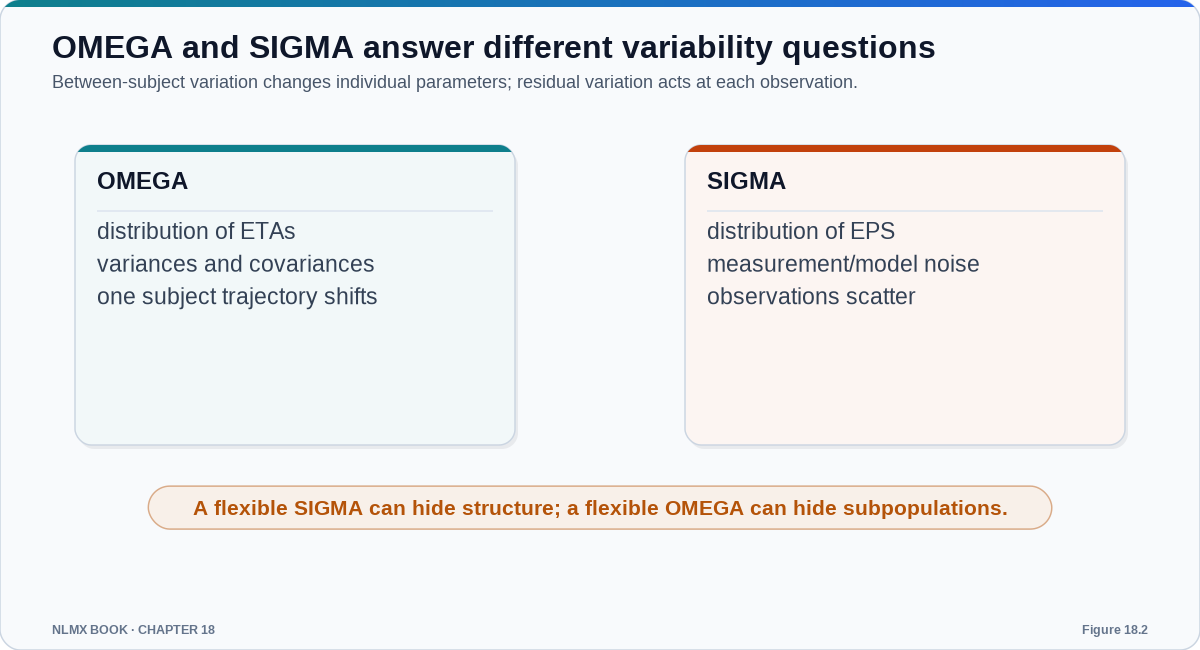
Residual error describes the distribution of an observation conditional on the individual trajectory. Let \(Y(\varepsilon)\) be the $ERROR expression and \(h=\partial Y/\partial\varepsilon\) at EPS zero. nlmx computes the Gaussian residual variance as \(V=h^{\mathsf T}\Sigma h\), allowing additive, proportional, combined, correlated, and more general coded error models.
For Y=IPRED+EPS(1), \(V=\sigma_{11}\). For Y=IPRED*(1+EPS(1)), \(V=IPRED^2\sigma_{11}\). A combined model with independent EPS terms adds the two variance contributions. If residual variance depends on ETA through IPRED, FOCE-I evaluates it at the conditional mode; FOCE holds it at ETA zero. This is the “interaction.”
SIGMA diagonals are variances. A proportional error initialized as 0.04 corresponds to residual SD 0.2, often described as roughly 20% under the linear proportional form. Transform-both-sides or log-scale models have different interpretations and likelihood constants.
Residual error absorbs assay noise, recording variation and remaining model discrepancy. It should not be stretched to hide wrong doses, omitted distribution, or time-dependent bias. A proportional-only model at zero prediction can yield zero variance and an invalid likelihood; combined error or explicit record handling may be needed.
Practical interpretation
Evaluate the coded error model at predictions of 0, 0.1, 1, 10 and 100. Tabulate variance and SD. This quickly reveals whether error is constant, proportional or combined and whether zero creates a singular case. Repeat at two ETA values. If variance changes, FOCE and FOCE-I are solving meaningfully different conditional problems. Keep this small table in the model-review record.
Common mistakes
Do not confuse a SIGMA variance with an SD, compare OFV across different DV transformations without accounting for likelihood, or call residual error purely measurement error. Multiple EPS terms may be correlated when SIGMA is a block.
Checklist
- Write \(Y(\varepsilon)\), its derivative, and resulting variance.
- State the analysis scale and units.
- Check whether variance depends on ETA.
- Inspect zero-prediction and censored cases.
- Keep residual assumptions aligned across software.
Further reading
See FOCE-I, F_FLAG likelihoods, and Chapter 21 diagnostics.