27.9 pcVPC lower bound and log-transformed data
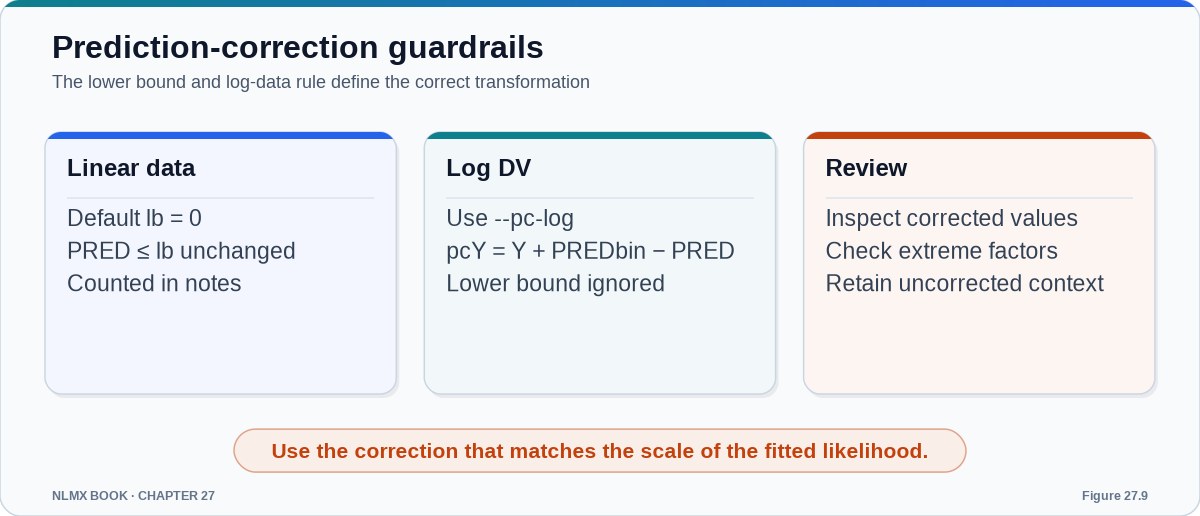
The ordinary pcVPC lower bound defaults to zero. Records with PRED at or below that bound are left uncorrected and counted in the notes, preventing division by a nonpositive denominator. For a model fitted to log DV with additive error, use --pc-log, which applies pcY = Y + PREDbin - PRED on the log scale.
Novice translation
This topic changes three practical decisions in a predictive-check review. First, a supplied --pc-lower-bound should represent a real lower support for the analysed scale, not a plotting convenience. Second, with --pc-log, every real log value is valid and the lower-bound option is ignored with a warning. Third, prediction correction does not change the initial BLQ classification; censoring is determined from uncorrected values. Keep those decisions separate: one defines what is simulated or summarised, another controls how evidence is displayed, and the last controls what conclusion the evidence can support. A reviewer should be able to reproduce each decision from the resolved settings and numerical tables, not infer it from the appearance of the figure.
What to understand
- A supplied
--pc-lower-boundshould represent a real lower support for the analysed scale, not a plotting convenience. - With
--pc-log, every real log value is valid and the lower-bound option is ignored with a warning. - Prediction correction does not change the initial BLQ classification; censoring is determined from uncorrected values.
Practical interpretation
Document whether reported axes show raw, prediction-corrected, or log-scale values and how readers could recover the original clinical scale.
Evidence to retain
For pcvpc lower bound and log-transformed data, retain the issued command, vpc_settings.vpc, the source model/data/result identifiers, seed and replicate count, the relevant CSV/JSON fields, warnings and notes, and the exact figure used for interpretation. Record any sensitivity run that changed the conclusion. If an option was selected after seeing the data, label that analysis exploratory. This evidence separates a reproducible diagnostic decision from a visual impression and lets another pharmacometrician check counts, transformations, exclusions, and uncertainty assumptions.
Common mistakes
- Using multiplicative correction on log DV
- Hiding uncorrected records
- Choosing a lower bound without scientific meaning
Page checklist
- Match correction to likelihood scale
- Read correction notes
- Check support assumptions
- Label axes clearly
Further reading
See previous page, next page, complete VPC command and settings index.