17.32 Worked example: saturable elimination and TMDD
The nonlinear teaching dataset contains 30 IV-bolus subjects, 300 observations, and three dose levels (10, 100, and 1000). It compares 1cmt_noabs, 1cmt_noabs_mm, and 1cmt_noabs_tmdd. Dose-normalized AUC analysis reports a slope of 0.62 with strong evidence that exposure rises more than proportionally, motivating nonlinear elimination candidates.
The linear candidate has OFV 670.74 and BICc 695.75. MM improves OFV to 210.84 and BICc to 247.26, converges, completes covariance, has maximum structural RSE about 4.2%, and is eligible. QSS improves raw OFV further to 75.09 and BICc to 117.21, but it does not converge and has a condition number about 24,045; it is ineligible.
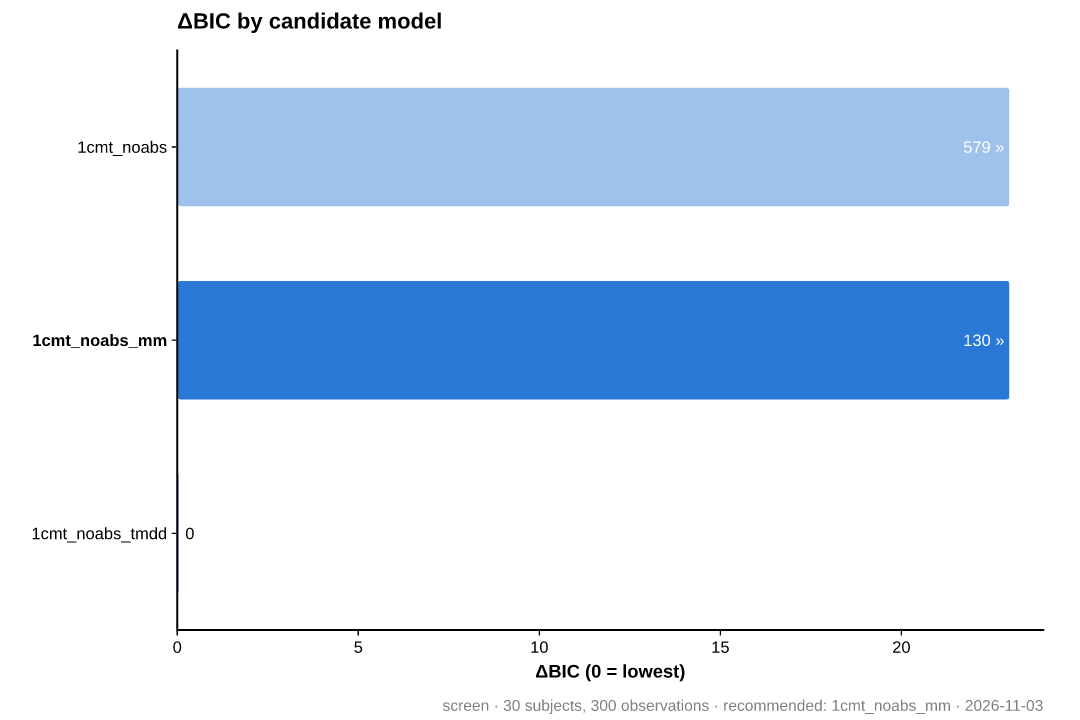
The recommendation is therefore MM, not the lowest-BIC row. The summary explicitly states that QSS fits much better numerically but was passed over. This is the desired safety behavior: keep evidence for a potentially important mechanism while refusing to promote an unreliable fit.
Follow-up could use alternative QSS starts, scaling, bounds, sampling diagnostics, richer mechanistic data, or a planned simulation-based identifiability assessment. If QSS becomes reliable, repeat the full comparison under documented settings. Do not simply copy the lowest intermediate objective.
Notice that the LRT table compares linear with MM and linear with QSS, but MM and QSS are not treated as a routine nested pair. The final BIC ranking would favor QSS numerically; eligibility reverses the operational recommendation. Both facts belong in any report of this example.
Common mistakes
Do not call the dose-proportionality slope proof of TMDD, ignore dose-group confounding, or report the QSS parameter estimates from a nonconverged fit as biological quantities.
Checklist
- Confirm dose range and group comparability.
- Reproduce the proportionality summary.
- Check convergence before BIC ordering.
- Preserve the passed-over QSS rationale.
- Plan targeted mechanistic/identifiability follow-up.
Further reading
Open the txtnonlinear summary and review nonlinear candidates.