41.10 Case 3: where should the fit start?
What you will learn
- Read an
autoinitreport: three estimation routes (NCA, NLS, ML), the recommended value, the between-subject variance and the NONMEM-ready block.- See why agreement of the three routes is itself evidence that the starting values are sensible.
- Spot the three traps the program warns about: biexponential data, sparse data and mismatched units.
- Paste the generated block into a control stream and know what to check first.
Prerequisites: Chapter 16, initial estimates from the data alone.
The question: where should the estimation start?
The evidence: the Chapter 16 bundle oral_one_compartment (24 subjects, 100 mg orally, 240 observations, 10 samples over 0.25–48 h), plus the reports of the five other Chapter 16 bundles for the traps.
Why starting values matter
An estimation algorithm moves from a starting point toward a minimum. Start close, and it takes a few steps; start far, and it may converge to a different minimum, to a boundary, or not at all. The starting values are not an input you may leave to chance. autoinit derives them from the data in three independent ways, so that if the three agree, you have a start the data themselves support.
Three routes
| Route | What it does | Strength | Weakness |
|---|---|---|---|
| NCA | non-compartmental estimates per subject (CL/F = dose/AUCinf, V/F from λz), then a summary | assumption-free | needs a usable terminal phase |
| NLS | a nonlinear least-squares fit of the model to each subject's profile | uses all points; gives KA | needs enough points per subject |
| ML | a likelihood-based fit across subjects | works for sparse data; gives ω² | heavier |
The recommended value is the geometric mean of the three, and the between-subject variance (OMEGA) comes from the ML route, corrected for shrinkage.
The numbers
param      NCA        NLS         ML   recommended   OMEGA   CV%
CL       3.046      3.032      3.051        3.043   0.0309    18
V        40.65      40.42     40.798       40.622   0.0172    13
KA        1.54      1.421      1.438        1.465   0.0238    16
ALAG         0          –          –            0        –     –   no lag needed (0% of oral subjects show one)
F1           –          –          –            1        –     –   fix F1 = 1: CL and V are apparent, CL/F and V/F
residual error: proportional 0.03 (CV), additive 0.0305 (SD); corr(CL, V) = -0.10
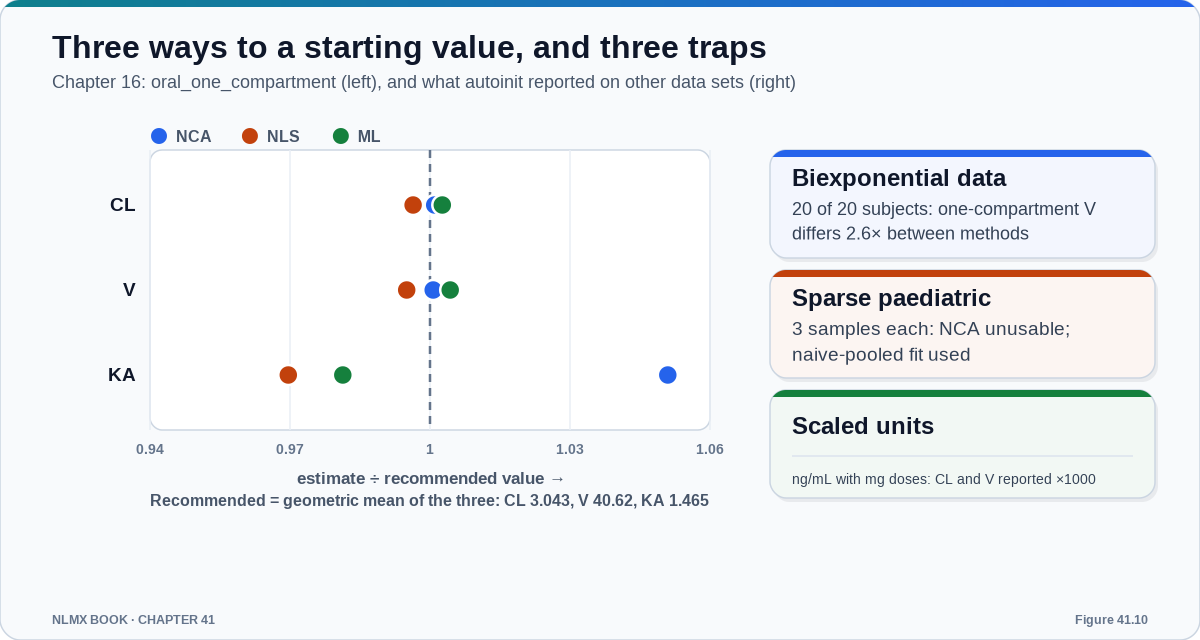
The figure plots each route's value divided by the recommended value. For CL and V the three routes agree within ±0.5 %; for KA they spread from −3 % to +5 % (1.54, 1.42, 1.44 against 1.465). That ordering is the usual one: clearance and volume are determined by the whole profile, while the absorption rate depends on a few early samples and is the least certain parameter of an oral model. A starting value for KA that is 5 % off is irrelevant to a fit; one that is 5-fold off is not, and the three-way spread tells you which situation you are in.
The other things in the report
- No lag. "0 % of oral subjects show one" is the program's check on whether the data need an absorption lag time. ALAG is therefore set to zero, not estimated.
- F1 = 1. Without intravenous data, bioavailability cannot be separated from clearance and volume, so the oral model is fitted with F = 1 and its CL and V are apparent. This is the same statement as in the NCA case (page 41.6).
- Two- and three-compartment starting values (V1, Q, V2, Q3, V3) are listed even for this one-compartment data set. They are rules of thumb, not estimates: V1 = 0.4 V, V2 = 0.6 V, Q = CL, Q3 = Q/2, V3 = V2. They exist so that a later structural screen has somewhere to start; do not read them as findings.
- The corr(CL, V) = −0.10 says there is no reason, from the individual estimates, to give CL and V a joint random effect. Another bundle in this chapter reports r = 0.97 and advises a block, which the next page shows.
The block to paste
init_blocks.txt holds the starting values as NONMEM-style records, ready to place in a control stream, for 1-, 2- and 3-compartment models:
$THETA
(0, 3.0434) ; CL (clearance)
(0, 40.622) ; V (central volume)
(0, 1.4651) ; KA (absorption rate)
(0, 3.0000E-2) ; proportional error (CV)
(0, 3.0503E-2) ; additive error (SD)
$OMEGA
3.0853E-2 ; IIV CL (CV 18%)
1.7206E-2 ; IIV V (CV 13%)
2.3790E-2 ; IIV KA (CV 16%)
Its first line says "check them against the data first", and that is the working instruction. Compare CL with dose/AUC, the volume with what you know of the drug, and the OMEGA with your expectation of between-subject variability. The block is a starting point, not a model.
Three traps in other bundles
| Bundle | What autoinit reported | What it means |
|---|---|---|
iv_two_compartment |
20 of 20 subjects "clearly biexponential"; V differs 2.6-fold between methods (NCA 114, NLS 43.4); the program recommends V1 = 20.4, Q = 6.08, V2 = 61.1 | A one-compartment V is meaningless for biexponential data; the methods disagree because the model is wrong. The disagreement is the signal |
sparse_pediatric |
40 subjects with 3 samples each: 0 of 40 have a usable terminal phase and 0 of 40 can be fitted individually, so NCA is not used and typical values come from a naive-pooled fit; the residual proportional error is 0.41 | Sparse data cannot support per-subject routes; estimates are rougher, and the report says so |
scaled_units |
Doses in mg, concentrations in ng/mL | The program warns that CL and V are 1000 times the values implied by dose/concentration, and advises dividing V by 1000 (volumes in L). A units mismatch looks like a model problem |
Two further bundles show how a design is summarised. iv_oral_crossover (16 subjects, 320 observations) derives F1 = 0.597 from the IV and oral doses by NCA, and NLS and ML then use that value for the oral doses; and mixed_regimens (12 single-dose rich plus 12 steady-state sparse subjects) gives one set of estimates from both groups while each subject keeps its own regimen.
The decision
| Question | Evidence | Decision | Reversible? |
|---|---|---|---|
| Where does the one-compartment oral fit start? | initial_estimates.csv: three routes agree to ±0.5 % on CL and V, ±5 % on KA |
Start at CL 3.04, V 40.6, KA 1.47, no lag, F fixed at 1 | yes |
| Is one compartment enough? | no biexponential warning; corr(CL, V) −0.10 | Provisionally yes; test in the structural screen (41.11) | yes |
What this case does not show
autoinit is a start, not a verdict on structure. A wrong structure produces good-looking starts that the fit then rejects; the cure is the screen of the next page, and the final judge is the fit's own diagnostics (Chapter 21).
Review checklist
- Do the three routes agree? If not, which one is the outlier and why?
- Did you fix F1 only when there is no IV data?
- Are your doses and concentrations in units that give the volume you expect?
- Did you read the Notes section before pasting the block?
Navigation
See the previous page, the next page and the complete case-study reference.