36.29 Shared method, approximation, retry, and threads options
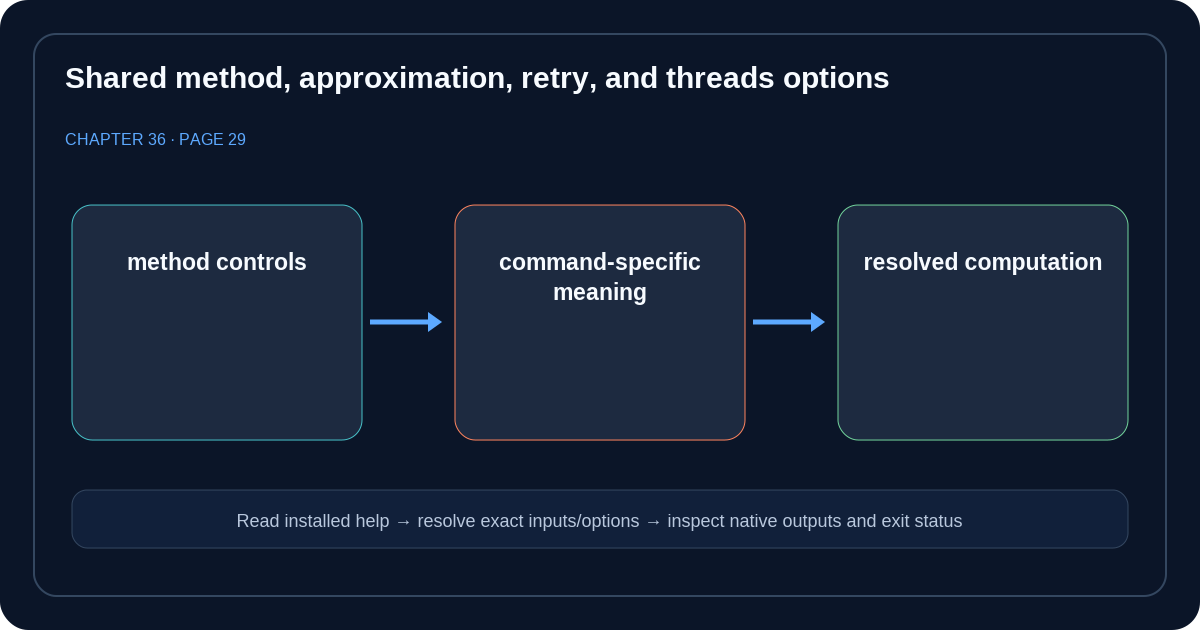
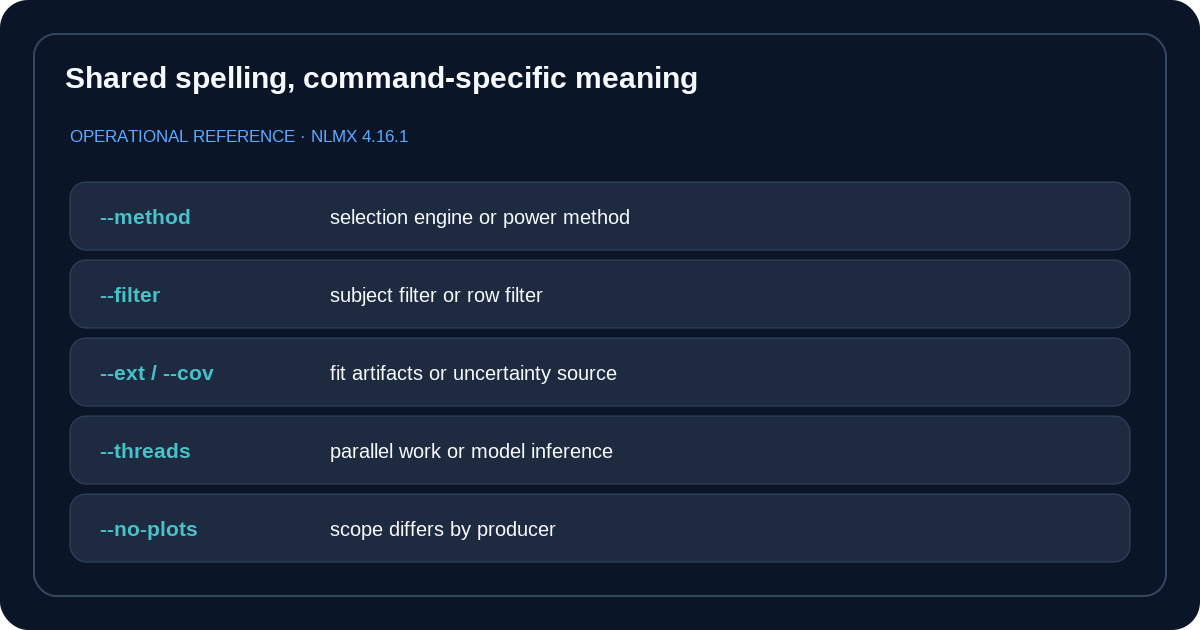
This chapter is a lookup reference for nlmx 4.16.1. Option tables are generated from the installed release executable. Read an option in the context of the command page: nlmx uses a global parser, but an accepted option can be irrelevant to a command unless its help text names that command or the command's method chapter defines the behavior.
The safe sequence is: identify the installed version, open that command's help, freeze input/settings/output paths, run into a new or empty output directory, inspect both the process status and the command-native verdict, and retain the log/resolved settings/checksums. A command line is reproducible only when its referenced files and software version are also frozen.
The same option name can mean different decisions
--method selects the covariate engine for cov but SSE/FIM mode for power; read the command's accepted values. --approximation chooses likelihood treatment for fitting/screening and can affect validation comparisons. --retry belongs to fit recovery and can materially change optimizer controls or approximation. --threads controls parallel analytical work for most commands, but in ask it controls embedded-model CPU inference.
Defaults should be made explicit in regulated scripts when a release change could alter behavior. Do not copy an option from another command merely because the parser accepts it. Check the installed command help and the resolved settings. When comparing runs, change one method control at a time and state whether the comparison is algorithmic sensitivity, recovery from failure, or a planned primary analysis.
Approximation names are normalized spellings (fo, foce, foce-i, laplace, and supported SAEM contexts). The control stream can supply an estimation method, while command-line values can override it. Record both the source and resolved approximation.
Novice review checklist
- Can you identify the exact installed nlmx version and canonical command?
- Are positional inputs, named options, settings, and output paths unambiguous?
- Did you distinguish parser acceptance from command-specific meaning?
- Will the run preserve enough native evidence to determine semantic success?
- Is a qualified human decision required after the software completes?
Navigation
See the previous page, next page, and complete command index.