23.35 Worked frozen run, interpreted line by line
The teaching model has 60 subjects and 480 oral PK observations. Truth is CL–WT exponent 0.75, CL–EGFR 0.55, V–WT 1.0, and no SEX effects. The base FOCE-I model omits covariates.
nlmx cov --model-dir documents/ch22/results/base_fit --run-stem run22 `
  --covariates "CL=WT,EGFR,SEX;V=WT,SEX" --method frozen `
  --refine 5 --write-subject-scores --write-matrices `
  --seed 23048 --output documents/ch23/results/refined
Input reconciliation found 60 subjects, three covariates, five relationships, six frozen nuisance parameters, and a .cov condition number of 6.038e4. The reconstructed base OFV was −1082.5614 and stationarity was approximately zero on six degrees of freedom.
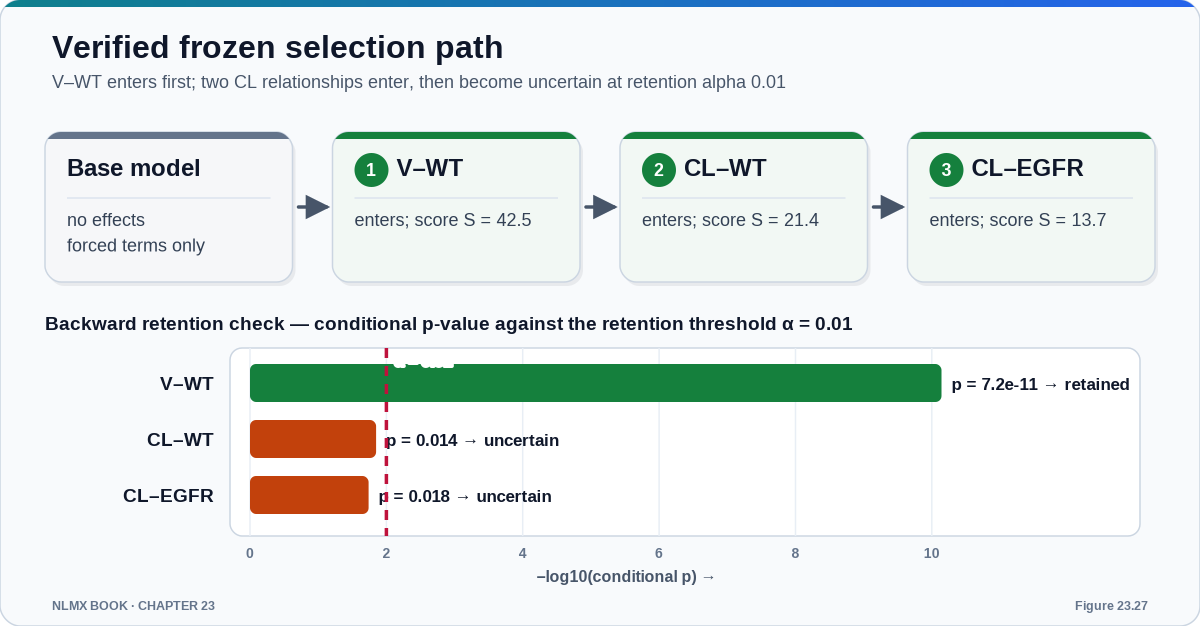
Univariate efficient statistics were 42.464 for V–WT, 21.433 for CL–WT, 13.727 for CL–EGFR, and near zero for both SEX effects. Forward selection added V–WT, CL–WT, then CL–EGFR. Backward retention at 0.01 dropped the two CL effects at p 0.0142 and 0.0182, classifying them uncertain. V–WT remained retained.
Refinement confirmed all three true effects by one-candidate likelihood refits and both null effects as null. The final retained-set refit contained V–WT exponent 0.9975 and OFV −1123.325. SCM from Chapter 22 retained all three true effects jointly, showing why uncertain relationships need escalation.
Candidate-only information retained the three true effects but is not the primary nuisance-adjusted test. Exact uncertainty preserved classifications. The observed-Hessian sensitivity failed explicitly on negative efficient information.
Common mistakes
- Comparing only final classifications and ignoring the trace.
- Calling the CL effects rejected despite strong/refit evidence.
- Reporting one-step 1.433 instead of final V–WT 0.9975.
- Treating candidate-only results as superior because they match truth.
- Generalizing accuracy from this single simulated dataset.
Checklist
- Reproduce command, inputs, version, and seed.
- Follow base, univariate, forward, backward, uncertainty, refine, and final stages.
- Compare estimates with known truth cautiously.
- Preserve successful and failed sensitivity bundles.
- Confirm conclusions in broader simulations.
Further reading
Open the refined report, csvcomparison CSV, and jsonvariant summary.