23.6 Subject-level likelihood and score contributions
Population log likelihood is a sum over independent subjects. If ℓᵢ is subject i's contribution, the candidate score is Uβ = Σᵢ ∂ℓᵢ/∂β. Keeping the individual contributions instead of only their sum enables OPG information, influence review, subject-level permutation, and diagnosis of evidence driven by a few participants.
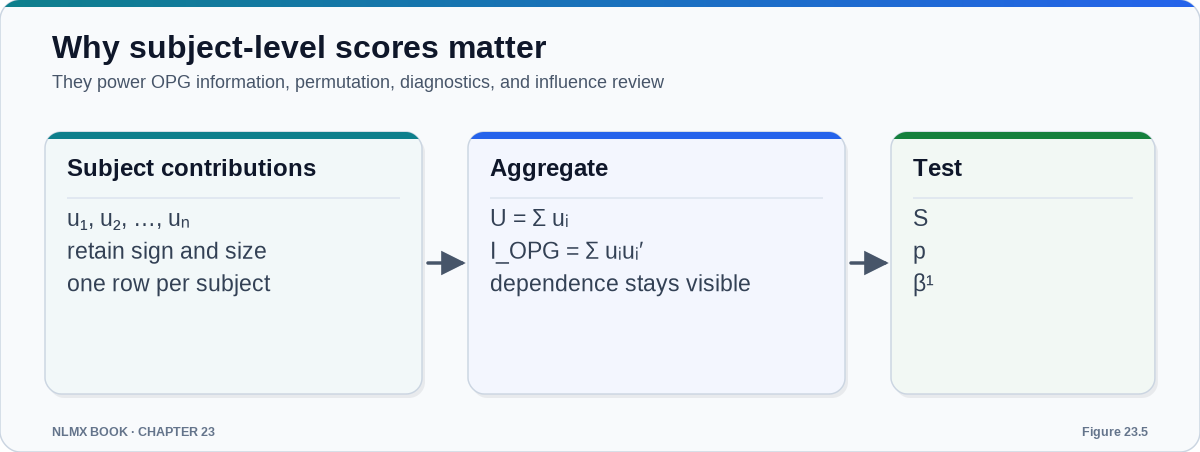
For a baseline candidate whose design value is xᵢ, nlmx can reuse a target score and form a contribution proportional to xᵢsᵢt. Time-varying covariates are evaluated by record in the frozen engine, so the simple subject-constant description becomes an accumulated record-sensitive derivative. Multi-column categorical or spline candidates produce a vector contribution per subject.
--write-subject-scores writes the available objective and score pieces. Subject IDs are hashed by default; --keep-subject-ids should be used only when governance permits. Examine the distribution, signs, and largest absolute contributions. A strong total score formed by one unusual subject is different evidence from a consistent score distributed across the population, even when the asymptotic statistic matches.
Subject scores are sensitive data-derived artifacts. Archive them with the same controls as model outputs and avoid distributing unmasked identifiers.
Common mistakes
- Treating observation rows as independent subjects.
- Assuming every subject contributes equally.
- Sharing identifiable subject-score files unnecessarily.
- Deleting subject evidence needed to explain a surprising statistic.
- Interpreting influence as automatic grounds for exclusion.
Checklist
- Confirm the number of independent subjects.
- Inspect the largest positive and negative contributions.
- Relate influential scores to data quality and design support.
- Preserve privacy defaults.
- Reassess evidence with justified influence sensitivity analyses.
Further reading
Continue to the candidate score, OPG information, and permutation calibration.