31.9 Arms and allocation modes
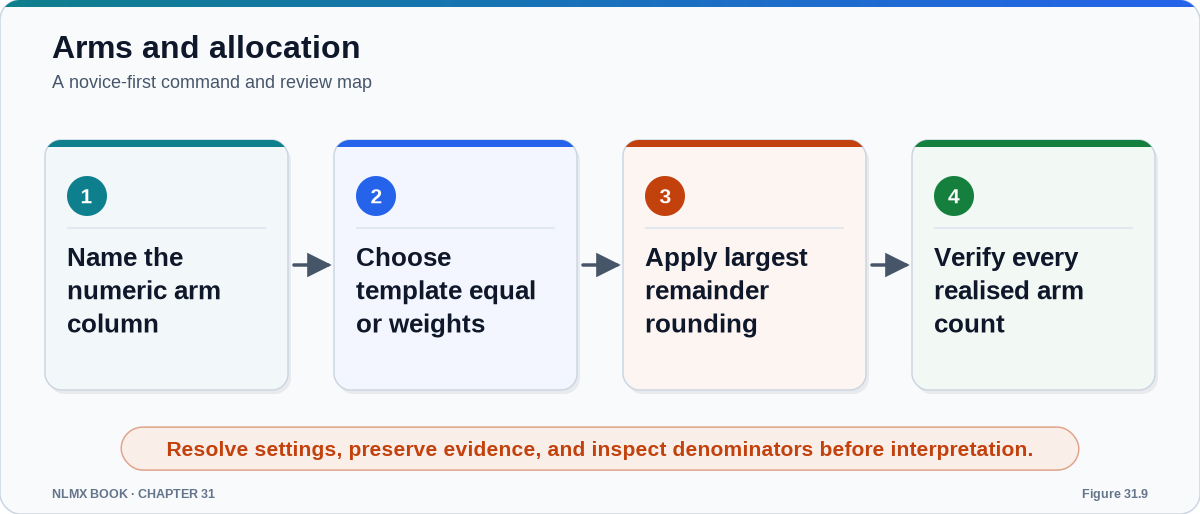
--arm-col names a numeric $INPUT column whose ascending levels define arms. template preserves template proportions, equal uses equal weights, and weights uses --arm-weights. Largest-remainder rounding makes counts sum exactly to N.
What the controls mean
- Without an arm column the dataset is one arm.
- Weights must be positive and one value must exist per realised level.
- Supplying arm weights without
--allocationswitches the default template mode to weights.
The issued command is only the beginning of the audit trail. Always distinguish the reference model, the design template, the resolved scenario, the replicate-specific truth, the fitted result, and the test decision. A value can be correct at one layer and misinterpreted at another.
Command or settings pattern
--arm-col ARM --allocation weights --arm-weights 1,1,2
Command-line values override settings-file values. Use a fresh folder for an analytical run; preserve the command, resolved settings, log, checksums, and row-level data. Defaults are versioned behavior, so a production protocol should state important values explicitly.
Interpretation and quality control
Reconstruct integer counts for every N, confirm no critical arm disappears, and check covariate support within each arm.
For a novice review, first confirm counts and labels, then inspect numerical values, then ask whether the assumptions represent the proposed clinical study. For an expert review, additionally reconcile aggregates from row-level output, reproduce a subset of trials, and compare the implementation with an independent reference where the claim requires it.
Common mistakes
- Ordering weights by labels rather than ascending numeric levels
- Assuming equal allocation is always optimal
- Reporting a point estimate without its denominator, interval, method, and version
Minimum evidence to retain
- nlmx version, command,
.powerfile, resolved settings, seed, threads, and output checksums; - control stream, design dataset, EXT/COV or parameter sets, and their provenance;
- scenario table, replicate rows and failures, method summaries, plots, report, and interpretation;
- prespecified criteria, Monte Carlo target, validation scope, deviations, and reviewer decisions.
Navigation
See the previous page, next page, and complete command and settings index.