17.34 Validation boundaries, selection bias, and known limits
Validate screen as an end-to-end decision system. Candidate generation must match the intended equations and parameterization; data preparation must preserve event history; estimators must reproduce reference likelihoods within declared tolerances; eligibility must classify known failures; ranking must calculate criteria correctly; and outputs must agree across CSV, JSON, text, HTML and control stream.
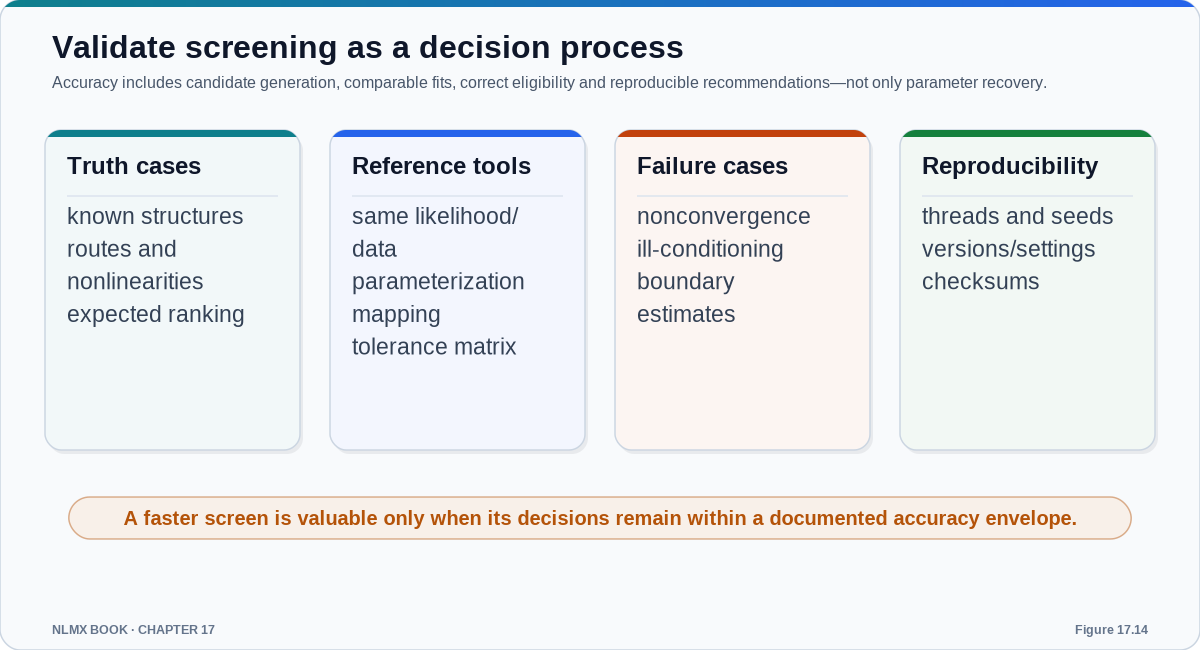
Use known-truth simulations spanning routes, compartment counts, absorption delays, nonlinear elimination, sparse/rich sampling, variability, censoring and repeated dosing. Compare against major pharmacometrics software only after aligning equations, transformations, integration tolerances, approximation, parameter bounds, data and likelihood constants. Report absolute/relative parameter tolerances, OFV tolerance, convergence agreement and decision agreement separately.
Screening many candidates creates selection optimism: the winner’s fit looks better partly because it won. The screen does not adjust inference for the search. Confirmation on held-out information, simulation, bootstrap, external data or prespecified diagnostics may be needed. Automated candidates also cover a bounded library; indirect response, time-varying clearance, complex absorption, mixture models and mechanistic systems may require manual models.
Speed is valuable only inside an accuracy envelope. Benchmark release builds with identical workloads and report hardware, threads, approximation, covariance, plots and fit reports. Never claim universal equivalence from a few successful examples.
Common mistakes
Do not call synthetic examples validation, compare unmatched parameterizations, or define tolerance after seeing discrepancies. A matching winner can hide materially different estimates; matching estimates can hide different failure classification.
Checklist
- Freeze a versioned cross-software test matrix.
- Align data, equations, likelihood and algorithms.
- Test success, failure and boundary cases.
- Validate numeric results and decision logic separately.
- Publish discrepancies and known unsupported structures.
Further reading
Proceed to planned Chapter 18 for estimation theory and Chapter 42 for the full validation framework. Return to the Chapter 17 overview for navigation.