40.22 Measuring speed without sacrificing accuracy
What you will learn
- Define an equal-work benchmark
- Place accuracy gates before timing conclusions
- Report uncertainty, hardware, and failures
Prerequisites: Chapter 39 troubleshooting, Chapter 36 command reference, and Chapter 38 output reference.
This page is scoped to nlmx 4.16.2 and an external-documentation snapshot of 2026-11-10. Product names describe different system boundaries; a blank or “outside role” is not a quality ranking. Treat every migration as a new implementation until model semantics, analysis population, objective definition, numerical behavior, outputs, and decisions have been independently reconciled.
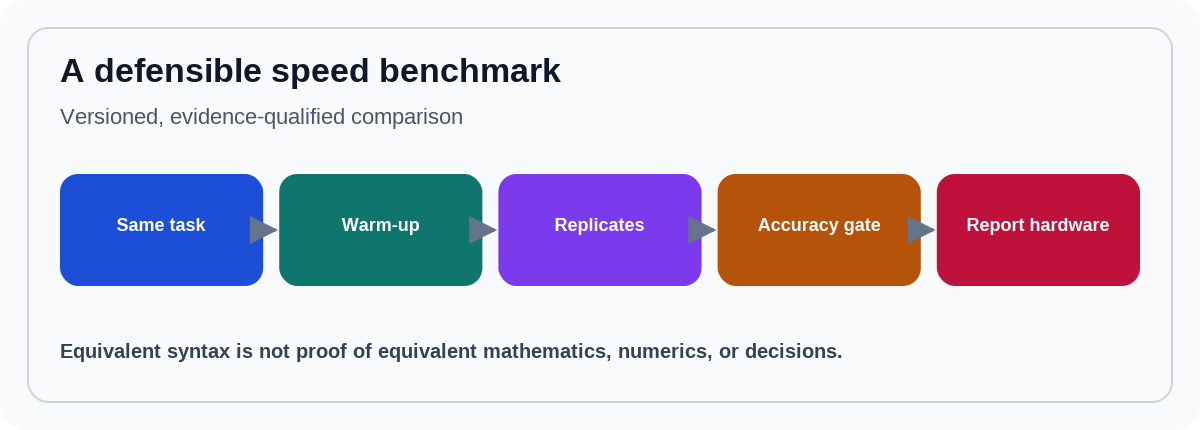
A speed claim is meaningful only after an accuracy/decision gate. Define the same scientific task, input population, model/method, approximation, tolerance, iterations/draws/replicates, output obligations, failure policy, and convergence target. Excluding covariance/plots from one tool or using fewer importance samples is not equal work.
Use controlled hardware: CPU model/count, RAM, OS, power mode, storage, compiler/build flags, product versions/licenses, container/VM, thread/process settings, and background load. Separate cold start, model compilation/parsing, warm run, computation, and output/rendering. Warm up where justified; run multiple randomized-order replicates; report median and dispersion, not the fastest run.
For deterministic fitting require objective/parameter/gradient/covariance acceptance before including a timing. For stochastic workflows require MC precision/operating-characteristic equivalence. Count failed/retried runs and total CPU as well as wall time. Report peak memory and output size where relevant.
Avoid universal extrapolation. State fixture/hardware/task and confidence interval. Scaling claims need multiple subject/observation/ETA sizes. A faster wrong approximation is not an achievement; a faster method with an explicitly different accuracy target is a separate result.
Benchmark result table
For every run store valid/invalid, final accuracy metrics, wall time, CPU time, peak memory, threads/processes, retries, and output obligations. Summarize timing only among runs that pass accuracy. Report both first-run and warmed behavior if parsing/compilation/caching matters. Include the slow failed runs in operational throughput. A useful conclusion is “median 3.2× faster on fixture F after OFV/estimate gates”; “faster” without a gate, denominator, and hardware is not reproducible.
Review checklist
- Are the exact product versions, task boundaries, inputs, methods, and settings named?
- Were semantics and frozen-parameter results aligned before optimized outputs?
- Is the comparison using a method-appropriate deterministic or stochastic tolerance?
- Are unsupported or analogous features described without implying equivalence?
- Can every claim be reproduced from retained primary evidence?
Navigation
See the previous page, next page, and complete comparison reference.