27.12 Choosing VPC, pcVPC, pvcVPC, or NPC
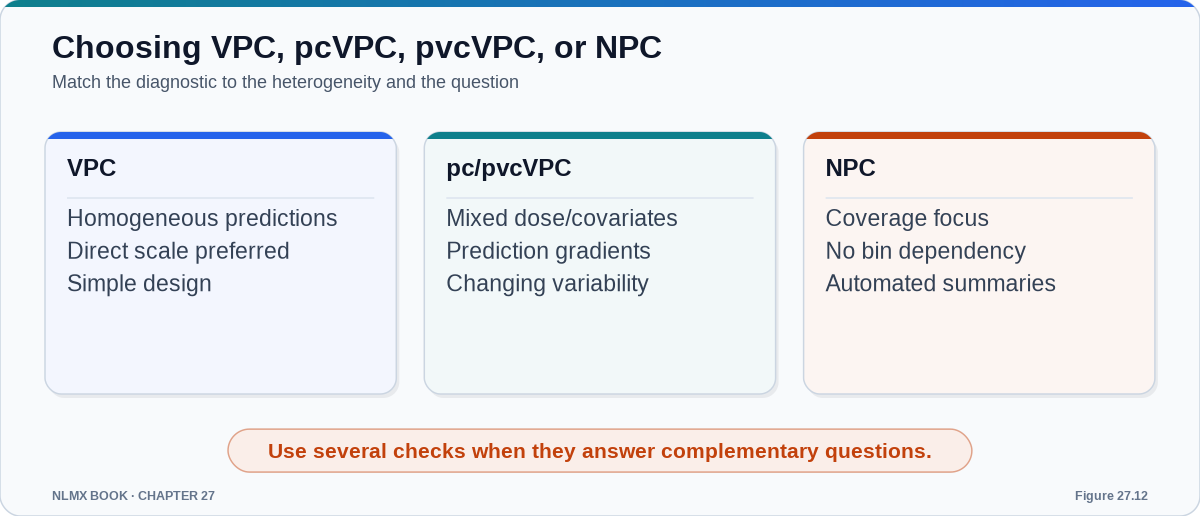
Select a check based on the scientific question and the design. Plain VPC preserves the original scale, pcVPC reduces explained design heterogeneity, pvcVPC additionally standardises changing variability, and NPC tests record-level coverage without binning. These are complementary views, not competitors with one universal winner.
Novice translation
This topic changes three practical decisions in a predictive-check review. First, use pcVPC as a practical default for mixed doses or important covariates, but show plain scale when clinical magnitude matters. Second, use pvcVPC when simulation SD varies substantially within bins and state the transformation prominently. Third, use NPC when coverage is the primary endpoint or when bin choices are contentious; retain a visual check for localisation. Keep those decisions separate: one defines what is simulated or summarised, another controls how evidence is displayed, and the last controls what conclusion the evidence can support. A reviewer should be able to reproduce each decision from the resolved settings and numerical tables, not infer it from the appearance of the figure.
What to understand
- Use pcVPC as a practical default for mixed doses or important covariates, but show plain scale when clinical magnitude matters.
- Use pvcVPC when simulation SD varies substantially within bins and state the transformation prominently.
- Use NPC when coverage is the primary endpoint or when bin choices are contentious; retain a visual check for localisation.
Practical interpretation
Predefine a primary diagnostic and sensitivity checks. Post hoc switching among types until a model looks acceptable weakens the evaluation.
Evidence to retain
For choosing vpc, pcvpc, pvcvpc, or npc, retain the issued command, vpc_settings.vpc, the source model/data/result identifiers, seed and replicate count, the relevant CSV/JSON fields, warnings and notes, and the exact figure used for interpretation. Record any sensitivity run that changed the conclusion. If an option was selected after seeing the data, label that analysis exploratory. This evidence separates a reproducible diagnostic decision from a visual impression and lets another pharmacometrician check counts, transformations, exclusions, and uncertainty assumptions.
Common mistakes
- Choosing after seeing results
- Reporting only the most favorable check
- Equating checks with formal goodness-of-fit tests
Page checklist
- Name primary question
- Choose primary check
- Plan sensitivities
- Report all material results
Further reading
See previous page, next page, complete VPC command and settings index.