22.4 Typical values, covariate-adjusted parameters, and random effects
Separate three quantities. TVP is the typical parameter at the declared reference covariates. The covariate-adjusted typical parameter multiplies TVP by one or more covariate factors. The individual parameter further incorporates ETA, commonly as
P_i = TVP × factor(X_i) × exp(ETA_i)
The covariate effect shifts the center of the population distribution. OMEGA describes remaining unexplained variability around that center. Retaining a covariate should often reduce relevant variability, but the reduction is not guaranteed and should not be forced.
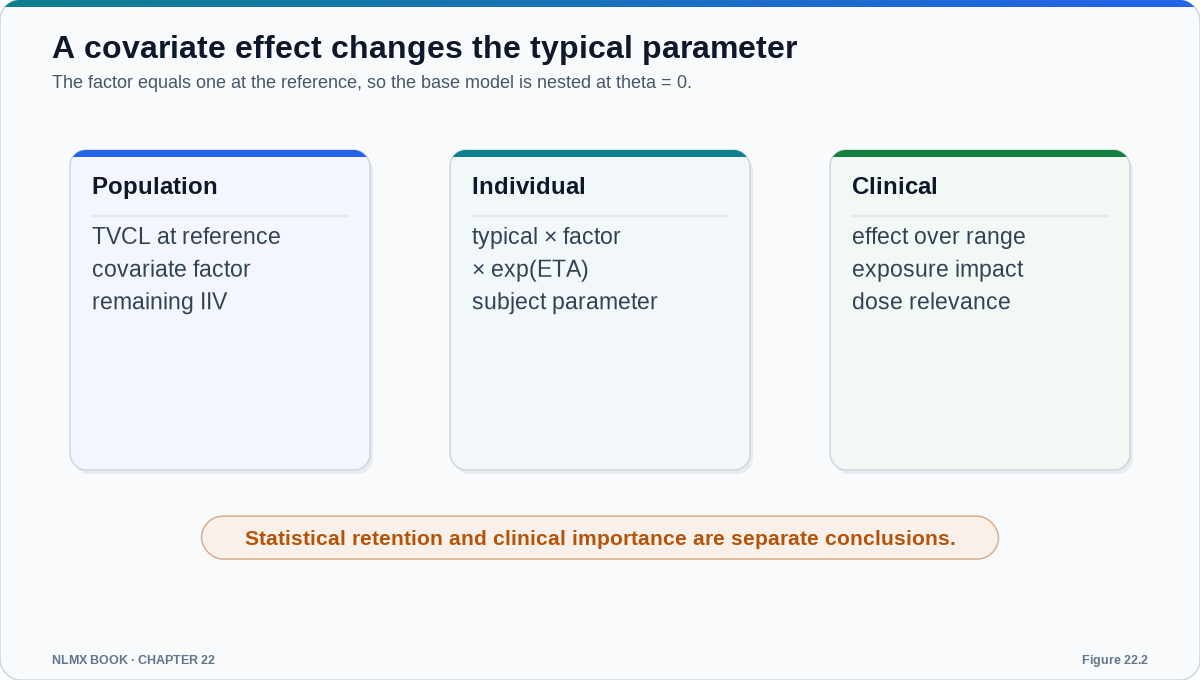
Centering matters. TVCL in a WT model refers to the typical subject at the WT reference and every other reference covariate. Changing the reference usually reparameterizes TVCL without changing fitted predictions, so typical estimates from differently centered models are not directly comparable.
An EBE–covariate trend in the base model can motivate a hypothesis, but EBEs are shrunken and model-dependent. After adding the effect, inspect residual ETA relationships cautiously and review OMEGA, shrinkage, and prediction diagnostics. The goal is not necessarily to make every EBE plot perfectly flat.
Some parameters lack an ETA. The frozen engine can test effects on such parameters when supported; posterior methods rely on subject-level posterior information and have different limits. The effect interpretation still concerns a typical parameter, but individual evidence is weaker or differently represented.
Common mistakes
- Calling TVP an overall population mean without reference context.
- Treating covariate effects as replacements for all IIV.
- Comparing centered typical estimates directly.
- Selecting covariates from EBE plots without shrinkage awareness.
- Assuming every parameter requires an ETA before testing a covariate.
Checklist
- Define TVP at all reference covariates.
- Write the full individual parameter equation.
- Review OMEGA and shrinkage before and after covariates.
- Distinguish EBE hypotheses from population evidence.
- Document method limitations for parameters without ETA.
Further reading
See centering, posterior method, and Chapter 21 shrinkage.