27.2 Prerequisites and final-model readiness
A VPC inherits the strengths and weaknesses of the fitted model. Begin from a converged, scientifically reviewed fit with correct data/event interpretation, plausible parameters, and understood covariance and boundary warnings. Confirm that the final control stream, EXT, dataset, and optional COV belong to the same run family.
Novice translation
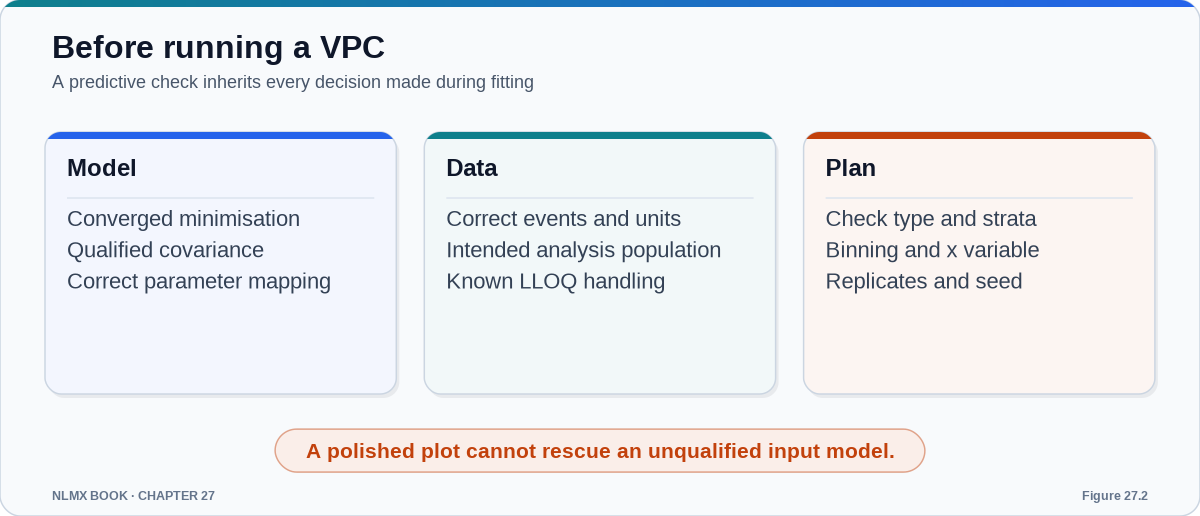
This topic changes three practical decisions in a predictive-check review. First, check minimisation termination, gradients, boundaries, condition numbers, residual diagnostics, and the final control stream. Second, verify dose and concentration units, EVID/MDV/CMT handling, repeated-dose fields, endpoint routing, and the exact analysis population. Third, predefine check type, x variable, bins, strata, LLOQ rule, parameter-uncertainty policy, replicate count, and seed. Keep those decisions separate: one defines what is simulated or summarised, another controls how evidence is displayed, and the last controls what conclusion the evidence can support. A reviewer should be able to reproduce each decision from the resolved settings and numerical tables, not infer it from the appearance of the figure.
What to understand
- Check minimisation termination, gradients, boundaries, condition numbers, residual diagnostics, and the final control stream.
- Verify dose and concentration units, EVID/MDV/CMT handling, repeated-dose fields, endpoint routing, and the exact analysis population.
- Predefine check type, x variable, bins, strata, LLOQ rule, parameter-uncertainty policy, replicate count, and seed.
Practical interpretation
Chapter 27 examples use the fitted Chapter 26 covariate model, not its earlier unconfirmed draft. The fit converged and produced matching EXT and COV artifacts.
Evidence to retain
For prerequisites and final-model readiness, retain the issued command, vpc_settings.vpc, the source model/data/result identifiers, seed and replicate count, the relevant CSV/JSON fields, warnings and notes, and the exact figure used for interpretation. Record any sensitivity run that changed the conclusion. If an option was selected after seeing the data, label that analysis exploratory. This evidence separates a reproducible diagnostic decision from a visual impression and lets another pharmacometrician check counts, transformations, exclusions, and uncertainty assumptions.
Common mistakes
- Running from a draft model
- Mixing EXT/COV files from different runs
- Treating a VPC as a substitute for fit diagnostics
Page checklist
- Freeze control/data/results
- Verify artifact stems
- Review fit warnings
- Document the VPC plan
Further reading
See previous page, next page, complete VPC command and settings index.