22.21 Correlated covariates and redundant signal
Covariates such as EGFR and CRCL, weight and body-surface area, or age and renal function can carry overlapping information. Each may be strongly associated univariately, yet only one remains conditionally when both compete.
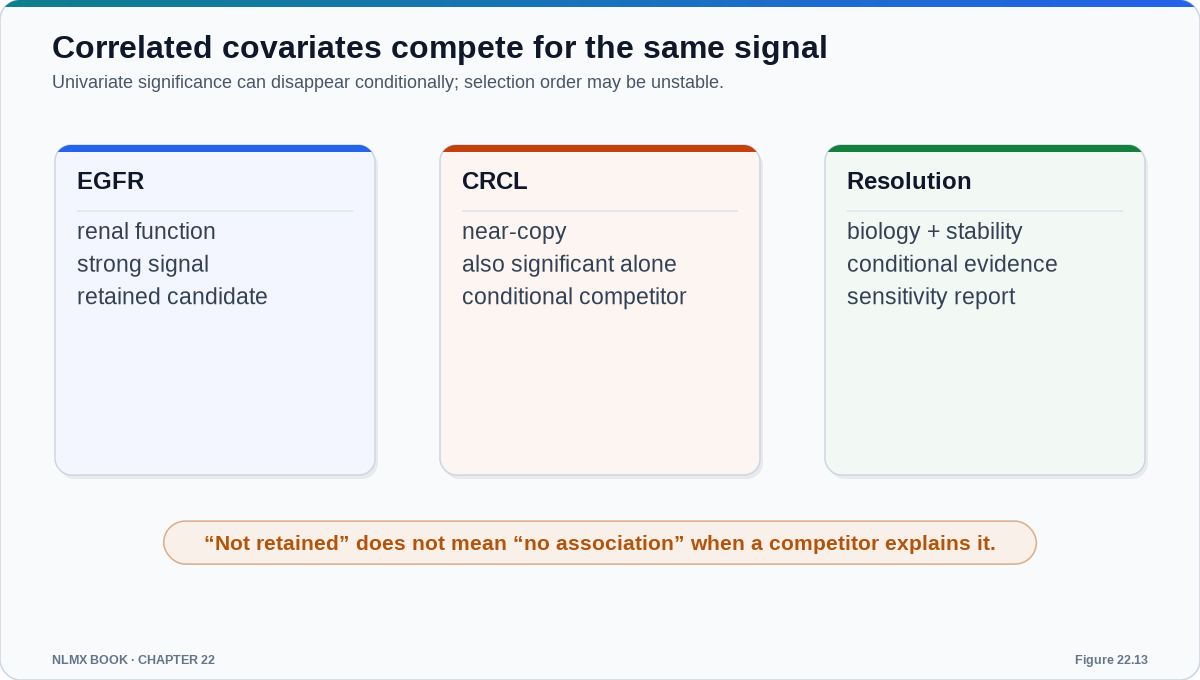
Univariate adjusted p-values describe each pair against the base model. Conditional selection asks what a candidate adds after retained terms. “Not retained” can therefore mean redundant, not absent. The frozen output uses an uncertain classification for significant univariate relationships not kept conditionally, highlighting possible competitors.
Selection order can be unstable when correlations are high. SCM may choose the covariate producing the slightly better refit; posterior stability may split selection probability across alternatives. Use scientific meaning, measurement reliability, availability in intended populations, and clinical implementation—not p-values alone.
Diagnose correlation at subject baseline and within relevant strata. Predefine competition groups or limit simultaneous candidates where appropriate. Sensitivity analyses can replace one competitor with another and compare predictions, coefficient stability, and external transportability.
Avoid including both near-duplicates simply to preserve every significant relationship. Collinearity can inflate uncertainty, distort signs, and make extrapolation fragile.
Interpreting competition between predictors
When WT, body-surface area, creatinine clearance, and EGFR encode overlapping physiology, a strong univariate result for each does not imply four independent mechanisms. Inspect correlations, scatterplots, category cross-tabs, variance inflation, and which subjects distinguish the predictors. Conditional selection can cause one proxy to absorb the shared signal and make another appear unimportant; a different dataset may choose the alternative. Compare clinically motivated representations, consider always_include for a well-established structural relationship, and report near-equivalent candidates. Avoid combining redundant measures merely to improve a fit statistic. The final choice should balance mechanism, transportability, measurement reliability, and numerical identifiability.
Common mistakes
- Calling a conditionally dropped covariate unrelated.
- Selecting whichever competitor enters first without scientific review.
- Keeping near-duplicates and ignoring instability.
- Using raw correlation without considering missingness/strata.
- Reporting one selected proxy as uniquely causal.
Checklist
- Examine correlation, ranges, missingness, and reliability.
- Identify competition groups prospectively.
- Compare conditional and univariate evidence.
- Run replacement sensitivities.
- Choose based on science, transportability, and stability.
Further reading
See scope status, frozen selection, and SCM.