Forward stopping rules and near ties
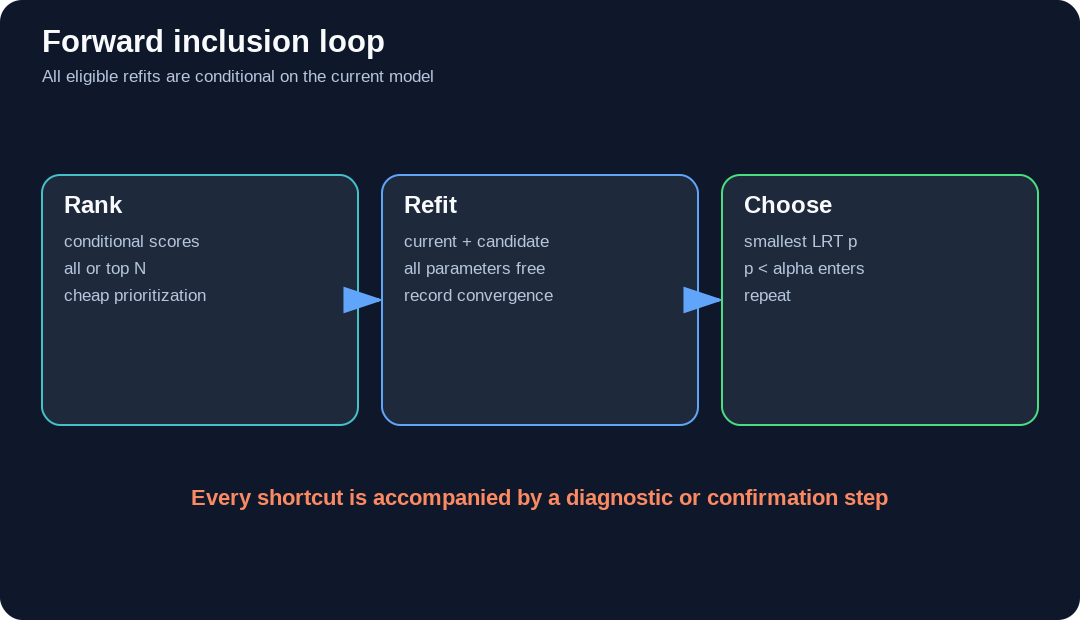
The stage stops when no successfully evaluated candidate has p < alpha. That is an algorithmic endpoint, not proof that no omitted relationship exists. The scope may be incomplete, a capped candidate may not have been refitted, the chosen form may be poor, or a relationship may require another relationship to be present first.
Near ties deserve explicit review. Two candidates with similar conditional p-values may swap order after small numerical, data, or reference-value changes. Because the winner changes the next active model, a small first-step difference can produce a different path. Preserve the complete candidate rows, not only the winning row.
For consequential analyses, rerun with --scm-candidates-per-step 0, examine an alternative direction, and evaluate prespecified threshold or form sensitivities. Report whether the endpoint, coefficients, and clinical conclusions remain stable. Never extend the path manually because a p-value “almost” crossed the chosen alpha.
Common mistakes
- Treating a stepwise p-value as clinical importance or causal proof.
- Reading a candidate comparison without its active model, convergence state, degrees of freedom, and exact threshold.
- Reporting only the terminal relationship list while discarding failed models, path decisions, configuration, and provenance.
Page checklist
- The scientific question, model identities, and comparison direction are explicit.
- Numerical validity is reviewed before interpreting statistical evidence.
- The result is linked to the complete trace and final joint-model diagnostics.