38.15 Posterior-stability, both-engine, and resume outputs
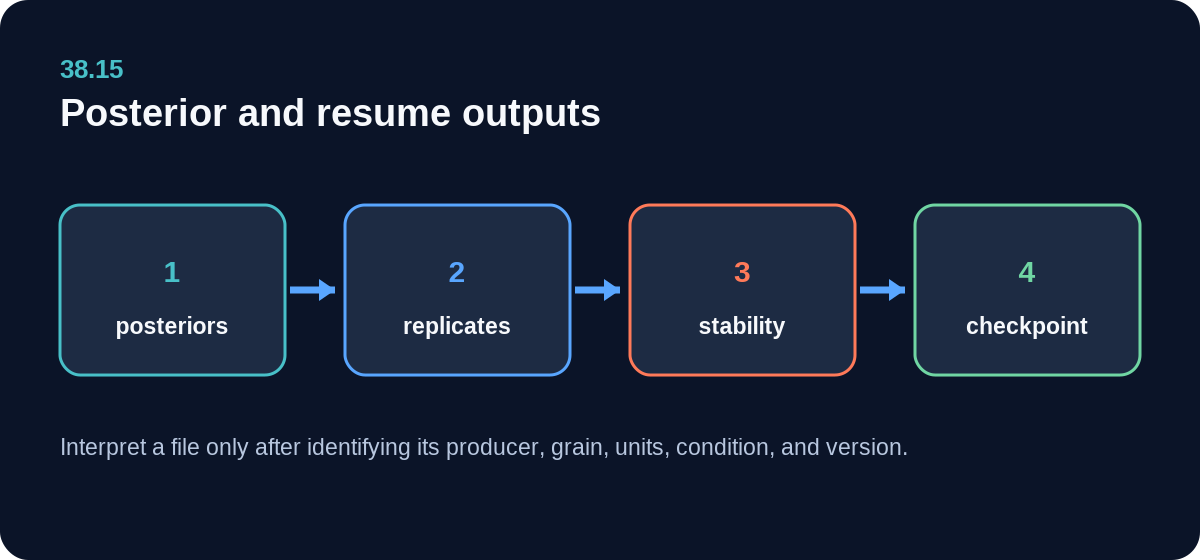
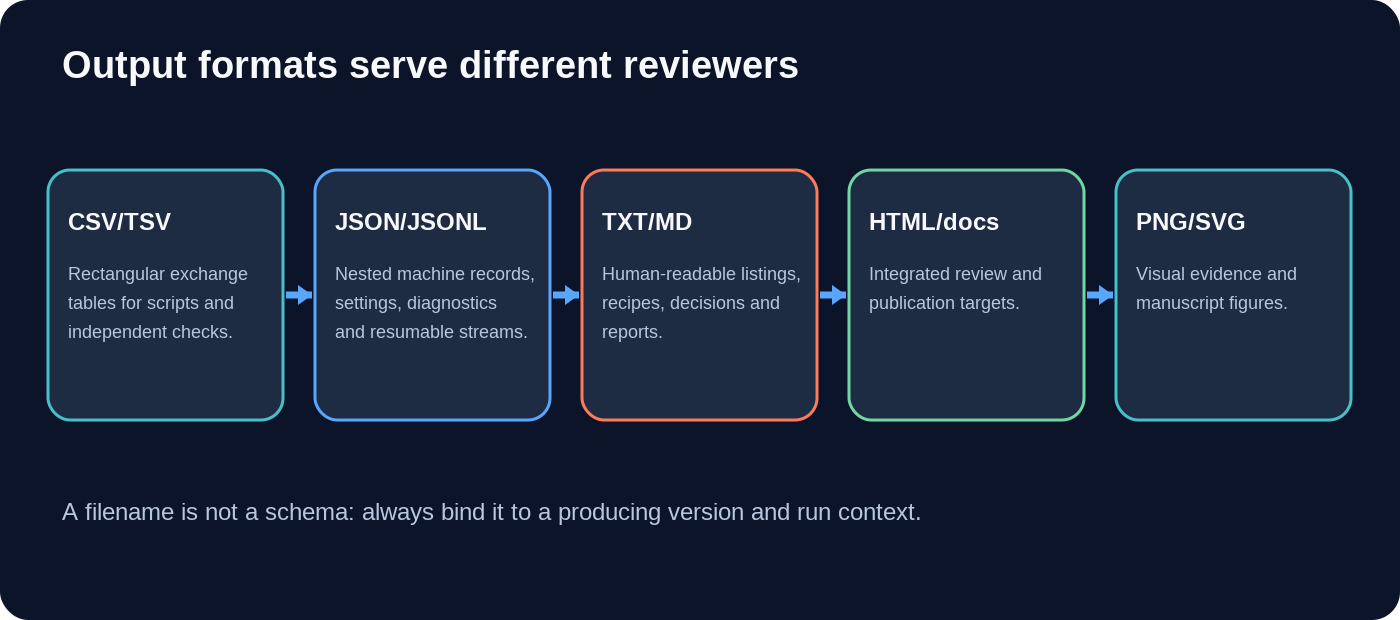
Posterior outputs range from subject posterior reconstruction to large resampling traces and resumable checkpoints. Checkpoints and refit caches are internal continuation evidence, not stable analysis tables. For method = both, the engine subtrees remain authoritative and the comparison table is a concise crosswalk.
Files produced by posterior/cov posterior, cov posterior, cov --method both
The table is a versioned contract for nlmx 4.16.2. “When present” is part of the schema: absence can mean disabled, not applicable, no qualifying rows, an earlier failure, or a defect. Distinguish those states with the summary/log and expected configuration.
| File or pattern | Format | When present | Row/object grain | Purpose | Key fields or structure | Units | Role |
|---|---|---|---|---|---|---|---|
posterior_summary.csv |
CSV | posterior stage completes | one row per subject × ETA summary | posterior means/modes, variances, source, and feasibility | subject,ETA summaries/source/diagnostics | ETA-specific | primary |
shrinkage_summary.csv |
CSV | posterior stage completes | one row per ETA | moment identity and shrinkage | ETA,Var_mean,mean_variance,OMEGA,relative_error,shrinkage | variance and percent/fraction | primary |
feature_registry.csv |
CSV | posterior features built | one row per encoded feature | covariate encoding, centering/scaling, group/cluster, and eligibility | feature,covariate,type,encoding,reference,scale,cluster,status | covariate-specific | primary |
selection_probabilities.csv |
CSV | stability selection runs | one row per equation | selection probability/CI by learner, stability, agreement, cluster, class, and reasons | pair,form,probability,CI,learner probabilities,sign/form stability,agreement,cluster,IIV explained,class,reasons | probabilities/percent | primary |
equations.csv |
CSV | stability selection runs | one row per equation | equation selection/share/pair probability and median/final estimate | pair,type,form,equation,median_estimate,selection_probability,share,pair_probability,sign_stability,IIV_explained,chosen,classification,final_estimate | probabilities; effect scale | primary |
coefficient_stability.csv / form_stability.csv |
CSV | stability selection runs | equation/form summaries | conditional coefficient quantiles and form probabilities | relationship/form and stability summaries | effect scale/probability | primary |
learner_summary.csv / cluster_switching.csv |
CSV | stability selection runs | learner or cluster summary | fits/failures and correlated-feature switching | learner/cluster-specific | counts/probabilities | primary |
replicate_status.csv |
CSV | replicates run | one row per resampling replicate | completion, learner failures, selection count, and timing | replicate,status,completed/failures,selections,seconds | seconds; counts | primary |
checkpoint.json |
JSON | checkpointing enabled before completion | one resumable state | fingerprinted stability state used by resume | analysis hash, settings/input identity, completed replicates, RNG/state | not applicable | checkpoint/cache |
posterior_refits.json |
JSON | final refit attempted | one refit cache | reusable final joint-refit result | fingerprinted refit entries | mixed | checkpoint/cache |
analysis_results.json / retained_relationships.json |
JSON | JSON output enabled | one analysis/retained set | machine-readable classifications, evidence, estimates, and final relationships | nested result objects | mixed | machine summary |
variance_consistency.json / posterior_diagnostics.json |
JSON | posterior checks run | one diagnostic document | OMEGA identity, curvature repair, convergence, source counts, and exclusions | diagnostic-specific | mixed | machine summary |
subject_posteriors.csv / posterior_draws.csv / replicate_selections.csv |
CSV | corresponding write option enabled | subject, draw, or replicate-selection grain | large optional trace tables for independent checks | dynamic ETA/relationship columns | ETA/effect-specific | primary |
frozen/** / posterior/** |
result subtrees | method both | one subtree per engine | complete independent engine outputs | engine-specific | mixed | primary |
comparison.csv / comparison.md |
CSV / Markdown | method both | one row per parameter-covariate relationship | side-by-side frozen and posterior classification/evidence | relationship,frozen_form,frozen_class,frozen_p_raw,frozen_p_adj,frozen_beta,posterior_form,posterior_class,posterior_selection_probability,posterior_coefficient,agreement | p/probability/effect scale | primary |
Reading sequence
- Confirm the command, nlmx version, exit status, output root and settings/CLI overrides.
- Open the text/JSON summary to understand status, warnings, counts and conditional branches.
- Validate the primary table headers and expected row grain before parsing values.
- Reconcile row counts and identifiers across related files.
- Trace important estimates, classifications or decisions to the native model/data evidence.
- Inspect HTML and figures after verifying their source tables.
- Verify checksums and retain the complete tree, including failures relevant to denominators.
Common parsing mistakes
- treating an optional missing file as an empty successful result;
- grouping at subject level when the table is subject-by-occasion, replicate or simulation;
- using displayed text/plot rounding as the analytical value;
- joining dynamic files by row position;
- losing exclusions, failed fits or warnings while copying only the selected result;
- assuming units from a familiar column name rather than the run's data/model/settings;
- parsing a cache/checkpoint as if it were a stable final-results API.
Review questions
- Does every row have a clearly stated grain and candidate primary key?
- Are denominators and failure states retained?
- Are units and transformations traceable?
- Is the file a primary result, reproduction recipe, presentation, or operational state?
- Can a second analyst reproduce the reported value from retained inputs and settings?
Navigation
See the previous page, next page, and complete output reference.