40.19 Migrating a Monolix project
What you will learn
- Translate Mlxtran/project semantics explicitly
- Separate SAEM, likelihood, SE, and diagnostic tasks
- Compare stochastic outputs with suitable uncertainty
Prerequisites: Chapter 39 troubleshooting, Chapter 36 command reference, and Chapter 38 output reference.
This page is scoped to nlmx 4.16.2 and an external-documentation snapshot of 2026-11-10. Product names describe different system boundaries; a blank or “outside role” is not a quality ranking. Treat every migration as a new implementation until model semantics, analysis population, objective definition, numerical behavior, outputs, and decisions have been independently reconciled.
Archive the .mlxtran project/model/data, Monolix version, task settings, seeds/chains, population/individual/conditional-distribution outputs, likelihood method, FIM method, diagnostics, and model-building history. Translate structural, statistical, observation, censoring, covariate, and random-effect models—not GUI labels alone.
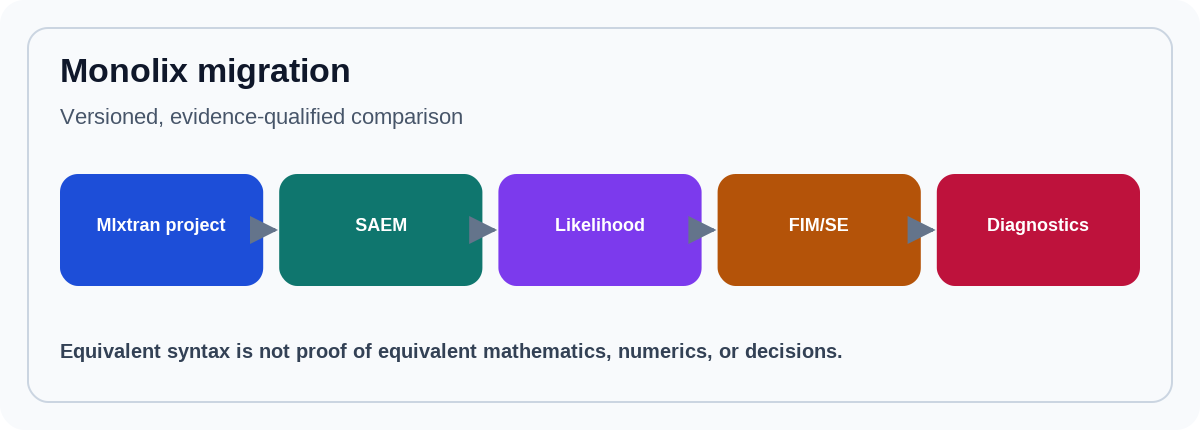
Monolix estimates population parameters with SAEM. Its likelihood is a separate linearization or importance-sampling task; standard errors use linearization or stochastic-approximation FIM. Map nlmx SAEM, IS OFV, and covariance choices accordingly, while acknowledging independent algorithms. Compare prediction/event semantics first, then parameter distributions across seeds, likelihood with MC uncertainty, individual modes/means, covariance on aligned scale, and diagnostics.
For covariate model building, Monolix SCM can be compared to refit SCM after aligning criteria. COSSAC and SAMBA are distinct algorithms, not synonyms for nlmx frozen/posterior engines. Preserve their relationship priority/path and final refits.
Monolix diagnostic/report file layouts and Mlxtran syntax are different; write explicit adapters and validate counts/units. A project that visually looks equivalent in both GUIs/reports is not enough.
Task-by-task mapping
Map Monolix population-parameter estimation to nlmx SAEM, the Monolix likelihood task to nlmx importance-sampling evaluation, conditional modes/distributions to the corresponding nlmx individual outputs, and standard-error tasks to the chosen nlmx covariance definition. Mark every mapping approximate until tested. Do not compare a Monolix linearized likelihood with nlmx IS OFV, or a stochastic-approximation FIM with the nlmx sandwich matrix, as though the tasks were identical.
Primary source note: The official NONMEM-to-Monolix guide, SAEM page, and standard-errors page define the task mapping used here.
Review checklist
- Are the exact product versions, task boundaries, inputs, methods, and settings named?
- Were semantics and frozen-parameter results aligned before optimized outputs?
- Is the comparison using a method-appropriate deterministic or stochastic tolerance?
- Are unsupported or analogous features described without implying equivalence?
- Can every claim be reproduced from retained primary evidence?
Navigation
See the previous page, next page, and complete comparison reference.