12.26 fail-on, exit status and automation
--fail-on LEVEL controls which result makes qc-nm return a failing process status for automation. The documented levels are never, error, and warning. This policy is distinct from the report verdict and from whether corrections are generated.
Choose a gate deliberately
error is the usual strict defect gate: a FAIL causes the process to fail. warning is stricter because WARN and FAIL results can stop the pipeline. never records findings without using them to fail the command; it is useful while establishing a baseline or generating teaching evidence. The Chapter 12 example uses fail_on = "never" so the intentionally flawed input still produces a complete bundle.
nlmx qc-nm model.ctl --fail-on error -o qc_gate
Be explicit about whether the gate evaluates the original or effective after-correction state in the nlmx version being validated. Store the summary and checklist even when the command exits nonzero so reviewers can diagnose the cause.
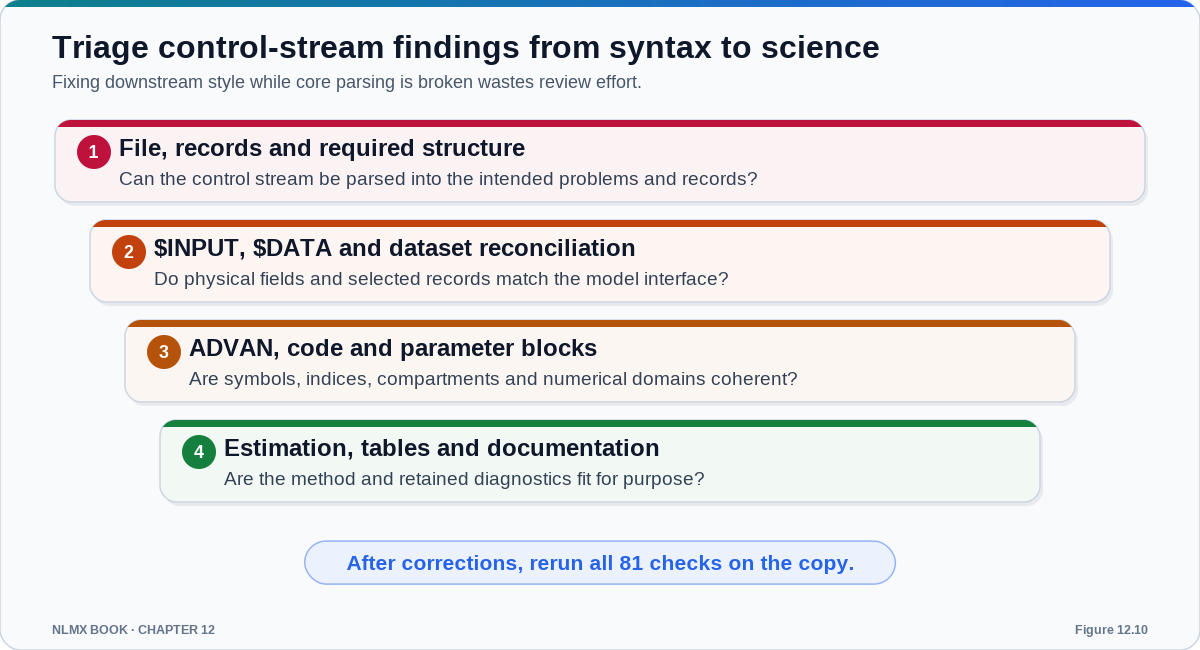
A useful pipeline pattern
Run a pinned executable with a version-controlled .qcn, write to a fresh output directory, archive the evidence regardless of exit status, and only then allow later stages. Use --overwrite only when the pipeline deliberately replaces a disposable directory; immutable run-specific directories are safer for audit.
Do not make qc-nm the sole release gate. Add compilation, target NONMEM execution, numerical acceptance tests, dataset checks, and independent scientific review. A static source checker is one layer in a defense-in-depth workflow.
Common mistakes
- Using
neverin production and assuming failures will stop the pipeline. - Using
warningbefore a team has agreed which warnings are actionable. - Discarding output when the process status is nonzero.
- Allowing a corrected READY state to bypass numerical validation.
Checklist
- Document the chosen failure level and rationale.
- Pin nlmx, configuration, and NONMEM target version.
- Preserve artifacts on success and failure.
- Test the pipeline with deliberate WARN and FAIL fixtures.
- Combine static QC with execution and numerical tests.
Further reading
See complete command index, output bundle, and validation boundary.