23.5 Likelihood approximation and conditional modes
The frozen engine reconstructs the population likelihood from the control stream and data. --approximation auto follows $ESTIMATION where possible; explicit choices are fo, foce, foce-i, and laplace. The approximation must match the scientific and validation context because scores, information, stationarity, and comparisons with refits all depend on the likelihood being differentiated.
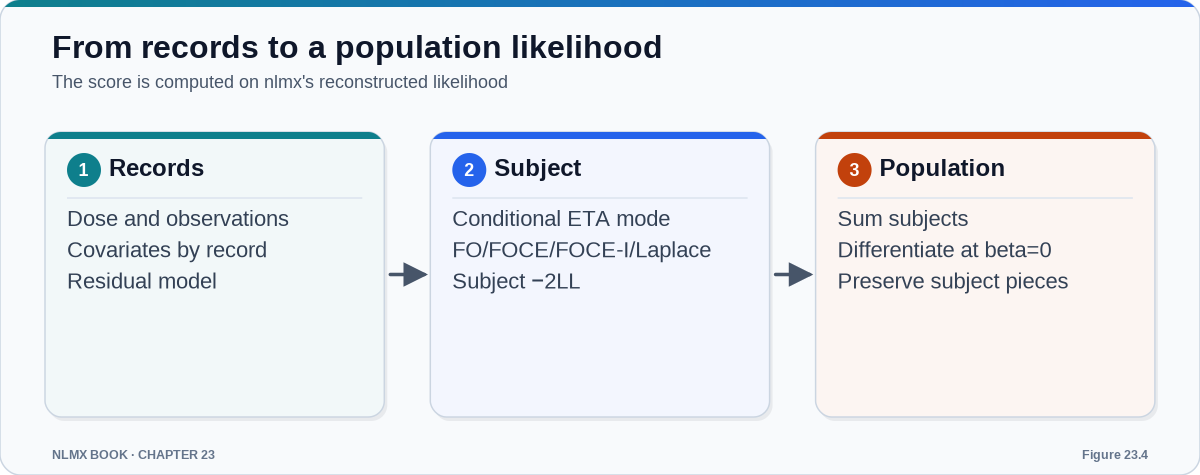
For conditional approximations, each subject has an ETA mode. The engine computes base modes once and reuses them as warm starts, then reevaluates conditional modes as candidate or nuisance perturbations require. A nonconverged subject mode is not harmless: it can distort a subject score and therefore OPG information, calibration, and selection. Reports count subjects without a converged mode and total likelihood evaluations.
FO is computationally simple but may be inadequate for nonlinear models with appreciable random effects. FOCE conditions around individual modes. FOCE-I includes ETA–residual interaction. Laplace adds curvature treatment suitable for general likelihoods when supported. “Matching the name” of a reference method is not enough; parameterization, residual likelihood, mode tolerance, and numerical conventions must also align.
When comparing frozen scores with refit ΔOFV, refits should use the same reconstructed likelihood. A comparison against an external package additionally needs an explicit approximation map and tolerance policy.
Common mistakes
- Leaving
autoundocumented. - Comparing FOCE-I scores with an FO or differently parameterized reference.
- Ignoring failed conditional modes because the overall command completed.
- Assuming warm starts make every conditional solution identical.
- Calling objective differences equivalent without checking likelihood conventions.
Checklist
- Record the resolved approximation.
- Review subject-mode convergence and tolerance.
- Keep the approximation fixed across score/refit comparison.
- Investigate model features that cannot be reconstructed exactly.
- Define cross-software equivalence criteria prospectively.
Further reading
See Chapter 18 for estimation theory, Chapter 20 for fit controls, and subject-level scores.