18.28 Standard errors, RSE, and confidence intervals
With covariance matrix \(C_{\hat\psi}\), standard error is \(SE_k=\sqrt{C_{kk}}\). nlmx reports \(RSE=100SE/|\hat\psi_k|\) on the estimated element’s natural scale. A symmetric 95% Wald interval is estimate ±1.96 SE.
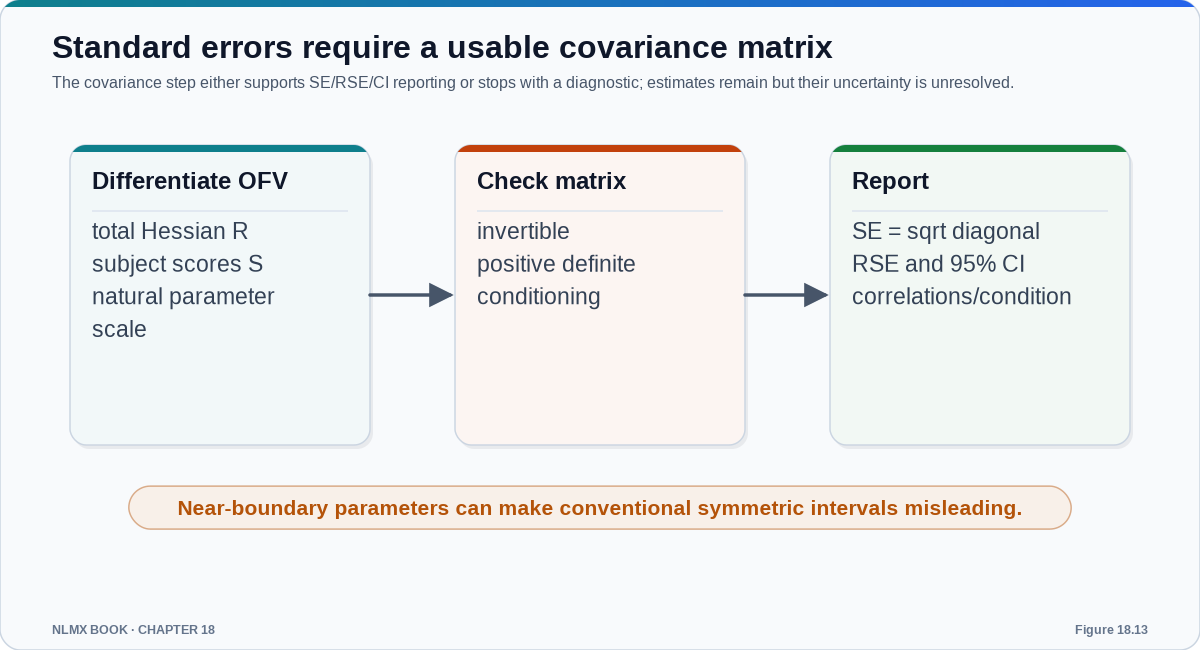
For OMEGA variance elements, RSE is for the variance, even if a derived CV is displayed. Transforming uncertainty to SD, CV, half-life or exposure requires the delta method, simulation from the covariance, or another justified method. Off-diagonal covariance elements can have unstable percentage RSE near zero.
Symmetric intervals can cross impossible ranges for positive parameters or correlations. Near boundaries or strong asymmetry, profile likelihood, bootstrap or transformed intervals may be preferable. A small SE does not protect against model bias.
Practical interpretation
Take a variance estimate and its SE, form the naive Wald interval, then transform the estimate to SD and CV. The endpoints are not obtained by simply square-rooting the variance interval when nonlinear transformation and covariance matter. Use a delta-method gradient or parameter draws, and label the method. This prevents uncertainty from becoming detached from the reported derived quantity.
Use RSE as a scale-free descriptive measure, not a universal quality cutoff. Near-zero estimates make it unstable, and a clinically important parameter can have moderate RSE yet support useful decisions. Link precision thresholds to the analysis purpose.
Common mistakes
Do not divide by an estimate without absolute value, report variance SE as CV SE, or interpret 95% confidence as a 95% probability about a fixed parameter under frequentist theory.
Checklist
- Name the covariance estimator and parameter scale.
- Verify diagonal entries are nonnegative.
- Transform derived uncertainty correctly.
- Flag boundary/asymmetric cases.
- Report adequate significant digits.
Further reading
See condition numbers, boundaries, and Appendix A.