Dry-run and automation gates
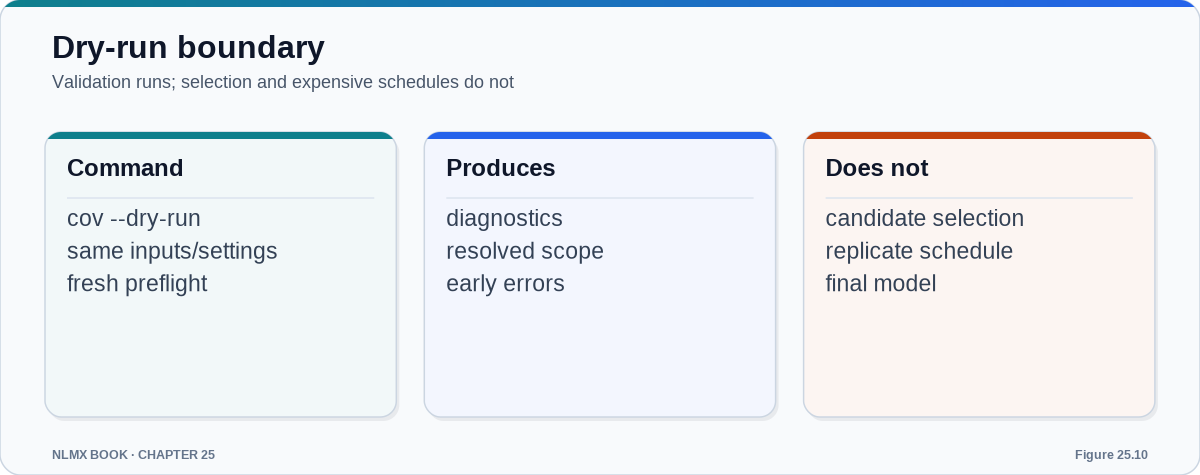
nlmx cov ... --dry-run executes the validation pipeline under the exact intended run invocation without starting candidate selection, posterior replicate schedules, or final refits. It is useful in CI, batch submission, resource reservation, and reviewer handoff because command-line overrides are exercised exactly as they will be in the full run.
Treat dry-run success as an entry gate, not a result. It cannot reveal convergence failures in later candidate refits, stochastic learner failures, path dependence, or final joint-model diagnostics. Pair it with resource estimates and a tested output location. A dry run should use the same executable and input bytes as execution.
Automation should fail on nonzero exit codes, archive the transcript, and avoid --overwrite except in an explicitly disposable directory. Promote warnings to errors only after the validation plan defines which warnings are acceptable. Never parse colorful console layout when machine-readable manifests or JSON outputs exist.
Common mistakes
- Changing the scientific question after seeing the result while presenting it as the original run.
- Reading one engine's summary without checking its prerequisites, failures, normalized settings, and fitted endpoint.
- Treating a generated draft, comparison label, or completed checkpoint as a substitute for model diagnostics and reference-software confirmation.
Page checklist
- The exact command, version, inputs, resolved settings, and output directory are identifiable.
- Engine-specific evidence is interpreted on its own scale before cross-method comparison.
- Recovery state, final refit, diagnostics, and remaining confirmation work are explicit.