40.10 Dataset, dosing, censoring, and population differences
What you will learn
- Align row interpretation and event expansion
- Reconcile missing/BLQ and predose policies
- Prove the analyzed population is identical
Prerequisites: Chapter 39 troubleshooting, Chapter 36 command reference, and Chapter 38 output reference.
This page is scoped to nlmx 4.16.2 and an external-documentation snapshot of 2026-11-10. Product names describe different system boundaries; a blank or “outside role” is not a quality ranking. Treat every migration as a new implementation until model semantics, analysis population, objective definition, numerical behavior, outputs, and decisions have been independently reconciled.
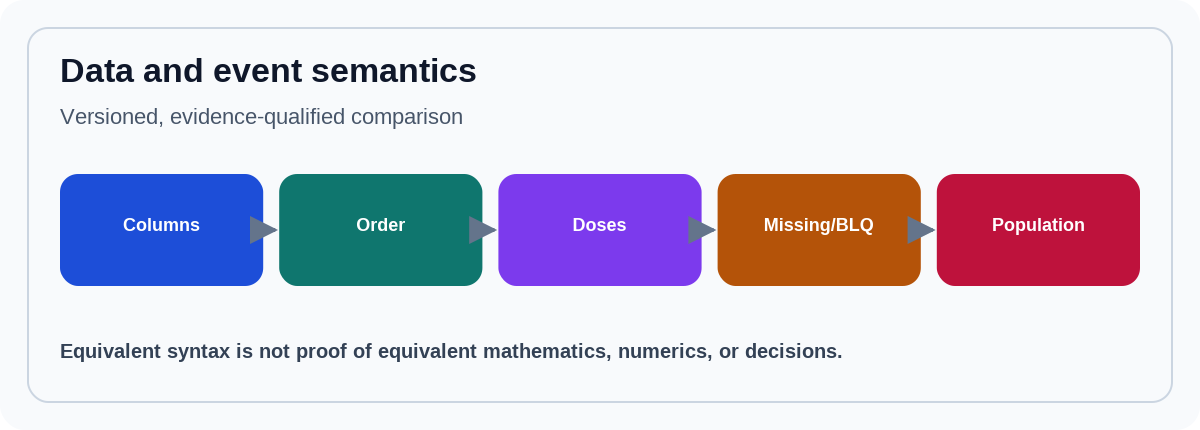
Cross-software comparisons often fail before estimation. Freeze the raw dataset hash, then reconcile column mapping/aliases, numeric/text comparisons in IGNORE/ACCEPT, missing tokens, subject-block definition, ordering, same-time events, MDV/EVID, CMT, DVID, dose expansion, and units.
nlmx normally excludes observations before any drug when the model predicts zero and records them; --keep-predose restores NONMEM-like inclusion for comparison. BLQ behavior depends on M1/M3/F_FLAG and command. Monolix and PopED translations may require different column/model encodings. PsN can rewrite/resample data for workflows, so compare each generated dataset, not just the source.
Create a reconciliation table: rows/subjects/doses/observations, excluded by each rule, censored/quantified, endpoint/event counts, covariate missingness, and final likelihood contributions. Select sentinel subjects with complex events and compare expanded event timelines/predictions.
Never attribute an OFV or speed difference to the engine until analyzed populations and contributions match. A workflow that silently replaces missing covariates with a median is not equivalent to dropping the subject or modeling missingness.
Population-reconciliation template
Record raw, after parser rules, after IGNORE/ACCEPT, after endpoint/MDV, after predose policy, after BLQ policy, and final likelihood counts for rows, subjects, observations, doses, and censored records. List reason-specific exclusions. The final count can match while different rows are retained, so also hash a stable row key or compare an exclusion table. Never use a total count alone as proof of population equivalence.
Review checklist
- Are the exact product versions, task boundaries, inputs, methods, and settings named?
- Were semantics and frozen-parameter results aligned before optimized outputs?
- Is the comparison using a method-appropriate deterministic or stochastic tolerance?
- Are unsupported or analogous features described without implying equivalence?
- Can every claim be reproduced from retained primary evidence?
Navigation
See the previous page, next page, and complete comparison reference.