34.3 Greeting, command catalog, manual, and file context
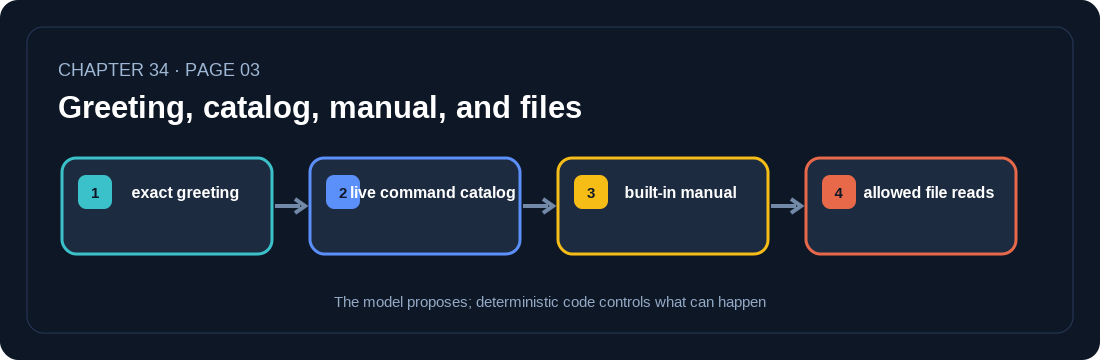
Every session begins with a greeting written by nlmx, not generated by the model. It names the assistant, version, session folder, and discovered datasets/control streams with exact counts. The model then receives a live command catalog derived from the same command-line definitions used for parsing.
How the mechanism works
Relevant manual sections are compiled into nlmx and retrieved within manual_chars. help returns generated options for one command; docs searches the built-in manual or exposes a real template; read can inspect only policy-approved files. Context is selected and bounded, not an unrestricted copy of the computer.
Evidence from nlmx 4.16.1
The mock greeting accurately reported that no NONMEM-shaped dataset was discovered in the start folder even though the later command explicitly named data/er/er_data.csv. Discovery is orientation, not permission or proof of suitability.
What the mechanism protects—and what it does not
The mechanism controls a defined part of the workflow. It does not make the model’s prose correct, select the right scientific question, validate external data, or transfer accountability away from the user. Treat policy safety, computational success, statistical adequacy, and scientific validity as separate conclusions.
Review practice
Manual grounding reduces unsupported answers but does not guarantee correct section choice or complete caveats. Verify citations against the versioned docs. File summaries and truncated manual excerpts must not be treated as the entire evidentiary record.
For a novice, read the human transcript first, then the JSONL event log, exact settings/commands, and native command outputs. “The session completed” describes the outer process only; individual proposals may have been planned, declined, refused, failed, corrected, or executed.
Evidence to retain
- nlmx version/build, backend identity,
.asksettings, policy, limits, and system prompt; - request, raw replies, help/manual/file context events, confirmations, refusals, and corrections;
- every settings version and exact executed command, with child exit status and full output;
- reviewer interpretation, unresolved warnings, scientific limitations, and final disposition.
Navigation
See the previous page, next page, and guardrail, policy, and audit index.