20.20 Output bundle map
The output directory contains NONMEM-compatible run files, standardized CSVs, summaries, report/plots and provenance. It is designed to feed downstream nlmx commands directly.
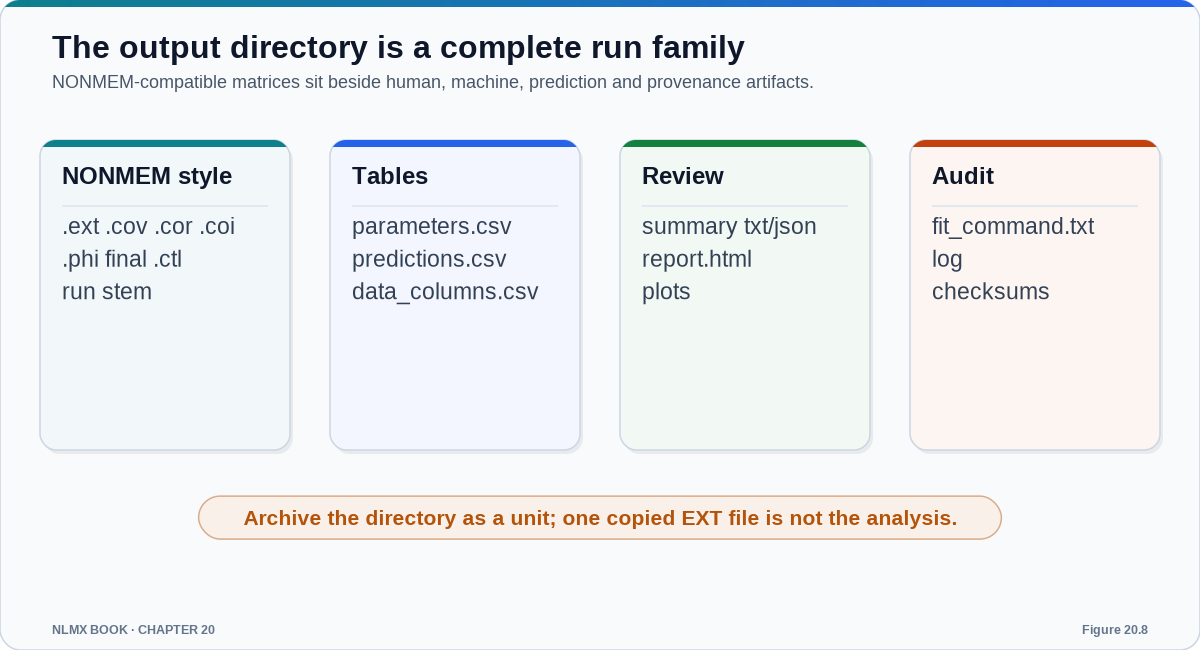
NONMEM-style: <stem>.ext, .cov, .cor, .coi, .phi, and fitted-value control stream. Tables: parameters.csv, predictions.csv, data_columns.csv, and optional no_drug_records.csv. Review: fit_summary.txt, fit_summary.json, report.html, plot assets. Audit: fit_command.txt, log and checksums.sha256.
Optionality matters: covariance files/SEs require successful covariance; predictions can be suppressed; no-drug file appears only when needed; plots directory requires publication plot option, while report has built-in figures. SAEM adds structured SAEM information.
Archive whole directory read-only, then copy/version for downstream modifications. Verify checksums before use. Schema consumers should validate columns/version and tolerate documented additions, not positional assumptions.
Classify artifacts by purpose
Use raw numerical artifacts (.ext, .cov, .cor, .coi, .phi, CSV and JSON) for programmatic comparison. Use fit_summary.txt, HTML and plots for human review. Use the final control, command, log, version and checksums for provenance. No single file replaces the other classes.
After every run, check expected-file presence against requested features. Covariance files should not be expected after --no-cov-step; plot directories may be absent when plots are disabled. Conversely, a missing requested artifact is a workflow finding even if parameters exist. Validate schemas and row counts before downstream automation.
Archive the bundle atomically with its input identity. Moving only the report breaks links to the numbers and settings behind it. Treat filenames and schemas as versioned interfaces: downstream scripts should fail clearly on missing columns or incompatible versions rather than silently guessing.
Common mistakes
Do not treat missing optional file as zero values, copy only EXT, edit generated CTL in place, or use rounded summary text for calculations.
Checklist
- Inventory expected/optional files.
- Verify checksum and stem consistency.
- Use CSV/JSON for automation.
- Preserve original bundle.
- Record downstream derived artifacts separately.
Further reading
The next pages document EXT/matrices, PHI/parameters, predictions, and summaries/audit.