12.14 OMEGA, SIGMA and variance structure: PAR05-PAR08
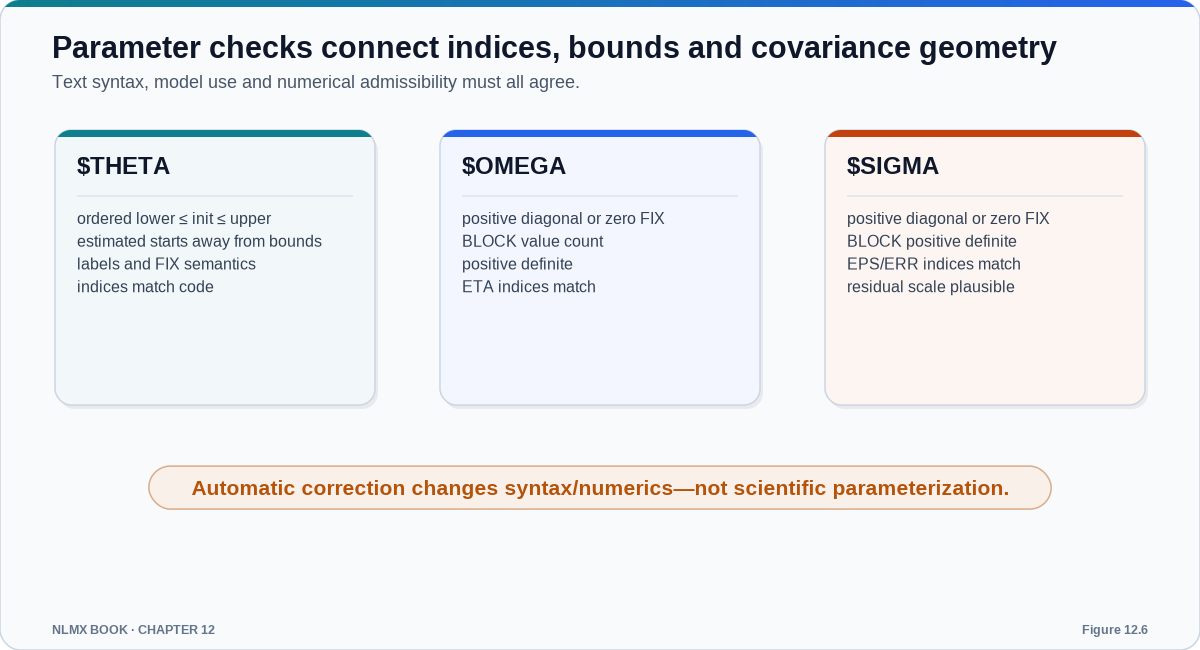
PAR05 requires diagonal OMEGA and SIGMA values to be positive unless a zero is explicitly fixed. PAR06 examines whether covariance blocks are positive definite. PAR07 checks the number of values in BLOCK(n) and compatibility of SAME. PAR08 comments on implausibly small or large OMEGA-derived coefficients of variation.
Diagonal values and zero variance
A free variance initialized to zero places estimation at a problematic boundary. In the Chapter 12 example, $SIGMA 0 becomes $SIGMA 0 FIX. That correction makes the intent explicit, but you must decide whether residual variability truly belongs fixed at zero. Often the better scientific response is a positive initial value and an estimable residual-error model.
For log-normal variability, a rough coefficient of variation can be derived from the OMEGA variance. PAR08 uses a broad plausibility screen, not a population-specific acceptance criterion. Large variability may be real, a consequence of weak data, or a sign that the model scale is inappropriate.
Blocks and positive definiteness
A symmetric BLOCK(n) needs n(n+1)/2 lower-triangular entries. Correct count does not guarantee a valid covariance matrix: the matrix must also be positive definite. SAME must refer to a compatible preceding block. The block_pd correction may adjust a failing matrix, but any numerical repair changes the starting covariance structure and deserves explicit review.
Common mistakes
- Confusing variance with standard deviation or coefficient of variation.
- Fixing zero automatically without deciding whether variance should be estimated.
- Reading positive definiteness as evidence that correlations are plausible.
- Reordering ETAs without updating OMEGA blocks and labels.
Checklist
- Map every ETA to its diagonal variance and covariance labels.
- Confirm variance-scale units and initial values.
- Count every block entry and verify
SAMEcompatibility. - Examine eigenvalues or a Cholesky factor when block validity is uncertain.
- Reassess parameter uncertainty and shrinkage after fitting.
Further reading
See parameter corrections, indices, and validation limits.