15.30 Worked example: BLQ-heavy and sparse profiles
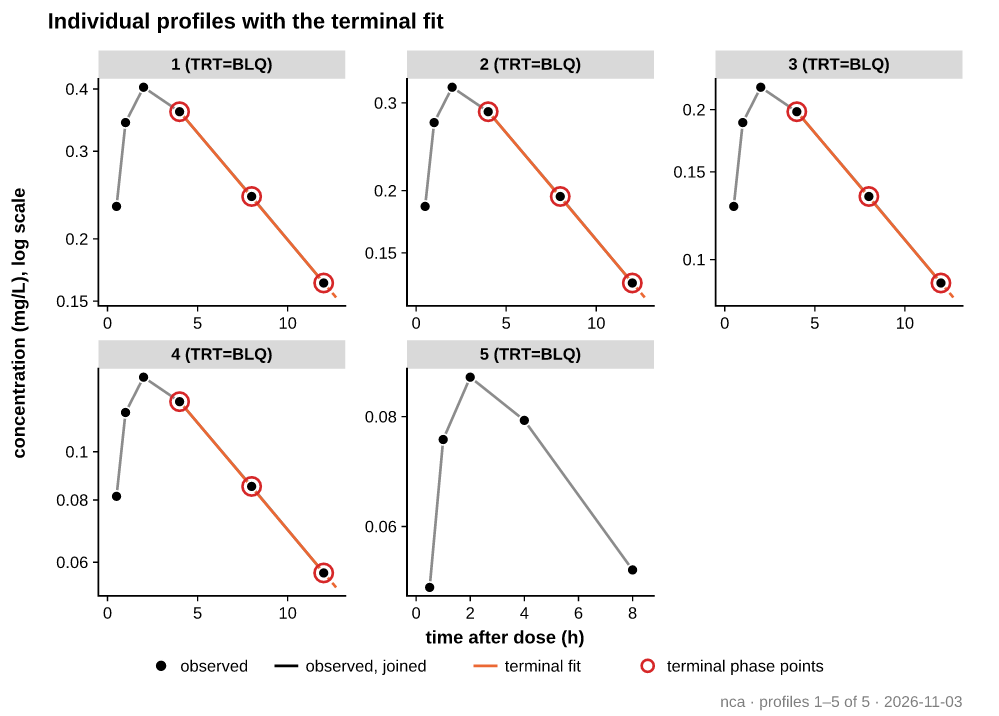
This evidence set gives six subjects a low 25 mg oral dose. Late concentrations fall below LLOQ 0.05 and are flagged in BLQ; the sixth subject has only two observations and is intentionally too sparse for the default three-observation minimum.
Files:
Expected disposition
Six profile rows are constructed, five are analysed, and one is skipped for insufficient usable observations. Several analysed rows have LZ_SPAN_SHORT and AUC_EXTRAP_GT_20, showing that process success and AUClast availability do not guarantee reliable infinite-time parameters.
The default tmax-zero-missing rule leaves terminal BLQ records out. Inspect STATUS and CONC_USED rather than reading the LLOQ-reported DV as a measured 0.05 concentration. Terminal omission changes Tlast and candidate points.
Sensitivity exercises
Rerun with --blq-rule half-lloq. Compare nca_profiles.csv, AUClast, lambda-z candidates, AUCinf, flags, and number of estimable half-lives. Then rerun with --max-extrap 10; the default action remains flag unless [lambda_z] extrap_action="omit" is set in a separate settings file.
Do not lower --min-observations to two to manufacture an analysable profile: two points cannot support the default best-fit regression minimum and provide weak area coverage. The skipped row is the scientifically honest outcome.
Why this case matters
Clean exponential fixtures exercise formulas; this case exercises data disposition, flags, skips, and missingness. A validation matrix needs both. Downstream summaries should report parameter-specific N and the skipped-profile count.
Common mistakes
- Treating the recorded LLOQ as the true terminal concentration.
- Counting a skipped row as a zero-parameter subject.
- Relaxing thresholds until every profile yields AUCinf.
- Comparing sensitivity output without documenting the changed rule.
Checklist
- Confirm six constructed and five analysed profiles.
- Audit every BLQ transformation.
- Tabulate flags and skip reasons.
- Compare primary and sensitivity rules separately.
- Report endpoint-specific N.
Further reading
Review BLQ controls, flags and skips, and sparse-sampling limits.