18.12 FOCE
First-order conditional estimation (FOCE) linearizes each subject at its conditional mode rather than ETA zero. It therefore adapts the tangent to individual information. In the no-interaction form implemented here, residual variance is evaluated at ETA zero and held fixed during the mode search and linearized likelihood.
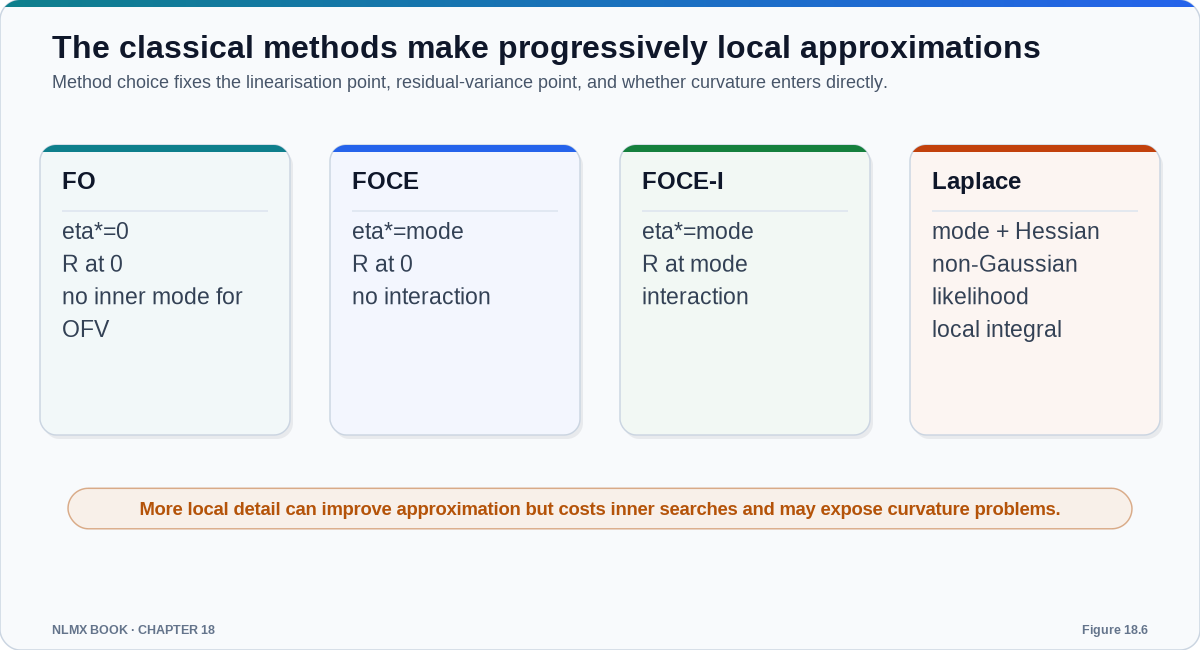
For additive error, residual variance does not depend on prediction, so FOCE and FOCE-I often coincide closely. With proportional/combined error, holding variance at zero can matter because changing ETA changes IPRED and thus variance. This is why method labels must include interaction status.
FOCE corresponds to METHOD=1 without INTERACTION. It requires an inner mode search for every subject at each outer proposal, making it more expensive than FO. Warm starts and parallel subject processing reduce cost.
FOCE remains a linearized marginal likelihood. It does not numerically integrate the exact nonlinear likelihood. Strong curvature, large variability or difficult conditional modes can still cause bias or instability.
Practical interpretation
To diagnose FOCE, save the zero-ETA residual variances and the final conditional modes for several representative subjects. Recalculate how far the mode’s prediction lies from the zero-ETA prediction. Large movement combined with strongly prediction-dependent error warns that fixed (R(0)) may be consequential. The appropriate comparison is a matched FOCE-I run, not an unrelated model with different residual structure.
Common mistakes
Do not call every METHOD=1 fit FOCE-I; INTERACTION changes residual variance handling. Do not assume the conditional mode calculated under fixed variance equals the FOCE-I mode.
Checklist
- Verify
METHOD=1and interaction setting. - Confirm inner modes converge.
- Determine whether residual variance depends on ETA.
- Compare with FOCE-I when proportional error is material.
- Keep approximation fixed for structural comparisons.
Further reading
Next: FOCE-I and the nonlinear worked example.