23.19 Candidate construction, design columns, and scaling
A candidate begins as a parameter–covariate relationship with type, reference, permitted equation forms, status, and data support. nlmx converts the equation derivative at coefficient zero into one or more design columns. Continuous power, exponential, and linear forms usually produce one coefficient; categorical proportional forms can produce a column for each non-reference level; splines can produce several basis columns.
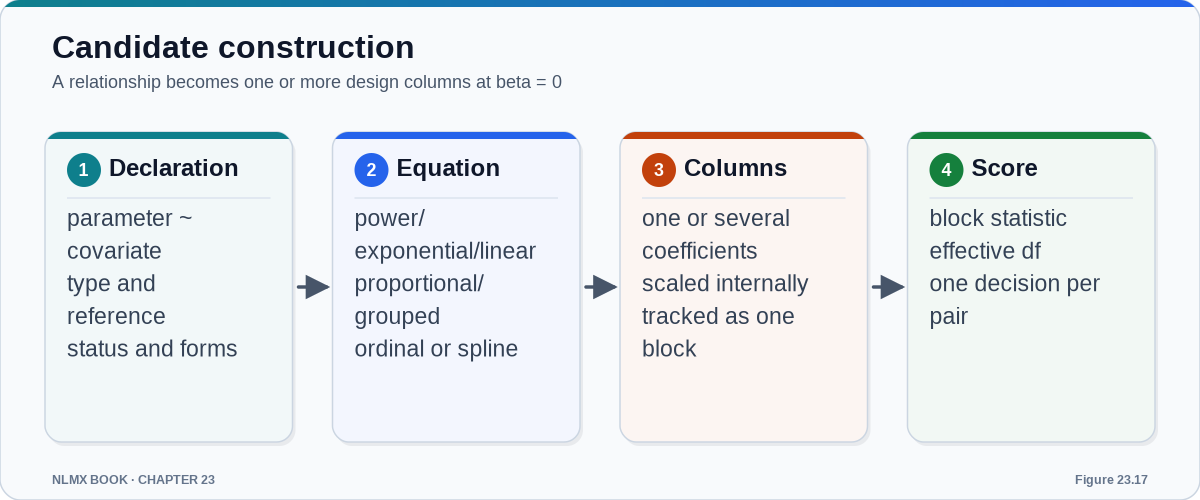
Columns are internally scaled for numerical work, while reported coefficients are returned to the raw design scale. Scaling must not change the statistic or scientific equation, but it influences conditioning and finite differences. The candidate key records parameter, covariate, and form so evidence remains distinguishable.
Parameters with exponential ETAs receive conventional multiplicative effects through the ETA/log scale. Parameters without an ETA can be screened by applying the factor after their last assignment. Time-varying covariates enter by record. Verify generated equations because a scientifically correct covariate definition can still be wrong for a particular parameter location or ETA form.
Candidate generation is capped by --max-candidates and, for posterior methods, separate feature limits. The cap is a safety rail, not an analysis-plan substitute.
Common mistakes
- Counting relationships and design columns as the same quantity.
- Forgetting the categorical reference level.
- Assuming internal scaling changes the scientific coefficient.
- Testing a parameter assignment that is overwritten later.
- Expanding forms until the candidate cap is reached without a hypothesis plan.
Checklist
- Review every generated candidate key and equation.
- Confirm reference, units, and parameter insertion point.
- Count columns and effective degrees of freedom.
- Inspect scaling and conditioning diagnostics.
- Keep the candidate family scientifically prespecified.
Further reading
Revisit Chapter 22's equation pages, then continue to block tests and form comparison.