22.35 Diagnostics, confirmation, and validation
Selection evidence is not model qualification. Fit the proposed final model and repeat Chapter 21 diagnostics: convergence, covariance, boundaries, condition number, PRED/IPRED, residuals versus time/prediction, ETA distributions, shrinkage, strata, and influential subjects.
Check whether the covariate effect reduces systematic bias in the intended subgroup without creating new patterns elsewhere. Review OMEGA reduction and shrinkage, but do not require variance to disappear. Inspect coefficient correlation and sensitivity to alternative forms, references, starts, missingness, and competitor covariates.
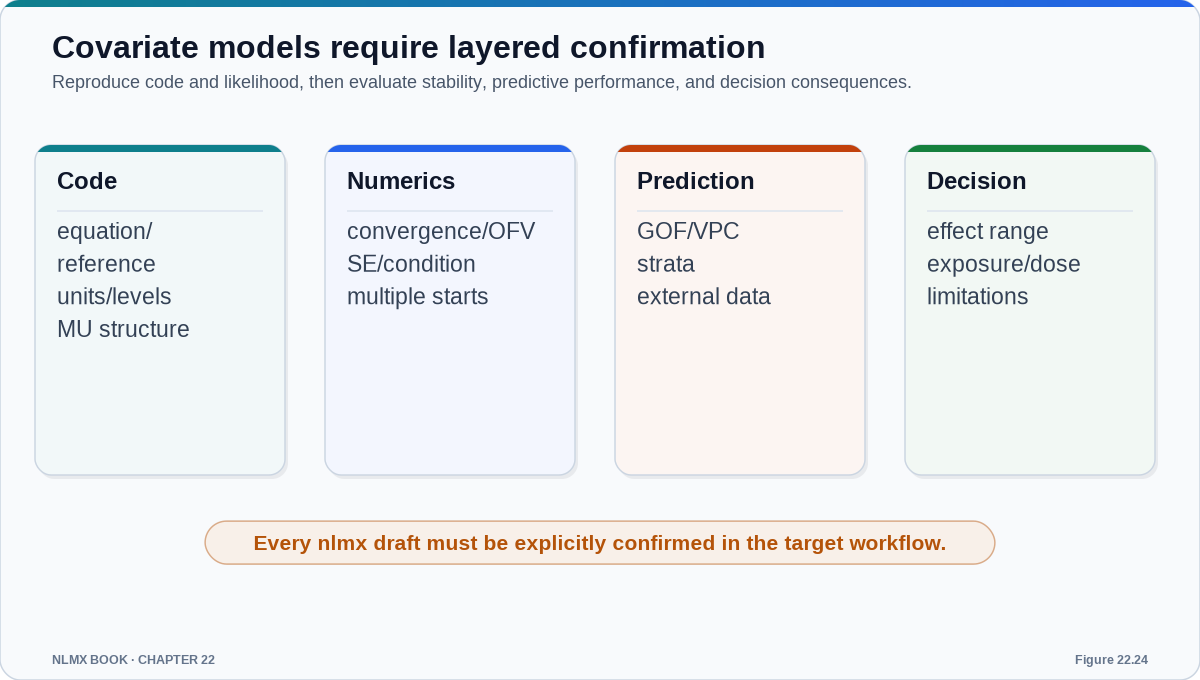
Simulation-based VPC or pcVPC tests predictive distribution across time and strata. External validation or temporal/study holdout assesses transportability. For dose decisions, simulate exposure/response across realistic joint covariate distributions and dosing rules.
Cross-software confirmation should match data rows, control logic, method, likelihood, initials, covariance, and convergence tolerance. Compare predictions at fixed parameters before comparing optimizer results. Define absolute/relative tolerances prospectively.
Validate failure behavior and outputs too: sparse levels, missing codes, ill-conditioned COV, failed refits, resume, schema changes, and checksums. Pin nlmx version and qualification set.
Minimum confirmation package
Refit the generated model from documented inputs and require successful minimization, plausible estimates, acceptable covariance behavior, and no unexplained numerical repair. Compare base and final diagnostics on identical populations: DV–PRED/IPRED, weighted residuals over time and prediction, individual profiles, ETA distributions and shrinkage, and stratification by retained and rejected covariates. Confirm that a retained effect reduces the intended ETA–covariate pattern without creating bias elsewhere. Test influential subjects, alternate initial values, and plausible form/missingness choices. For external software reproduction, define parameter mapping, objective conventions, tolerances, and comparison datasets in advance; agreement is demonstrated numerically, not inferred from similar-looking reports.
Common mistakes
- Ending review when a relationship is retained.
- Checking only the subgroup that improved.
- Interpreting OMEGA reduction as proof of causality.
- Comparing NONMEM without matching likelihood/settings.
- Omitting failed refits and sensitivity models.
Checklist
- Refit and repeat complete diagnostics.
- Assess coefficient/structure/missingness sensitivity.
- Perform VPC and external/holdout checks as appropriate.
- Confirm cross-software with prespecified tolerances.
- Archive failures, versions, and validation conclusions.
Further reading
Use Chapter 21’s diagnostic checklist, Chapter 20’s NONMEM reproduction workflow, and Chapter 42 validation when drafted.