What “refit-based” means
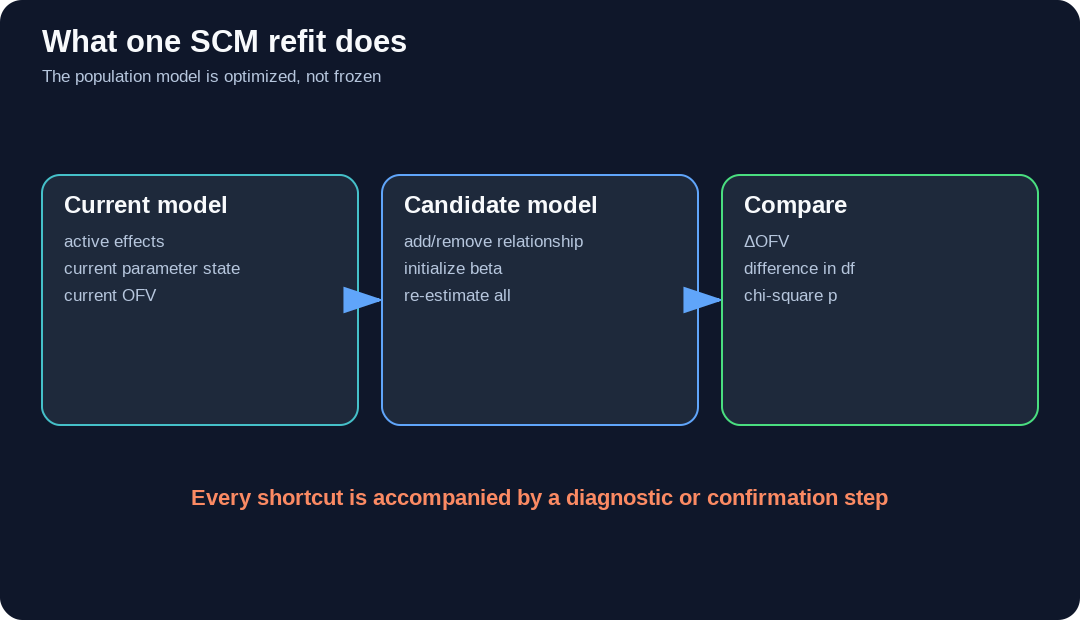
A frozen test holds the fitted base model fixed while evaluating a local candidate coefficient. A refit-based comparison creates another model and optimizes its free parameters. For forward inclusion, the larger model is current + candidate; for backward elimination, the reduced model is current − relationship. The objective-function difference comes from those optimized endpoints.
This distinction matters when parameters compensate for one another. Adding WT on CL can change typical CL, its interindividual variance, the residual model, individual ETAs, and the apparent evidence for EGFR. The candidate coefficient is not the only moving quantity. Refit evidence is consequently slower but can expose curvature, parameter correlation, and nonlinearity that a local score only approximates.
“Refitted” does not automatically mean “valid.” Both endpoints must represent comparable converged likelihoods. Different data exclusions, approximation modes, error models, parameter constraints, or failed optimization endpoints destroy the simple nested-model interpretation. Always inspect convergence and numerical diagnostics before interpreting the reported likelihood-ratio p-value.
Common mistakes
- Treating a stepwise p-value as clinical importance or causal proof.
- Reading a candidate comparison without its active model, convergence state, degrees of freedom, and exact threshold.
- Reporting only the terminal relationship list while discarding failed models, path decisions, configuration, and provenance.
Page checklist
- The scientific question, model identities, and comparison direction are explicit.
- Numerical validity is reviewed before interpreting statistical evidence.
- The result is linked to the complete trace and final joint-model diagnostics.