40.7 ODE solvers, analytic propagation, and event semantics
What you will learn
- Align dose/event timing before comparing solvers
- Understand nlmx analytic and ODE paths
- Validate profiles around discontinuities and steady state
Prerequisites: Chapter 39 troubleshooting, Chapter 36 command reference, and Chapter 38 output reference.
This page is scoped to nlmx 4.16.2 and an external-documentation snapshot of 2026-11-10. Product names describe different system boundaries; a blank or “outside role” is not a quality ranking. Treat every migration as a new implementation until model semantics, analysis population, objective definition, numerical behavior, outputs, and decisions have been independently reconciled.
nlmx uses analytic propagation for supported classic ADVANs, a matrix exponential for detected constant-coefficient linear $DES systems, Dormand–Prince for non-stiff nonlinear systems, Rosenbrock for stiff ADVANs, and an automatic stiffness switch for ADVAN13. NONMEM/PREDPP and Monolix have their own solver libraries/options. Equivalent differential equations can differ numerically because tolerances, interpolation, event restarts, stiffness detection, and steady-state algorithms differ.
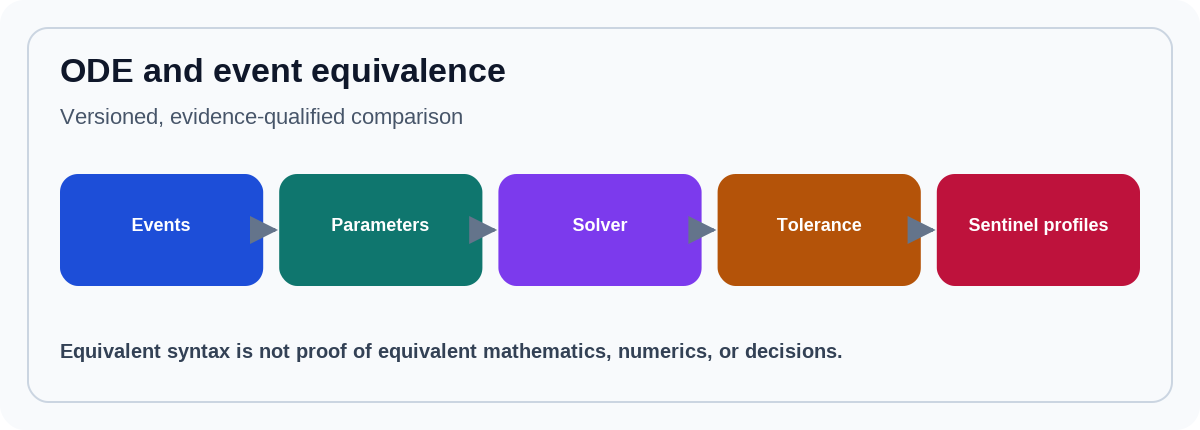
Solver comparison is meaningless until event semantics align: record order at equal TIME, bolus/infusion, RATE -1/-2, bioavailability, lag, ADDL/II, SS, resets, dose/observation CMT, output compartment, MTIME/MPAST, and time-varying covariates. Confirm units and parameter transformations.
Use sentinel profiles: single bolus, infusion start/end, same-time dose/observation in both orders, repeated/steady-state doses, reset, lag, and extreme covariates. Compare amounts and predictions immediately before/after events and on a dense grid. Tighten tolerances to establish a numerical plateau. For a system nlmx detects as linear, compare against an independent matrix-exponential reference.
Do not “fix” a mismatch by loosening acceptance tolerances before locating whether it is event semantics, equation translation, or integration error.
Sentinel-event table
For each sentinel subject list record number, TIME, EVID, AMT, RATE, CMT, ADDL, II, SS, lag/bioavailability, event applied before/after the observation, and prediction immediately on both sides. Add a dense reference profile and mass-balance or analytic checks where possible. A discrepancy located exactly at infusion end or same-time dose/observation usually points to event order; a gradually growing discrepancy usually points to equations, tolerances, or solver behavior.
Review checklist
- Are the exact product versions, task boundaries, inputs, methods, and settings named?
- Were semantics and frozen-parameter results aligned before optimized outputs?
- Is the comparison using a method-appropriate deterministic or stochastic tolerance?
- Are unsupported or analogous features described without implying equivalence?
- Can every claim be reproduced from retained primary evidence?
Navigation
See the previous page, next page, and complete comparison reference.